


Another scandal rocks Tunisia's isolated president

Tunisian prosecutors have decided to open an investigation into audio recordings in which a former senior adviser to the Tunisian president Kais Saied allegedly criticises his leadership and comments on the president's health problems.

While Nadia Akacha denies being the person heard in these recordings, the former iron lady and Saied loyalist is said to have referred to the president's nonchalant diplomatic relations with his American counterpart and to have denigrated certain colleagues.

These seven leaked audio recordings of alleged conversations have monopolised the attention of the Tunisian media for more than a week and polluted the image of an already politically isolated president.

Kais Saied comfortably won the 2019 election against a media tycoon who was facing corruption charges. The new president then seized full power on 25 July 2021 by suspending the house, removing the then prime minister, and governing by decree in a way that reduced the influence of parliamentarians and reshaped the political system.

These moves prompted accusations of a coup d'état from members of the conservative Islamist party once dominant in Tunisia's parliament - Ennahda. They criticise the failure to respect the 2014 constitution.

Saied solicited the opinion of the people to help him rewrite the 2014 constitution through an online questionnaire earlier this year. The new constitution would then be submitted to a national referendum in July before parliamentary elections are held in December 2022.

Yet, the constitutional questionnaire did not interest the Tunisian population, as the questionnaire was filled by less than 10% out of an electorate of 6 million people.

The population seems to consider political tensions as irrelevant to their concrete needs, while Tunisia is facing a major economic crisis.

On Thursday, 5 May, Tunisia's dinar currency has fallen to new record lows versus the dollar. Rising inflation - now at 7.5% - a worsening trade deficit ($1.4 billion) due to the impact of the Ukraine crisis paints a bleak picture for the future of the North African country.

Just as the purchasing power of ordinary Tunisians continues to erode, so does the growing isolation of the Tunisian president.

Sources: CommonSpace.eu with RFI (Paris), Reuters (London) and other media outlets
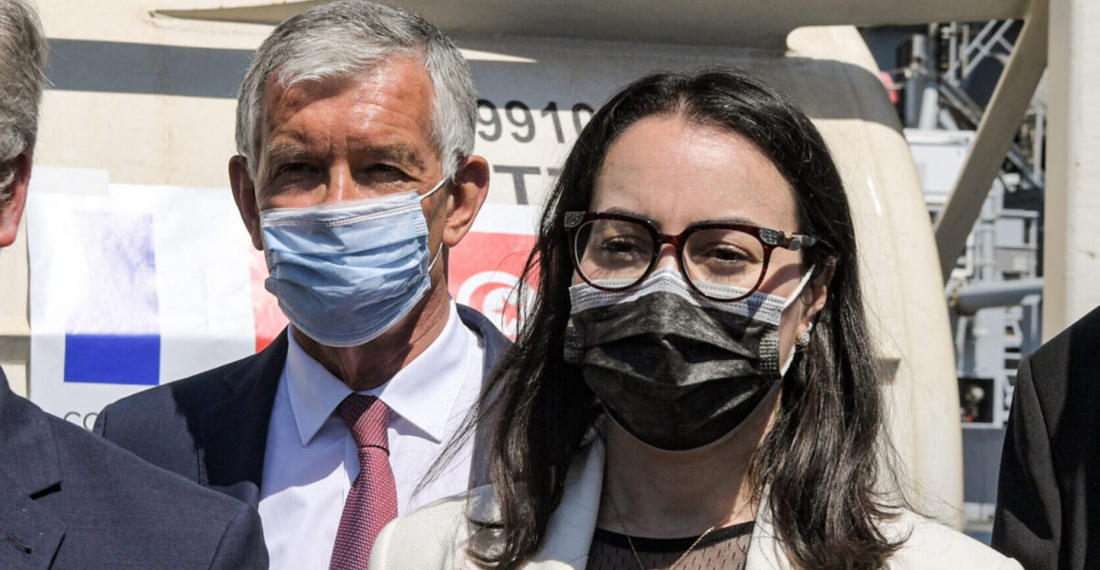
Picture: Tunisia's Presidential chief of staff Nadia Akacha and other officials look on at the port of Rades on the eastern outskirts of the capital Tunis on July 22, 2021 ; Twitter: @MiddleEastMnt


Related articles

Editor's choice
News
Borrell tells the European Parliament that the situation in Afghanistan was critical, but the EU will remain engaged

Borrell tells the European Parliament that the situation in Afghanistan was critical, but the EU will remain engaged

Borrell underlined that the European Union will make every effort to support the peace process and to remain a committed partner to the Afghan people. "Of course, we will have to take into account the evolving situation, but disengagement is not an option.  We are clear on that: there is no alternative to a negotiated political settlement, through inclusive peace talks.
Editor's choice
News
Germany accuses Russia of cyberattacks and disinformation campaign

Germany accuses Russia of cyberattacks and disinformation campaign

The German government holds Russia responsible for a cyberattack on German air traffic control, and for targeted disinformation campaigns before the last federal election. According to the German Foreign Office in Berlin, the incidents could be clearly attributed to the Russian military intelligence service, the GRU. In response, the Russian ambassador to Berlin was summoned to the Foreign Ministry. "We have been observing a massive increase in threatening hybrid activities by Russia for some time now," a spokesperson for the Foreign Ministry stated. These range from disinformation campaigns and espionage to cyberattacks and sabotage attempts. The aim is to divide society, sow distrust, and undermine confidence in democratic institutions. The spokesperson added that with these actions, Russia is "very concretely threatening our security, not only through its war of aggression against Ukraine, but also here in Germany."  The Foreign Ministry spokesperson explained that the cyberattack on air traffic control in August 2024 was clearly attributed to the hacker collective "APT28," known as "Fancy Bear," and to the responsibility of the Russian military intelligence service, the GRU. Furthermore, it could now be "conclusively stated" that Russia had attempted "to influence and destabilize both the last Federal election and the ongoing internal affairs of the Federal Republic of Germany." There was "absolutely irrefutable evidence" for this". The so-called "Storm 1516" campaign, which has been running since 2024, is allegedly backed by "reliable information" that the Moscow-based think tank "Center for Geopolitical Expertise" is behind it. The Center is also said to be supported by Russian military intelligence. Its primary aim is to influence democratic elections in the West. (Click the image to read more).

Popular

Editor's choice
News
Germany accuses Russia of cyberattacks and disinformation campaign

Germany accuses Russia of cyberattacks and disinformation campaign

The German government holds Russia responsible for a cyberattack on German air traffic control, and for targeted disinformation campaigns before the last federal election. According to the German Foreign Office in Berlin, the incidents could be clearly attributed to the Russian military intelligence service, the GRU. In response, the Russian ambassador to Berlin was summoned to the Foreign Ministry. "We have been observing a massive increase in threatening hybrid activities by Russia for some time now," a spokesperson for the Foreign Ministry stated. These range from disinformation campaigns and espionage to cyberattacks and sabotage attempts. The aim is to divide society, sow distrust, and undermine confidence in democratic institutions. The spokesperson added that with these actions, Russia is "very concretely threatening our security, not only through its war of aggression against Ukraine, but also here in Germany."  The Foreign Ministry spokesperson explained that the cyberattack on air traffic control in August 2024 was clearly attributed to the hacker collective "APT28," known as "Fancy Bear," and to the responsibility of the Russian military intelligence service, the GRU. Furthermore, it could now be "conclusively stated" that Russia had attempted "to influence and destabilize both the last Federal election and the ongoing internal affairs of the Federal Republic of Germany." There was "absolutely irrefutable evidence" for this". The so-called "Storm 1516" campaign, which has been running since 2024, is allegedly backed by "reliable information" that the Moscow-based think tank "Center for Geopolitical Expertise" is behind it. The Center is also said to be supported by Russian military intelligence. Its primary aim is to influence democratic elections in the West. (Click the image to read more).

