NATO PA seminar in Baku offers politicians a chance for a "home match". In a rare opportunity to engage on home territory Armenian and Azerbaijani politicians stick to script when talking about Karabakh conflict.

Although in the past decade there have been hundreds of meetings between Armenian and Azerbaijani politicians and civil society representatives in different parts of the world, it is rare that the two sides are able to engage in a debate on home territory. The seminar being held by the NATO Parliamentary Assembly in the Azerbaijani capital Baku is offering a rare opportunity for members of parliament from the two countries to exchange views on a number of issues, including the Nagorno-Karabkah conflict on home territory. An Armenian Parliamentary delegation is in Baku to participate in the event and this was welcomed by the organisers of the seminar, as well as many of the participants.

The problem is that the politicians are sticking strictly to the script. In a number of exchanges during the course of the first day of the seminar both Armenian and Azerbaijani MPs repeated often heard maximalist positions on the conflict, its origins and its resolution. This caused frustration amongst some of the NGO representatives present who made several appeals to the politicians to engage in a more constructive manner.

Two issues were particularly contentious: how to reconcile the principles of territorial integrity and self-determination in the context of the Nagorno-Karabakh conflict, and the participation of the self declared Nagorno-Karabakh Republic in the current negotiation process.

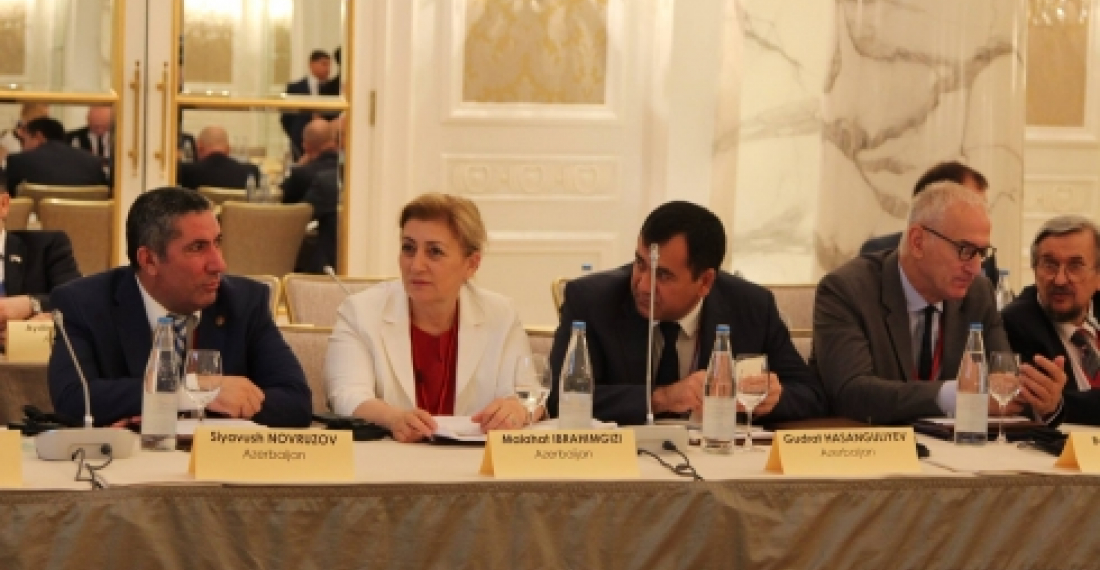
Speaking for the Armenian side, MPs Tevan Poghosyan and Koryun Nahapetyan insisted that the principles of territorial integrity and self determination were equal, and that it was not possible to speak about the territorial integrity of Azerbaijan without referring also to the right of the people of Nagorno-Karabakh for self determination. This was challenged by the Azerbaijani delegation. Deputy Speaker of the Milli Meclis Ziyafat Asgerov, and MPs Siyavoush Novruzov, Gudrat Hasanguliev, Zahid Oruij and others argued that Azerbaijan was the victim of aggression. Its territory had been occupied and hundreds of thousands of its people were displaced. They further added that the principle of self determination was not applicable in the Karabakh situation because an Armenian state already existed.

Regarding the issue of the participation of NKR in the negotiations a number of international speakers, including Dennis Sammut and Matthew Bryza said that the question of the format of the negotiations was difficult to change since it required the agreement of both sides and that if anything is changed than everything would be open up for discussion including the composition of the Minsk Group.

Both the Armenian and the Azerbaijani politicians used tough language in their presentations but the atmosphere remained remarkably calm and friendly.

Earlier in the keynote speeach at the opening of the conference, Dennis Sammut, Director of LINKS Analysis and researcher at Oxford University said that the Nagorno-Karabakh conflict constituted a real danger for peace in the South caucasus and beyond and the international community needed to find a way of keeping the spotlight on the negotiations that are ongoing to try to resolve the conflict. He said that four messages need to be constantly repeated:  respect for the territorial integrity of states; respect for the rights of minorities and self determination as appropriate; rejection of a military solution to the conflict; and the need to engage with the population that remains in Nagorno-Karabakh in a status neutral manner and in a way that will allow access to this population. The full text of Dennis Sammut speech is available here.

Commonspace.eu political editor said that "this meeting is important because Armenian and Azerbaijani politicians have to learn to engage with each other in front of their own populations, not in far away exotic cities in Europe as has been the case so far. Not surprisingly they are finding this difficult at first but this is a process, and the NATO PA seminar provided an excellent opportunity for this process to start. It is regrettable that some media outlets in Armenia and Azerbaijan made completely distorted reports of the meeting. This is very disappointing. But despite these difficulties a new space for dialogue has been created, and we now look forward to many more Armenian politicians travelling to Baku, and Azerbaijani politicians travelling to Yerevan in the future, thus breaking artificial taboos that constitute a serious hindrance to the peace process."

s0ource: commonspace.eu

photo: The Azerbaijani Delegation at the NATO PA seminar being held in Baku, 16-18 June 2014.
Related articles

Editor's choice
News
Borrell tells the European Parliament that the situation in Afghanistan was critical, but the EU will remain engaged

Borrell tells the European Parliament that the situation in Afghanistan was critical, but the EU will remain engaged

Borrell underlined that the European Union will make every effort to support the peace process and to remain a committed partner to the Afghan people. "Of course, we will have to take into account the evolving situation, but disengagement is not an option.  We are clear on that: there is no alternative to a negotiated political settlement, through inclusive peace talks.
Editor's choice
News
Mystery surrounds the crash of a Turkish airline in Georgia which resulted in the death of 20 Turkish Airforce personnel

Mystery surrounds the crash of a Turkish airline in Georgia which resulted in the death of 20 Turkish Airforce personnel

​ Twenty Turkish Airforce personnel died when a military plane crushed on the Georgian side of the Azerbaijan - Georgia border on Tuesday (11 November). The C130 took off from Ganja and was heading to Merzifon, transporting service members that had participated in Azerbaijan's Victory Day celebrations. Half an hour after takeoff, the aircraft lost altitude and broke apart in mid-air over a mountainous area on the Georgian border. Lockheed C130 Hercules have been in service with Turkey since the 1960s and are considered among the most reliable in their class. However, some of these aircraft are 50–60 years old. In October, the Turkish Ministry of Defense announced plans to replace them with new C130J Super Hercules models, with deliveries expected to begin in the coming years. All aircraft fragments have already been collected for technical examination. The cause of the crash has not yet been officially determined. A Turkish expert and retired military officer Coşkun Başbuğ noted on CNN Türk, a technical malfunction "should be ruled out" as the cause of the crash. "Various possibilities should be considered, but the first thing to consider is that the C-130 is a time-tested military transport aircraft, the last known incident involving which occurred in 1982." "A technical malfunction should be ruled out as the cause of the crash. The same applies to weather conditions, as the relevant authorities would have reported bad weather. The remaining theories include a mid-air collision, sabotage, or an attack," he emphasized. Former Turkish Armed Forces Logistics Commander and retired Army General Erdoğan Karakuş stated in an interview with Turkish television that although the C-130 aircraft are old, they have undergone a complete modernization in Turkey, and their technical condition is thoroughly inspected before each flight. The Turkish Air Force is expected to operate the C-130 aircraft until 2040. ​

Popular

Editor's choice
News
Mystery surrounds the crash of a Turkish airline in Georgia which resulted in the death of 20 Turkish Airforce personnel

Mystery surrounds the crash of a Turkish airline in Georgia which resulted in the death of 20 Turkish Airforce personnel

​ Twenty Turkish Airforce personnel died when a military plane crushed on the Georgian side of the Azerbaijan - Georgia border on Tuesday (11 November). The C130 took off from Ganja and was heading to Merzifon, transporting service members that had participated in Azerbaijan's Victory Day celebrations. Half an hour after takeoff, the aircraft lost altitude and broke apart in mid-air over a mountainous area on the Georgian border. Lockheed C130 Hercules have been in service with Turkey since the 1960s and are considered among the most reliable in their class. However, some of these aircraft are 50–60 years old. In October, the Turkish Ministry of Defense announced plans to replace them with new C130J Super Hercules models, with deliveries expected to begin in the coming years. All aircraft fragments have already been collected for technical examination. The cause of the crash has not yet been officially determined. A Turkish expert and retired military officer Coşkun Başbuğ noted on CNN Türk, a technical malfunction "should be ruled out" as the cause of the crash. "Various possibilities should be considered, but the first thing to consider is that the C-130 is a time-tested military transport aircraft, the last known incident involving which occurred in 1982." "A technical malfunction should be ruled out as the cause of the crash. The same applies to weather conditions, as the relevant authorities would have reported bad weather. The remaining theories include a mid-air collision, sabotage, or an attack," he emphasized. Former Turkish Armed Forces Logistics Commander and retired Army General Erdoğan Karakuş stated in an interview with Turkish television that although the C-130 aircraft are old, they have undergone a complete modernization in Turkey, and their technical condition is thoroughly inspected before each flight. The Turkish Air Force is expected to operate the C-130 aircraft until 2040. ​