


Nalbandian on Ukraine: "peaceful settlement in the legal field contributing to the decrease of tension and resolution of pending questions."

The Foreign Minister of Armenia Edward Nalbandian has given an interesting reply couched in diplomatic words full of nuances when answering a question about events in Ukraine during a joint press conference with the Foreign Minister of Serbia, Ivan Mrkic,  in Yerevan yesterday. The Minister stated that Armenia is "hopeful that all possible steps are undertaken to find a peaceful settlement in the legal field which will contribute to the decrease of tension and resolution of pending questions".

The Armenian Foreign Ministry website carried a transcript of the press conference, including the following questions and answers on Ukraine

Public Radio- Mr. Minister, what is the Armenian position on the developments taking place in Ukraine. There are publications in our media that there is no even a message written in the name of Armenia in the Condolence Book opened in the Embassy of Ukraine. Will you clarify why?

Edward Nalbandian- I think these are useless and meaningless manipulations because the Foreign Ministry has expressed its condolences to Ukraine and the people of Ukraine by the press secretary. It occurred one-two days before the opening of the Book of Condolence. On the opening of the Book, the Foreign Ministry received a note from the Embassy of Ukraine in Yerevan registered on February 24, i.e. the following day of the opening.

On the same day the representative of the Ministry had a telephone conversation with the Ambassador of Ukraine and the Ambassador expressed understanding that the note was delivered with delay.

As for our position and approach on the processes in Ukraine it has been expressed on the highest level, the President has spoken about it.

We are hopeful that all possible steps are undertaken to find a peaceful settlement in the legal field which will contribute to the decrease of tension and resolution of pending questions.

Radio Liberty - Mr. Minister, Armenia as well as Russia is a member of the CSTO. I have two questions on Ukraine crisis. Has the crisis been discussed in the framework of the CSTO and if it is discussed what will be the Armenian position? Thank You.

Edward Nalbandian- I usually do not like using the word "if" much in any case. Of course, it is reasonable that there are many questions discussed in the framework of the CSTO, because there is consent to coordinate the foreign policy in this format. When there are such discussions then we will see what developments would take place, and the appropriate positions will be expressed.

source: commonspace.eu with www.mfa.am

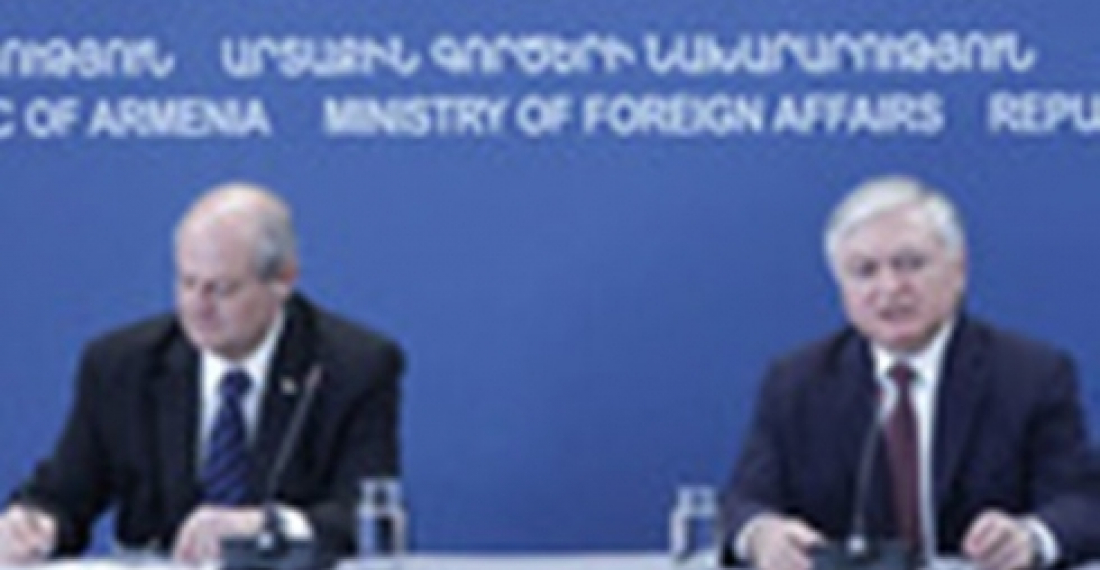
photo: The Foreign Ministers of Serbia and Armenia at a joint Press Conference in Yerevan on 10 March 2014 (picture courtesy of the Armenian Foreign Ministry press service).



 

Related articles

Editor's choice
News
UAE says it will withdraw from Yemen, but division emerges in Yemeni presidential council

UAE says it will withdraw from Yemen, but division emerges in Yemeni presidential council

In a move seen as an attempt to de-escalate a crises with Saudi Arabia, the United Arab Emirates, on Tuesday (30th December) announced that it was heeding a call to withdraw its troops from Southern Yemen. UAE says that its presence included counter-terrorism teams that were crucial in fighting against Islamist groups. UAE sources said that parts of Yemen not controlled by the Houthis have had Al Qaeda in the Arab Peninsula (AQAP) operatives using the territory to launch attacks on Europe, the US and Middle East. UAE teams have co-ordinated with American and British special forces and intelligence. The sources added that Emirati forces and their Yemeni allies also helped reverse Houthi gains in the south. including the liberation of Aden port. The small UAE contingent has remained in place since the UAE withdrew most of its military personnel in 2019. The leading English-language newspaper in Abu Dhabi, The National, said that the main UAE force was based at Riyan Mukalla International Airport, with access to fixed-wing aircraft and helicopters, but also operated smaller contingents in the port town Balhaf and Shabwa. "It is understood it also flew a number of drones from the airbase that were able to track terrorist movements, pass information back to its allies and assisted special forces' missions." Meanwhile a division has emerged in Yemen's presidential council after four members denounced what they called the 'unilateral decisions' by the chairman. Four of Yemen’s eight Presidential Leadership Council members on Tuesday denounced an announcement by the council’s chairman accusing him of breaching the governing agreement. Tension between Yemeni leaders has been rising for weeks, underscoring the fragility of the country's already fractured political landscape and further complicating efforts to confront the Iran-backed Houthi rebels. The latest rift took an unprecedented turn on Tuesday morning, marked by a Saudi-led coalition “limited operation” striking combat vehicles Riyadh linked to the Southern Transitional Council, which has three members in the PLC. The PLC Chairman, Rashad al Alimi, on Tuesday said that he was seeking to cancel the joint defence agreement with the UAE. “What has been issued … constitutes a clear violation of the Declaration of the Transfer of Power [agreement], which explicitly stipulates that the Presidential Leadership Council is a collective body whose decisions are taken by consensus, or by majority when consensus is not possible,” the statement by the four members said. “It does not, under any circumstances, allow for unilateral decision-making on sovereign, military, or major political matters." The statement was signed by STC chief Aidarous Al Zubaidi, Faraj Al Bahsani, Tariq Saleh and Abu Zaraa al Muharrami. (click the picture to read the full article).

Popular

Editor's choice
News
UAE says it will withdraw from Yemen, but division emerges in Yemeni presidential council

UAE says it will withdraw from Yemen, but division emerges in Yemeni presidential council

In a move seen as an attempt to de-escalate a crises with Saudi Arabia, the United Arab Emirates, on Tuesday (30th December) announced that it was heeding a call to withdraw its troops from Southern Yemen. UAE says that its presence included counter-terrorism teams that were crucial in fighting against Islamist groups. UAE sources said that parts of Yemen not controlled by the Houthis have had Al Qaeda in the Arab Peninsula (AQAP) operatives using the territory to launch attacks on Europe, the US and Middle East. UAE teams have co-ordinated with American and British special forces and intelligence. The sources added that Emirati forces and their Yemeni allies also helped reverse Houthi gains in the south. including the liberation of Aden port. The small UAE contingent has remained in place since the UAE withdrew most of its military personnel in 2019. The leading English-language newspaper in Abu Dhabi, The National, said that the main UAE force was based at Riyan Mukalla International Airport, with access to fixed-wing aircraft and helicopters, but also operated smaller contingents in the port town Balhaf and Shabwa. "It is understood it also flew a number of drones from the airbase that were able to track terrorist movements, pass information back to its allies and assisted special forces' missions." Meanwhile a division has emerged in Yemen's presidential council after four members denounced what they called the 'unilateral decisions' by the chairman. Four of Yemen’s eight Presidential Leadership Council members on Tuesday denounced an announcement by the council’s chairman accusing him of breaching the governing agreement. Tension between Yemeni leaders has been rising for weeks, underscoring the fragility of the country's already fractured political landscape and further complicating efforts to confront the Iran-backed Houthi rebels. The latest rift took an unprecedented turn on Tuesday morning, marked by a Saudi-led coalition “limited operation” striking combat vehicles Riyadh linked to the Southern Transitional Council, which has three members in the PLC. The PLC Chairman, Rashad al Alimi, on Tuesday said that he was seeking to cancel the joint defence agreement with the UAE. “What has been issued … constitutes a clear violation of the Declaration of the Transfer of Power [agreement], which explicitly stipulates that the Presidential Leadership Council is a collective body whose decisions are taken by consensus, or by majority when consensus is not possible,” the statement by the four members said. “It does not, under any circumstances, allow for unilateral decision-making on sovereign, military, or major political matters." The statement was signed by STC chief Aidarous Al Zubaidi, Faraj Al Bahsani, Tariq Saleh and Abu Zaraa al Muharrami. (click the picture to read the full article).
