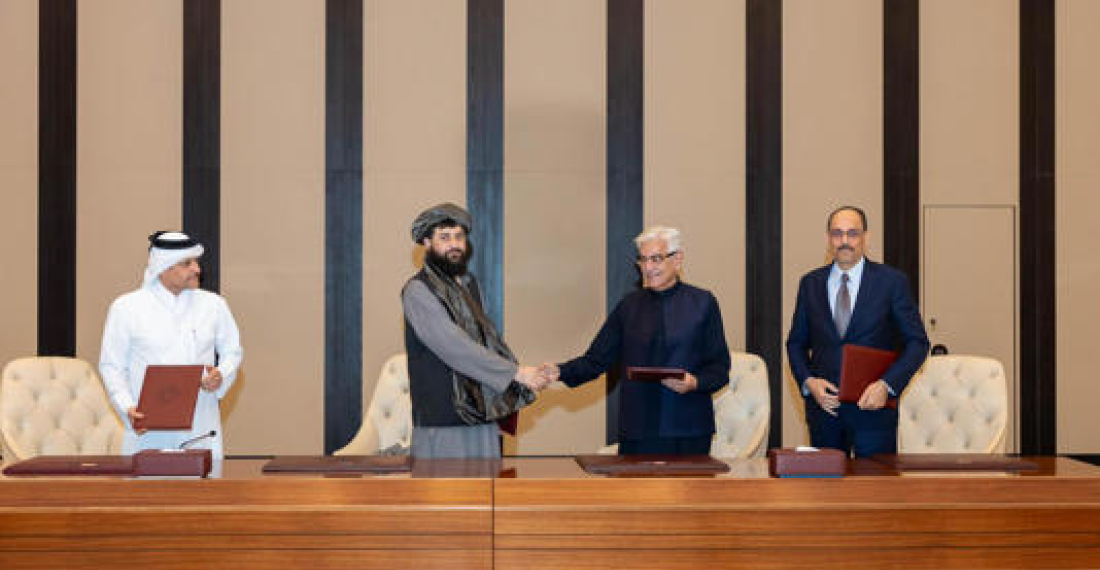
Qatar’s Ministry of Foreign Affairs said early on Sunday (19 October), that Afghanistan and Pakistan had agreed to an immediate ceasefire after talks mediated by Qatar and Turkiye following days of fierce fighting along their disputed border. They also agreed to “the establishment of mechanisms to consolidate lasting peace and stability between the two countries”. Doha said the two countries also agreed to hold follow-up meetings in the coming days “to ensure the sustainability of the ceasefire and verify its implementation in a reliable and sustainable manner”.
The talks in Doha followed clashes that killed dozens and wounded hundreds in the worst violence between the two South Asian neighbours since the Taliban seized power in Kabul in 2021.
Cross-border fighting, and Pakistani air strikes along their contested 2,600km frontier were triggered after Pakistan demanded that Kabul rein in rebels who had stepped up cross-border attacks, saying the fighters were operating from safe havens in Afghanistan.
In its foreign policy, the current Taliban government in Kabul is different from the one overthrown in 2004
The current Taliban government in Kabul is different, from the one overthrown by the American invasion in 2004, in the wake of 9/11, in that it is much more savvy when it comes to international relations. Despite the fact that a number of counties still withhold full recognition, the new government has abandoned the naiveness and isolation of the past. Nowhere is this felt more strikingly than in its relations with its South Asian neighbours.
Up to 2004 the Taliban government operated under the shadow of Pakistan. It was never an equal relationship. Pakistan saw Afghanistan as part of its sphere of influence, an awkward but strategic neighbour, After 2021 the new Taliban government felt less obliged to Pakistan, and looked for a more diversified foreign policy.
This month, an Afghan delegation led by the Taliban administration’s Foreign Minister Amir Khan Muttaqi visited India. After he met Foreign Minister Subrahmanyam Jaishankar on Friday, New Delhi said it will reopen its embassy in Kabul.
“Closer cooperation between us contributes to your national development as well as regional stability and resilience,” Jaishankar told his Afghan counterpart. He also affirmed India’s “full commitment to the sovereignty, territorial integrity and independence of Afghanistan”.
Muttaqi called India a “close friend”. In a joint statement, New Delhi and the Taliban committed to maintaining “close communication and continue regular engagement”. Although this was the first high level visit to India, the Taliban and the Indian government held ministerial level talks in UAE in January, and other contacts have been ongoing behind the scenes.
Many observers commented that the incidents this month between Pakistan and Afghanistan coincided with the visit of the Taliban delegation to New Delhi. Pakistan was more direct. Kabul is fighting India’s “proxy war,” Pakistan Defence Minister Khawaja Asif said after days of intense border fighting with the Afghan Taliban. All of the Taliban's decisions are being sponsored by New Delhi, Khawaja Asif said.
Pakistan-Afghanistan fighting is part of the wider problems in South Asia
The fighting between Afghanistan and Pakistan cannot be seen in isolation. It is part of the wider tensions in South Asia, at the centre of which is the conflict between India and Pakistan, which started with partition in 1947, and has resulted in a number of wars since. This is a deeply rooted religious, ethnic and territorial conflict which casts a shadow over the region. Both India and Pakistan are nuclear powers. Every time they fight each other the world holds its breadth. The last fighting in May 2025 lasted only a few days, but was the most intense for 25 years.
In other parts of South Asia, internal problems are rife, in Bangladesh, Nepal and Sri Lanka, and the issues are not disconnected from relations with New Delhi and Islamabad.
India is powerful but its power is not undisputed
India is a large, powerful country, and seen as a future great power. It is the world largest democracy, with a population of over one billion, the largest in the world. India has the fifth largest economy in the world, with a GDP of US$3.4 trillion. Yet India’s power in South Asia is not undisputed, even if the smaller countries prefer to co-exist, rather than do like Pakistan and confront. Questions have arisen about the Indian armed forces following the May fighting with Pakistan. In truth no one knows yet how strong India is militarily.
Russia and China
Two countries that have traditionally played a role in South Asia, and in the India-Pakistan rivalry, have been Russia and China, with the first traditionally supporting India, and the second Pakistan. Russia’s role has become increasingly transactional, reflecting the country’s reduced circumstances. But China continues to pour its largesse in Pakistan and the smaller South Asian countries. It was quick to re-establish its relations with the Taliban in Kabul after 2021. It has a territorial dispute with India in the Himalayas, which has occasionally erupted in violence. But China wants to avoid a direct confrontation with India if possible. The two conduct intense and complex diplomacy, which, most of the time works.
The limited role of the EU in South Asia
A recent publication on the website of the European External Action Service proudly states that “The European Union and India are intensifying their ties as part of a new strategic agenda to enhance prosperity, security, and tackle major global challenges together. This builds on the Strategic Partnership established in 2004 and is underpinned by shared interests and complementary strengths.” In truth, at the moment, South Asia is not a strategic priority for the EU. There are problems nearer to home that need to be tackled first. There are not enough resources, no institutional memory, and little appetite for more tangible engagement among the member states. The UK’s departure from the councils of the European Union after Brexit in 2019, took out the country that knows South Asia well. It is true that the UK also has a lot of baggage in the region, but it is convinced of the importance of engagement. South Asia is one area where EU-UK co-operation is necessary for both.
Trump’s bulldozing style will not work
In May 2025, US President, Donald Trump, claimed credit for the ceasefire between India and Pakistan. As CNN said at the time, he was pushing at an open door since neither side wanted the conflict to escalate. The American broadcaster added,” the US-brokered ceasefire agreement will not go anywhere near addressing the fundamental grievances fuelling the decades-long dispute over the status of Muslim-majority Kashmir, which is claimed by both India and Pakistan and has a separatist, independent movement.”
Engaging with South Asia requires patience, resilience and resources. Trump’s bulldozing style will not work. Nor the haste shown in abandoning Afghanistan to the Taliban, shown by his predecessor in 2021.
The Chinese are better at this, and the world needs to learn from their engagement.
GCC countries and Turkey
The countries that are showing that they have patience, resilience and resources that they are ready to spend on South Asia, are the leading countries of the GCC (Qatar, UAE and Saudi Arabia) and Turkey
It is not a coincidence that Qatar and Turkey brokered this week’s deal between Afghanistan and Pakistan.
Turkey, Qatar, UAE and Saudi Arabia have the clout necessary for effective engagement with South Asia.
South Asia must avoid catastrophe
But in the end the onus remains on the South Asian countries themselves to avoid the catastrophe of a destructive war between them.
This will require wisdom and flexibility by the leaders, and a political sophistication by the population at large. It is not clear if these attributes exist.
source: This Monday Commentary is prepared by Dr Dennis Sammut, Executive Director of LINKS Europe, and Managing Editor of commonspace.eu.
photo: Afghan Defence Minister Mullah Muhammad Yaqoob, centre left, shakes hands with Pakistani Defence Minister Khawaja Muhammad Asif after reaching a ceasefire deal negotiated by Qatar and Turkiye [Handout: Qatar Foreign Ministry