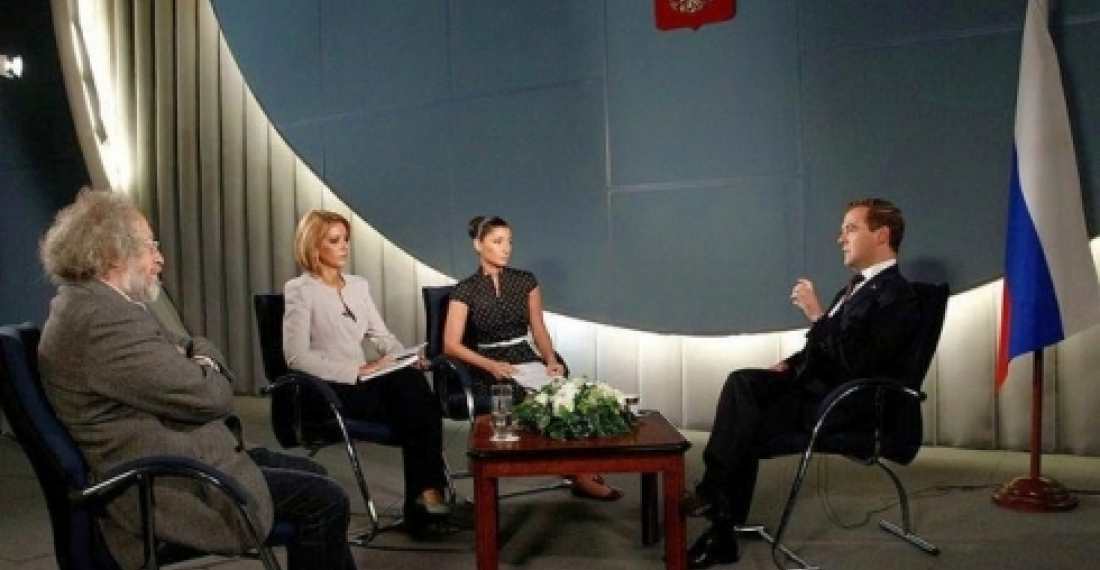
“Bummer!” – this is how the Azeri president would have qualified the Russian president’s straight-from-the-shoulder remark on Nagorno-Karabakh in his interview with Russia Today and First Informational Caucasus TV channels and Echo of Moscow radio company with regard to Saakashvili’s military speculation in August 2008.
However, in order to trace the chronicle of the subject, let us “get back to our muttons” first …
… Ilham Aliyev: “I’d like to add something. Actually, I expected as much from Sargsyan. Because I’ve had a lot of meetings with him”.
Recep Tayyip Erdogan: “I do not know him so well as you do…”
These phrases from the dialogue at a joint press conference in Baku unconditionally testify to the high point of the alliance of Baku and Ankara, which have strongly consolidated their efforts against Yerevan.
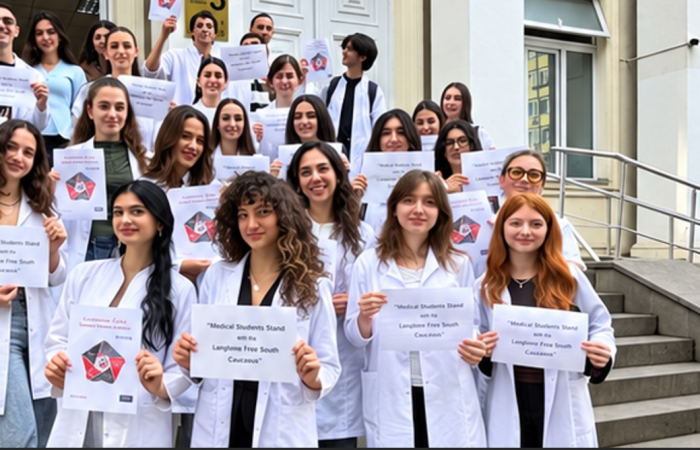
Baku, which looks for a reason even where there is no reason at all, has got into exaltation due to Serzh Sargsyan’s recent conversation with Armenian students, when the Armenian leader appealed to the historical memory of ancestors and was nostalgic about Western Armenia.
First and foremost, concerned over his own irremovability, Aliyev has seen a fateful error in Sargsyan’s “lyrical digression” about the well known state of affairs. Aliyev thought that the “reason” was meant to turn Baku’s ambitions concerning Karabakh and the lands around it into reality, which can be called nothing else but phantasmagoria. Aliyev was not mistaken when relying on the help of Turkey, the elder brother of Azerbaijan.
The Armenian public was expecting an official response of Yerevan. The response, however, came from Moscow.
Statement of Russian President Dmitry Medvedev
When touching on the “peace enforcement” operation against Georgia that Russia held in South Ossetia in 2008, the Russian leader pointed out Saakashvili’s “unwise” conduct, actually stressing the unacceptability of reoccurrence of such a scenario in Nagorno-Karabakh.
Medvedev said, “When this happened, both leaders (both President Aliyev and President Sargsyan) visited Sochi. Do you know what they told me? They said "Of course, it's bad that all it’s happened, it's a painful thing for the Caucasus". I said "It’s very bad". – “But you know it’s a certain lesson for us that it is better to hold endless talks on the destiny of Nagorno- Karabakh, on whether there will be a referendum there and how we should prepare a peace agreement than to have 5 days of war”. This was a very serious lesson for them. I think it is very illustrative. Why? Because if one recalls what happened then, it becomes clear that if our Georgian counterpart had some wits, we would also have met in Sochi, Kazan and in some other place. And we would also have thought how to look for compromises in the relations between the parts of the state, which used to be integral, but now it is Georgia and its split off parts. But this would be a political process. I do not know what prospects it would have. Probably, we would have never agreed, maybe some confederation would have appeared. But he tore his country”.
So…
If we suppose that Baku’s reaction is the response to Medvedev’s suggestion sent to both capitals earlier, Moscow was not slow to demonstrate its own forceful stance. In fact, in the context of the pooping anti-Armenia hysteria of Baku, this statement of Medvedev is a unambiguous warning to Aliyev to revert to recognition of the existing realities, particularly, to realize the internationally recognized people’s right to self-determination.
Furthermore, it is hardly beneficial to rely on the support of Ankara, urging it to unleash the conflict: Turkey, which is constantly trying on European values and is enchanted with the shine of these values, has enough domestic and real territorial problems not to get involved in Alyev’s doubtful speculation.
Medvedev has made it quite clear that Russia has an undisputable advantage over Ankara in such kind of issues, so the Azeri “hidalgo” will have to give up his cunning plan on consolidation of the Azerbaijani-Turkish forces against Armenia.
It is quite clear that the instinctive euphoria of Aliyev quickens the imagination and depicts the invincibility of Azerbaijani soldiers in Karabakh and Armenia. However, the “splendor” ascribed to the Azerbaijani army is ostensible, as there will never be any guarantees for absolute victory in the new war.
In case of a speculation like the one of Saakashvli, the region will turn into a complete chaos. It is not hard to imagine the results of it, and the results are not in Aliyev’s favor.
So, one should sensibly suppose that the temper of the “glorious sultan” Aliyev will be tamed after such warning by Medvedev, because there is no solution to the problem giving harmony in the Azerbaijani way, and the sooner Aliyev realizes that, the better we will sleep at last.
Nota bene: During the notorious cordial talks with the students, Sargsyan aptly compared Armenians with the mythic bird Phoenix. I’d like to draw our leader’s attention to the fact that very often we revive not on our historical land…
P.S. Having finished the article, I noticed the information that Medvedev invited Aliyev to Sochi. The forecast about Moscow’s response was not slow to arrive. And taking into account Medvedev’s regret over the fact that if he had been warned about the “paranoid scenario” in the “irritated brain” of Saakashvili he would have “dissuaded” him, it is not hard to suppose what the conversation with Ilham Aliyev will be about.
“The legend of harmful paranoid scenarios and danger of irritated brain”
“The legend of harmful paranoid scenarios and danger of irritated brain”