


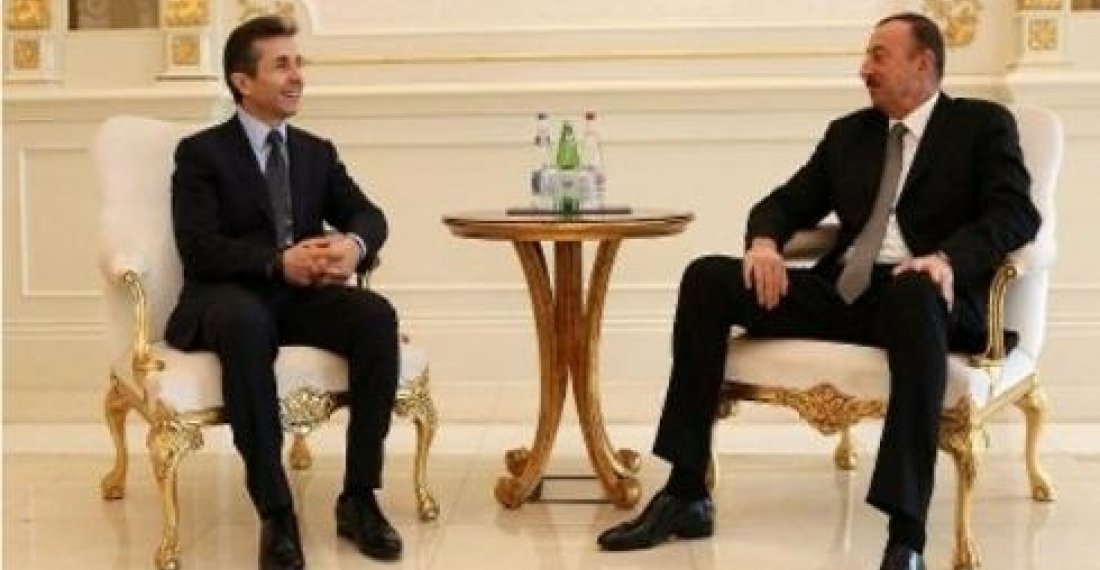
Ivanishvili on first official visit to Azerbaijan. Aliev and Ivanishvili have a unique opportunity to define the future of the Caucasus region.

Georgia's Prime Minister, Bidhzina Ivanishvili is in Azerbaijan on a short official visit during which he has met with Azerbaijani President Ilham Aliev and other senior Azerbaijani officials. Apart from a brief visit to Brussels in November Ivanishvili has not travelled overseas since his election in the begining of October. The visit to Baku is a reaffirmation of the important and strategic nature of the relationship between Azerbaijan and Georgia.

Commonspace.eu political editor made the following comment on the visit:

"Bidhzina Ivanishvili is the third Georgian leader that president Ilham Aliev has had to deal with since he became leader of Azerbaijan in 2003. First there was Edward Shevardnadze, who the Azerbaijani leader respected because of his friendship with his father, and also because he was instrumental in the first projects that gave Azerbaijan economic independence, such as the Baku-Tbilisi-Ceyhan pipeline. When Shevardnadze was overthrown, Aliev moved quickly to establish good relations with Mikheil Saakashvili. The two men have different temprement and do not share views on many issues but both understood the strategic nature of the Georgian-Azerbaijani relationship and put a lot of effort in making it work, which it did.

Ivanishvili is in many ways closer to Aliev in both temprement and political ideas. They both seek to prioritise improving the standard of living of their populations above other issues. They both take a pragmatic approach to relations with Russia. And they both have good business acumen. It is likely that Ivanishvili will in some ways be the most difficult of the three leaders that Aliev has had to deal with, simply because Ivanishvili will want to cut a better deal for Georgia. Ivanishvili as an astute businessman understands the value of Georgia for Azerbaijan and will; make the case in Baku forcefully. Now is the time for Azerbaijan to be generous in its relationship with Georgia for a successful Georgia is in the interest of Azerbaijan too. A strong Georgia-Azerbaijan relationship will also provide a good basis for future regional co-operation.

Like previous Georgian leaders Ivanishvili needs to balance his relationship with Azerbaijan with an equally solid relationship with Armenia. The dynamic of that relationship is different, but no less important. Ivanishvili will go to Armenia in January.

Ivanishvili's trip to Baku is of great regional importance. It is an important block in the construction of the future of the region where economics are becoming increasingly more important."

source: commonspace.eu

photo: Georgian prime Minister Bidhzina Ivanishvili with President Ilham Aliev of Azerbaijan in baku on 26 December 2012 (photo courtesy of the Bidhzina Ivanishvili facebook page)

Related articles

Editor's choice
News
Borrell tells the European Parliament that the situation in Afghanistan was critical, but the EU will remain engaged

Borrell tells the European Parliament that the situation in Afghanistan was critical, but the EU will remain engaged

Borrell underlined that the European Union will make every effort to support the peace process and to remain a committed partner to the Afghan people. "Of course, we will have to take into account the evolving situation, but disengagement is not an option.  We are clear on that: there is no alternative to a negotiated political settlement, through inclusive peace talks.
Editor's choice
News
Germany accuses Russia of cyberattacks and disinformation campaign

Germany accuses Russia of cyberattacks and disinformation campaign

The German government holds Russia responsible for a cyberattack on German air traffic control, and for targeted disinformation campaigns before the last federal election. According to the German Foreign Office in Berlin, the incidents could be clearly attributed to the Russian military intelligence service, the GRU. In response, the Russian ambassador to Berlin was summoned to the Foreign Ministry. "We have been observing a massive increase in threatening hybrid activities by Russia for some time now," a spokesperson for the Foreign Ministry stated. These range from disinformation campaigns and espionage to cyberattacks and sabotage attempts. The aim is to divide society, sow distrust, and undermine confidence in democratic institutions. The spokesperson added that with these actions, Russia is "very concretely threatening our security, not only through its war of aggression against Ukraine, but also here in Germany."  The Foreign Ministry spokesperson explained that the cyberattack on air traffic control in August 2024 was clearly attributed to the hacker collective "APT28," known as "Fancy Bear," and to the responsibility of the Russian military intelligence service, the GRU. Furthermore, it could now be "conclusively stated" that Russia had attempted "to influence and destabilize both the last Federal election and the ongoing internal affairs of the Federal Republic of Germany." There was "absolutely irrefutable evidence" for this". The so-called "Storm 1516" campaign, which has been running since 2024, is allegedly backed by "reliable information" that the Moscow-based think tank "Center for Geopolitical Expertise" is behind it. The Center is also said to be supported by Russian military intelligence. Its primary aim is to influence democratic elections in the West. (Click the image to read more).

Popular

Editor's choice
News
Germany accuses Russia of cyberattacks and disinformation campaign

Germany accuses Russia of cyberattacks and disinformation campaign

The German government holds Russia responsible for a cyberattack on German air traffic control, and for targeted disinformation campaigns before the last federal election. According to the German Foreign Office in Berlin, the incidents could be clearly attributed to the Russian military intelligence service, the GRU. In response, the Russian ambassador to Berlin was summoned to the Foreign Ministry. "We have been observing a massive increase in threatening hybrid activities by Russia for some time now," a spokesperson for the Foreign Ministry stated. These range from disinformation campaigns and espionage to cyberattacks and sabotage attempts. The aim is to divide society, sow distrust, and undermine confidence in democratic institutions. The spokesperson added that with these actions, Russia is "very concretely threatening our security, not only through its war of aggression against Ukraine, but also here in Germany."  The Foreign Ministry spokesperson explained that the cyberattack on air traffic control in August 2024 was clearly attributed to the hacker collective "APT28," known as "Fancy Bear," and to the responsibility of the Russian military intelligence service, the GRU. Furthermore, it could now be "conclusively stated" that Russia had attempted "to influence and destabilize both the last Federal election and the ongoing internal affairs of the Federal Republic of Germany." There was "absolutely irrefutable evidence" for this". The so-called "Storm 1516" campaign, which has been running since 2024, is allegedly backed by "reliable information" that the Moscow-based think tank "Center for Geopolitical Expertise" is behind it. The Center is also said to be supported by Russian military intelligence. Its primary aim is to influence democratic elections in the West. (Click the image to read more).

