Author and journalist Tom de Waal was recently in the South Caucasus for the launch of the Russian version of his book The Black Garden. Azerbaijani journalist Seymour Kazimov caught up with him in Tbilisi and asked him on his views on the Karabakh conflict and its resolution.
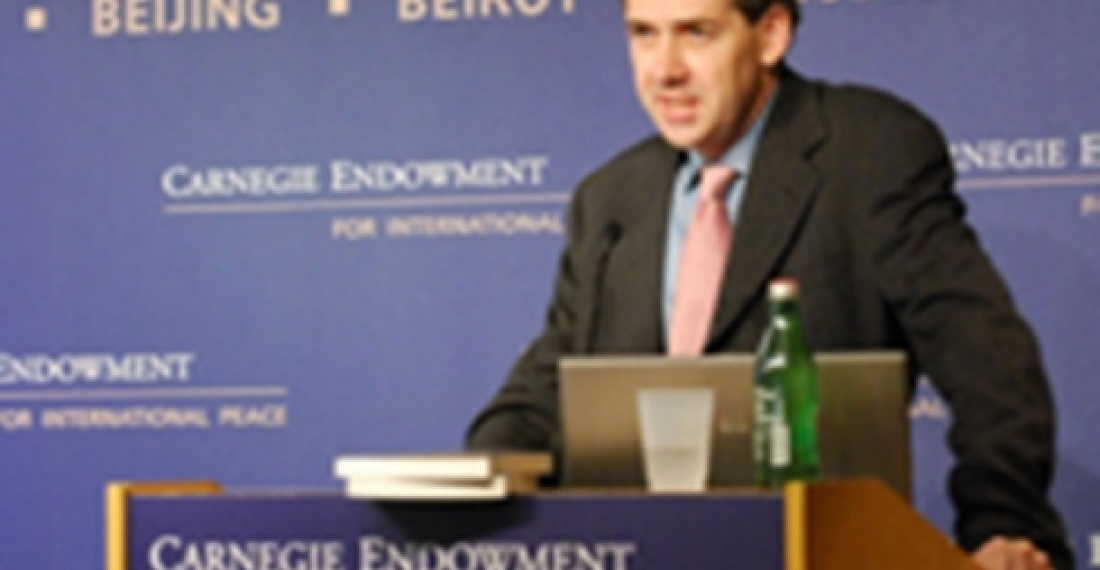
(Thomas de Waal is currently Senior Associate of the Russia and Eurasia Program at the Carnegie Endowment for International Peace in Washington DC).
May 2014 marked the 20th anniversary of the Ceasefire Agreement between Armenia and Azerbaijan. A lot has been said about the losses of the two parties to the conflict. It would be interesting to hear your perspective on the gains of the parties during those 20 years.
There have been some gains, but only small ones. It is enough to say that there has not been an outbreak of large scale conflict during the past 20 years. At the same time, we have seen small-scale skirmishes and people are still dying on the Line of Contact. As I mentioned, it might have been possible to attain progressive results in the absence of large scale clashes.
Russia and the West take opposite stands in almost all international conflicts. It is only on the Karabakh issue that Russia and the West have a shared position. What do you think? Does the status quo suit both parties' interests? Why are Russia and the West so passive on precisely the Karabakh issue?
There are other issues on which Russia and the West have similar positions too. Regarding the Karabakh issue, it is not as important as Afghanistan, Iran or the Middle East for Russia and the West. However, it is more important than Sri Lanka or Congo. Russia and the West are willing to solve the Karabakh issue but, at the same time, do not want to allocate too many resources to this end. The parties themselves understand that the longstanding conflict needs to be resolved as well. The current situation serves both Azerbaijan and Armenia. They both believe that making compromises is too risky.
Azerbaijan has announced that it is not considering joining the Eurasian Economic Union. However, it has not signed an Association Agreement with the EU. What is official Baku wary of? Is this related to the Karabakh issue?
In my opinion, the Azerbaijani elite thinks that it is pursuing a unique policy by keeping both Russia and the West at a distance and, of course, it does not want to create tensions in its relations with either side. It reminds me of the policy that Uzbekistan follows. In terms of its relations with Russia, Uzbekistan is a step closer to Europe. It is clear that Azerbaijan is hindered by European standards and transparency. At the same time, Russian intervention in Azerbaijan is undesirable for this elite. There is a great risk here. Currently, Azerbaijan does not have strong and reliable partners. After a while when the oil runs out, Azerbaijan will lose its strategic importance. When this happens, Azerbaijan will ask itself: "Where are our allies?"
Armenia has stated its position that it will join the Customs Union. Russia is seeking mechanisms for making Azerbaijan a member too. Do you think that "the key to resolution of the Karabakh issue still lies in the hands of Russia?"
The belief that the key to resolution is in the hands of Russia is unrealistic and an illusion. This is the most convenient excuse for both the Azerbaijani and the Armenian elites. They blame others for the lack of resolution, rather than admitting their own mistakes. They hold others responsible. Of course, Russia is one of the main actors among the foreign players. But this does not mean that "Russia holds the key to the resolution of the conflict." For instance, over the past 20 years neither conflict party has taken steps to resolve the conflict which Russia has blocked. This has not taken place.
People who are engaged in public diplomacy in Azerbaijan have recently been subject to pressures, including the arrest of Rauf Mirgadirov, a journalist...
Indeed. First of all, let me say that this pressure is not only on people who are engaged in public diplomacy. This is a general pressure against independent civil society representatives. For instance, Anar Mammadli and others. Rauf Mirgadirov's arrest might be related to his activities in Turkey, and his trip to Armenia was just an excuse. Furthermore, pressures against Arif and Leyla Yunus could be related to other issues. In any case, this is very alarming. Because these are persons who openly express the importance of dialogue with the Armenians. There are many others who share their views but seeing these kinds of pressures, they prefer to remain silent. Without the participation of this segment of society, it is very difficult to reach a settlement with the Armenian side.
What can you say about the presidents' rhetoric on the Karabakh issue? In one of your speeches, you described such rhetoric as active and passive aggression.
It seems that the Azerbaijani rhetoric has been based more on enmity during the past 20 years. However, this cannot be said about the former president Heydar Aliyev. He was more careful when talking about the Armenians. Of course, in his speeches he called the Armenians aggressors. But the current president and people around him are more aggressive on this issue. This rhetoric is published and disseminated on the Armenian side as well and reduces confidence. Such speeches serveDashnaktsutyun. This gives them the opportunity to spread the belief that "Azerbaijan is our enemy" in Armenian society. At the same time, the Armenian side argues that their rhetoric is not as harsh. This is indeed the case. However, I should note that it has a simple explanation, since Armenia is the winning side in the war that ended in 1994, despite its losses. The party that has lost more in this war is Azerbaijan, mainly its territories. When Armenia calls for peace and invites dialogue, but at the same time states that it will not return Fuzuli and Aghdam, I would call this passive aggression, rather than a call for peace.
You have worked on this conflict for a long time. As a researcher, have there been any changes in your attitude towards the sources, development and consequences of this conflict?
In terms of sources, I can say that I have researched this aspect of the conflict quite well and described it in the first edition of my book ("Black Garden: Armenia and Azerbaijan Through Peace and War" - editor's note). When the conflict started in the Soviet period, there was a naïve approach towards the developments. It is not right to refer to conspiracy theories in this regard. For instance, I do not believe that the "KGB" or Dashnaktsutyun had a "hand" in this. This was a bomb which would have detonated sooner or later within the Soviet system. The Karabakh Autonomous Oblast was a part of Soviet Azerbaijan and had relations with Soviet Armenia. With the weakening of the Soviet authority, this bomb would have detonated. Unfortunately, this was an inevitable process. However, despite the situation 20 years ago, the conflict is now between two independent states.
So how is it possible to resolve this conflict? How can the conflict be resolved in a way in which both Azerbaijan and Armenia are satisfied?
First of all, this is a long-term process and it is not possible to resolve it within a short period of time. Secondly, there is a peace plan based on 6 principles (the Madrid principles - editor's note). These are the fundamentals. The main problem is the lack of mutual trust. There is also a need for a ceasefire in the rhetoric as a first step. There needs to be mutual respect and real dialogue. The meetings between presidents and foreign ministers every 3-4 months for 2 hours is nothing serious. There is a need for a more structured process. Within this framework, regular meetings should be conducted and parties should respect one another's positions. As the process becomes more focussed, more foreign resources should be allocated for the resolution of the conflict.
There is no mutual trust between ordinary citizens of the parties. How can this be resolved?
People are sensitive to the environment that the authorities have created. If the authorities demonstrate a different course, the majority of people can change their views. A lot of people are tired of this conflict and the parties are well aware that they will live together in the future. If the situation changes, they will change as well.
Are the events taking place in Ukraine and Caucasus similar in nature?
The events taking place in Ukraine and Crimea have negative effects on the Armenia-Azerbaijan and Karabakh conflict. I am referring to the forceful resolution of the conflict and the redrawing of borders. From another point of view, there is nothing new here. There is simply one more conflict in the post-Soviet region now.
Do you think the events that took place in Abkhazia, the resignation of the "president" and the demonstrations, could be repeated in NagornyKarabakh?
No. People's democracy has been established in Abkhazia. There are characteristics of the "mountain democracy" of the Caucasus here. People get together, make decisions, and disperse. This does not exist in Karabakh. Authority here is exercised as a vertical function.
Lastly, how long should we wait for the resolution of the Karabakh conflict and "who" or "what" is preventing the resolution?
First of all, there is no need for waiting. Work needs to be done on a daily basis; stereotypes should be eliminated, dialogue pursued, etc. It is not right to wait passively. Overall, I am very doubtful that these authorities are able to resolve the conflict. Maybe the new generation and new governments would be able to achieve resolution. There is another factor at play too. The psychological element is a reality in the resolution of this conflict, in which the leadership in Azerbaijan and Armenia would realise that they need to work together, rather than against each other, for the sake of common interests and the resolution of the conflict. Approaches that are based on the absolute victory of one side over another do not contribute to the resolution of the conflict.
Seymur Kazimov interviewed Tom de Waal in Tbilisi in June 2014.
source: commonspace.eu.
photo: Tom de Waal (archive picture)