Interview of Kiro Manoyan, Head of ARFD Bureau's Hay Dat and Political Affairs Office, with ArmInfo News Agency
On August 6, 2012, the House of Representatives of the State of Massachusetts adopted a resolution submitted by State Representative Jonathan Hecht urging "the President and Congress of the USA to support the self-determination and democratic independence of Nagorno Karabakh". What prospects do you think this process may have?
Such steps are a logical result of the conducted work and are not at all spontaneous. Before Massachusetts, a similar resolution was adopted by the lawmakers of Rhode Island in May of the current year, which is also very much important for recognition of the NKR independence. Of course, official Baku is trying to console itself that such resolutions cannot affect the foreign policy of the USA. Nevertheless, it is already clear that even if such steps do not promote de-jure recognition of Karabakh, a community is being formed in the political circles of the USA, which in fact has already expressed its support to recognition of the NKR independence.
If we also take into consideration the positive assessment of several American congressmen regarding the recent presidential election in Karabakh, who congratulated Bako Sahakyan on re-election, we shall see that this assessment gives extra ground to the Karabakh recognition process. Such steps are very much important for Azerbaijan to finally understand that it cannot hold the negotiating process hostage of its own political poor judgment. At present they think in Baku that the NKR conflict will not be resolved at all until Azerbaijan agrees to any option of settlement of the conflict. There are numerous examples when after the ineffective talks a part of the world community unilaterally recognizes independence of this or that unrecognized but de-facto existing state. For this reason, continuation of this process is very much important and the more similar States in the USA and in the countries, where there are smaller management units than a state, the faster we shall reach our goal, that is to say, recognition of the NKR an independent state.
What steps should Armenia take to use the Kosovo precedent in the Karabakh peace process?
Armenia should, first and foremost, make Azerbaijan understand that the negotiations for resolution of the Karabakh conflict cannot continue endlessly. Armenia does not do that, unlike Azerbaijan, which does it by means of threats of use of force. To counterbalance the trigger-happy policy of Azerbaijan, Armenia must hint at possible change of the world community's approach to the Karabakh peace process. This will not allow Azerbaijan and some other countries to use the negotiations against recognition of the NKR's independence. We are sure that over the last 12 years application of the independence principle of Nagorno Karabakh has been the key content of the negotiations. Consequently, recognition of Karabakh's independence will in no way contradict the process. In addition, it will make Baku take the negotiations more seriously.
Several months ago Foreign Minister of Uruguay Luis Almagro said that his country was considering possible recognition of independence of the Nagorno-Karabakh Republic. Afterwards the Azeri Foreign Minister made a trip to the countries of Latin America to continue "conquering" these countries to create a counterweight to the Armenian communities. Is it possible today to seriously speak of the prospects for recognition of the NKR by the countries of Latin America?
Recognition of Nagorno Karabakh independence even by one country will undoubtedly promote continuation of this process by other countries. The policy of Azerbaijan in the countries of Latin America has really become active for the last period of time. I should say that Baku jointly with Ankara have been actively working over the last few years. This process is first of all regarding the countries, which have influential Armenian communities. We see no adequate response of Yerevan to such actions of Baku yet. Azerbaijan makes investments in these countries, participates in the oil and gas projects, creating a platform for itself for fully-fledged political and economic intrusion in the region. Meanwhile, Armenia, having rather wide diplomatic channels, for instance, with Argentina, does not fully use them. Latin America is very much important for Armenia, first of all for its votes in international structures. Azerbaijan and Turkey understand it very well. The time has come for Armenia to understand it too and finally to use its rather big potential.
The civil war in Syria and the possible war against Iran demonstrate the attempts to change the current geopolitical situation. May the Armenian-Turkish protocols become relevant again for Washington or Ankara given the changing situation in the region?
I do not think they can become relevant as a direct result of the changes you have mentioned. However, the Armenian-Turkish process may become relevant as a possible step in the current conditions. If the pressure of the United States and Europe on Turkey starts increasing again due to the latter's growing role in the Syrian conflict and the West's striving to level it, Ankara will have to take certain steps to weaken this pressure regardless of the state of the protocols on the threshold of 2015. For this purpose, Ankara may suddenly lift the blockade from Armenia, but it may also suddenly impose the blockade again. And we should always remember that.
At the same time, I do not think that a war may start against Iran in the classical sense of the word. The West itself is thinking over its further steps against Iran, and this is proved by the slow actions of the United States, Hillary Clinton's visit to Turkey, etc. Libya is a perfect example of what an uncontrolled revolution can lead to, and I think the West has taken this example into consideration. At the same time, the Syrian scenario in Iran is also low probable for a number of important reasons. Bombing-missile attacks are most likely to be applied against Iran. However, in any case, all these regional changes may become the reason of pressure on Ankara. If Turkey had an opportunity, it would have brought its troops to Syria long ago under the guise of NATO. But this did not happen, as we see. Therefore, I think that the West will always have a reason to temperate the growing appetites of the Turkish partners in NATO.
The NKR Prime Minister Ara Haroutyunyan has recently expressed the NKR's willingness to put up the Armenians of Syria, provide them with living conditions, and give them an opportunity to receive free education in Artsakh. Afterwards, the Foreign Ministry of Azerbaijan announced that the migration of Syrian Armenians to Karabakh was illegal. Do you think the settlement of the liberated lands of Artsakh with our compatriots may stimulate implementation of a global project on settlement of Karabakh?
The direct problem No 1 for the Armenians today is to ensure the safety of Syrian Armenians. I am convinced that there are Armenians in Syria who want to leave that country at present. I understand the readiness of the NKR authorities to receive guests from Syria. But I think that it is not correct to receive a man, which is within a hair of death in Aleppo, for permanent residence in Nagorno Karabakh, as we don't know if he will stay there tomorrow. That is to say, the problems of repatriation and safety of Syrian Armenians must be fully separated from each other. As for the aid to the repatriates, it should be undoubtedly done. As for the population of the liberated territories, it is clear that if the population of the NKR were 300-500 thsd people, in that case the Armenian party to the negotiating process would speak to Baku in an absolutely different language.
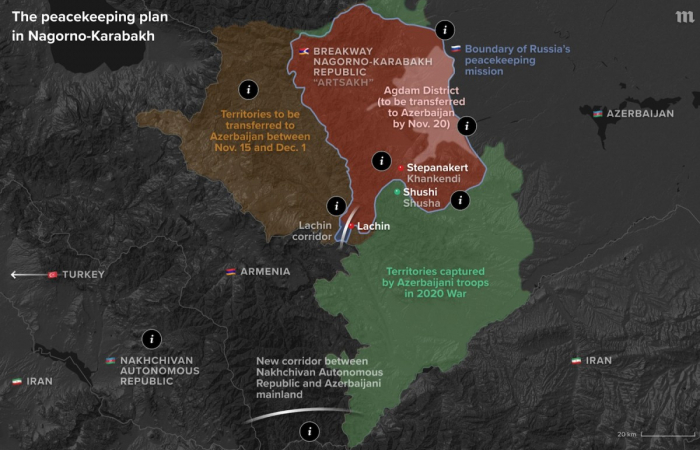
At present the world community understands the desire of the Armenians of the whole world to declare an independent state at the territory of the former Nagorno Karabakh Autonomous Region populated by Armenians, but it does not understand our desire to join the low-populated liberated territories to the NKR. We, Armenians, understand them, but not everybody understands them so well as we do. For this reason, everything possible should be done for the Karabakh residents to be able to openly populate their own territories the way they like. Undoubtedly, settlement of these territories will become an extra lever of the Armenian party to the talks on the NKR settlement.
Since 1992-93 the Armenian authorities have been trying to make a good impression at all the talks not only on Karabakh. Today, this has turned into one of the key foreign policy goals and the authorities of Armenia have been doing everything possible to escape displeasure of western partners. I think that the problem of population of the territories is just one of such problems. If our authorities were confident that their own people would support them, they would not need a good opinion from outside. Unfortunately, our authorities do not have such support. For this reason, the situation around Karabakh still fails to meet the interests of the Armenians.
By David Stepanyan
24 August 2012, ArmInfo
Interview
OPINION: Kiro Manoyan "The West’s pressure may make Turkey reanimate Armenian-Turkish protocols"