Opinion: The baggage of history slows down Europe's actions in the international arena

As the conflict over Ukraine heats up, several political analysts have pointed to the slow initial reaction by key European states, including France and Germany, to call Russia out when it first started mobilising troops at the border, writes Jolyon Wiersum in this op-ed. Analysts of the Normative Europe Theory see a series of contradictions which lie at the heart of the EU’s difficulty in responding to outright aggression on the international stage.

As the conflict over Ukraine heats up, several political analysts have pointed to the slow initial reaction by key European states, including France and Germany, to call Russia out when it first started mobilising troops at the border. For instance, in November 2021, the French President Emmanuel Macron was warned by an American intelligence report of a Russian invasion of Ukraine that would take place in January. Macron responded critically by denouncing the report and warning the world not to create a self-fulfilling prophecy. The French president was of course not alone in this. The German government, when asked if they would consider cancelling the Nord stream 2, replied by saying they were not in favour of invoking such strong sanctions against Russia.  Subsequently both countries have had to walk these statements back  given the perisisting and   very real threat of a Russian invasion of Ukraine. The German president has even recently gone so far as to include the cancelling of Nord stream 2, as a part of possible sanctions regime being imposed on Russia if Putin proceeds with the invasion.

This was not the first time the EU giants reacted slow and erred on the side of caution when faced with military conflict on Europe’s eastern borders.  

What underlies this slow reaction time?

Naturally, all bureaucracies throughout the world will have a slowing effect on the decision and policy-making processes. On the other hand, there are plenty of examples of the EU top tiers acting quickly when required, recent Covid-19 policy forming a prime example. All sorts of political theories can explain the complex strategic issues that must be addressed when creating foreign policy. Yet, what the EU faces when dealing with the unique situations on its borders is perhaps best explained by looking at its own inner dynamics.

Normative Europe theory holds the possible answer.

Since its transformation from the  a European Community into the European Union with the signing of the treaty of Maastricht, political analysts have been praising the Union for its normative power in relation to its neighbours. Essentially, leading by moral example.  However, in recent years this approach has been criticised due to obvious contradictions.

Analysts of the Normative Europe Theory see a series of contradictions which lie at the heart of the EU’s difficulty in responding to outright aggression on the international stage.  

The first comes from overall weariness of military intervention and contradictory policies as a result of the Iraq and Afghanistan wars. The EU had long touted the claim that it was a peace-project, yet for more than a decade a large portion of its member-states were actively involved in interventionist warfare. Squaring the circle between peace at home and war abroad is challenging.

The second comes from a heightened awareness of historical sensitivities in EU-neighbouring regions. For instance, the EU claims the moral high ground in  its international affairs and regularly expresses the will to solve issues with economic “carrots” rather than “sticks”. However, former European colonies, particularly in Africa, have expressed their discontent with so-called “EU neo-colonial policies”. According to critics, these policies are presented as the EU helping budding democracies flourish, but in effect they create an uneven playing field which only serves to benefit EU member-states. Western-European member-states have expressed willingness in recent years to address exactly these contradictions. Credibility however is a  finite resource for the EU and once lost is not easily regained.

The final contradiction is rooted in the geographical and historical differences between member-states. Primarily, the East-West divide has been a thorn in the side of the Common Foreign and Security Policy, and its main implementing agency the European External Action Service.  There is ever-increasing pressure on the Commission to deal with the two outliers in this divide: Poland and Hungary and to deal with a range of other shortcomings in Eastern member states. This is part of a larger contradiction between these Eastern-European countries, who   hold the frontline against Russia and will bear the brunt in an possible future Russian aggression, and their western counterparts, tears at the   fabric of the EU. The East,  on the one hand, does not suffer the historical burden of colonialism to the same extent as the West. A result of this is that eastern member-states do not operate under the same moral  compass  tempered with colonial-guilt as much as the western member-states do.  Furthermore, they have their own experience with totalitarianism and expansionism which has led the majority of these countries to be in favour of a proactive response in the face of aggression emanating from Russia. Unifying the two views, which essentially run along the East-West divide, into a cohesive foreign policy has proven to be time consuming at best.

Can the EU credibly function with these factors determining for a large part how the member-states will react in the face of foreign aggression? 

It would appear that the very boons the EU espouses, which are based on enlightened morals and human-rights, are in fact the exact same facets of the process that cause certain EU governments to second guess themselves and move at an excruciatingly slow pace. For now, the individual EU members-states have for a large part kept foreign policy separate from EU-supranational influence and refer to NATO in most military affairs. However, if the EU wishes to have a credible unified response to future international aggression, the best way  it could proceed would be to address speedily its internal contradictions.  
source: Jolyon Wiersum contributed this op-ed for commonspace.eu
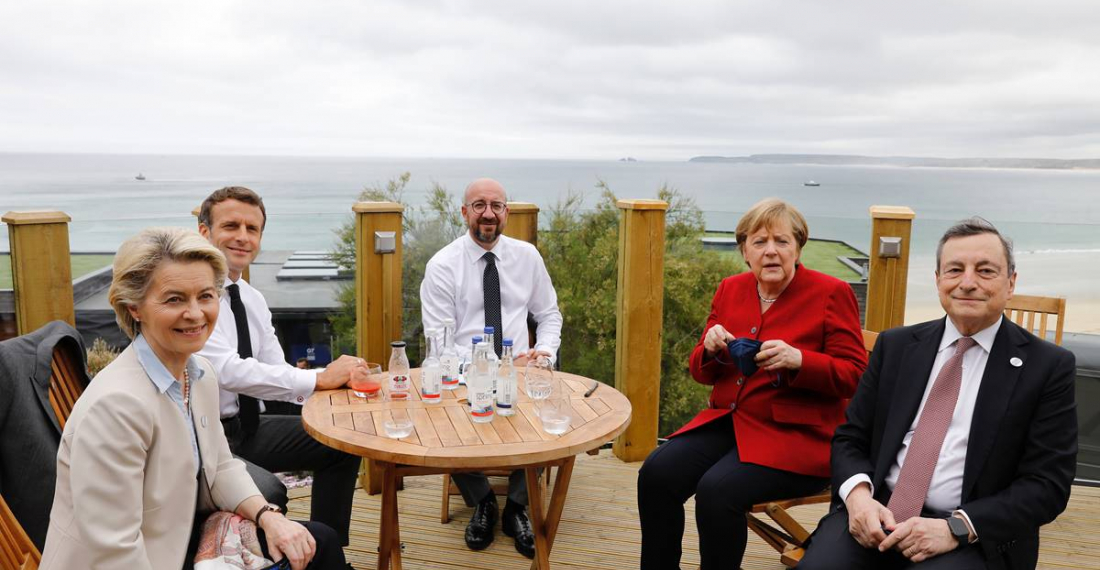
photo:  From left to right: Ursula VON DER LEYEN (President of the European Commission), Emmanuel MACRON (President of France), Charles MICHEL (President of the European Council), Angela MERKEL (until lately Federal Chancellor, Germany), Mario DRAGHI (Prime Minister, Italy) on the margins of a G7 meeting in Summer 2021. (Picture courtesy of the press service of the European Union.)

Related articles

Editor's choice
News
UAE says it will withdraw from Yemen, but division emerges in Yemeni presidential council

UAE says it will withdraw from Yemen, but division emerges in Yemeni presidential council

In a move seen as an attempt to de-escalate a crises with Saudi Arabia, the United Arab Emirates, on Tuesday (30th December) announced that it was heeding a call to withdraw its troops from Southern Yemen. UAE says that its presence included counter-terrorism teams that were crucial in fighting against Islamist groups. UAE sources said that parts of Yemen not controlled by the Houthis have had Al Qaeda in the Arab Peninsula (AQAP) operatives using the territory to launch attacks on Europe, the US and Middle East. UAE teams have co-ordinated with American and British special forces and intelligence. The sources added that Emirati forces and their Yemeni allies also helped reverse Houthi gains in the south. including the liberation of Aden port. The small UAE contingent has remained in place since the UAE withdrew most of its military personnel in 2019. The leading English-language newspaper in Abu Dhabi, The National, said that the main UAE force was based at Riyan Mukalla International Airport, with access to fixed-wing aircraft and helicopters, but also operated smaller contingents in the port town Balhaf and Shabwa. "It is understood it also flew a number of drones from the airbase that were able to track terrorist movements, pass information back to its allies and assisted special forces' missions." Meanwhile a division has emerged in Yemen's presidential council after four members denounced what they called the 'unilateral decisions' by the chairman. Four of Yemen’s eight Presidential Leadership Council members on Tuesday denounced an announcement by the council’s chairman accusing him of breaching the governing agreement. Tension between Yemeni leaders has been rising for weeks, underscoring the fragility of the country's already fractured political landscape and further complicating efforts to confront the Iran-backed Houthi rebels. The latest rift took an unprecedented turn on Tuesday morning, marked by a Saudi-led coalition “limited operation” striking combat vehicles Riyadh linked to the Southern Transitional Council, which has three members in the PLC. The PLC Chairman, Rashad al Alimi, on Tuesday said that he was seeking to cancel the joint defence agreement with the UAE. “What has been issued … constitutes a clear violation of the Declaration of the Transfer of Power [agreement], which explicitly stipulates that the Presidential Leadership Council is a collective body whose decisions are taken by consensus, or by majority when consensus is not possible,” the statement by the four members said. “It does not, under any circumstances, allow for unilateral decision-making on sovereign, military, or major political matters." The statement was signed by STC chief Aidarous Al Zubaidi, Faraj Al Bahsani, Tariq Saleh and Abu Zaraa al Muharrami. (click the picture to read the full article).

Popular

Editor's choice
News
UAE says it will withdraw from Yemen, but division emerges in Yemeni presidential council

UAE says it will withdraw from Yemen, but division emerges in Yemeni presidential council

In a move seen as an attempt to de-escalate a crises with Saudi Arabia, the United Arab Emirates, on Tuesday (30th December) announced that it was heeding a call to withdraw its troops from Southern Yemen. UAE says that its presence included counter-terrorism teams that were crucial in fighting against Islamist groups. UAE sources said that parts of Yemen not controlled by the Houthis have had Al Qaeda in the Arab Peninsula (AQAP) operatives using the territory to launch attacks on Europe, the US and Middle East. UAE teams have co-ordinated with American and British special forces and intelligence. The sources added that Emirati forces and their Yemeni allies also helped reverse Houthi gains in the south. including the liberation of Aden port. The small UAE contingent has remained in place since the UAE withdrew most of its military personnel in 2019. The leading English-language newspaper in Abu Dhabi, The National, said that the main UAE force was based at Riyan Mukalla International Airport, with access to fixed-wing aircraft and helicopters, but also operated smaller contingents in the port town Balhaf and Shabwa. "It is understood it also flew a number of drones from the airbase that were able to track terrorist movements, pass information back to its allies and assisted special forces' missions." Meanwhile a division has emerged in Yemen's presidential council after four members denounced what they called the 'unilateral decisions' by the chairman. Four of Yemen’s eight Presidential Leadership Council members on Tuesday denounced an announcement by the council’s chairman accusing him of breaching the governing agreement. Tension between Yemeni leaders has been rising for weeks, underscoring the fragility of the country's already fractured political landscape and further complicating efforts to confront the Iran-backed Houthi rebels. The latest rift took an unprecedented turn on Tuesday morning, marked by a Saudi-led coalition “limited operation” striking combat vehicles Riyadh linked to the Southern Transitional Council, which has three members in the PLC. The PLC Chairman, Rashad al Alimi, on Tuesday said that he was seeking to cancel the joint defence agreement with the UAE. “What has been issued … constitutes a clear violation of the Declaration of the Transfer of Power [agreement], which explicitly stipulates that the Presidential Leadership Council is a collective body whose decisions are taken by consensus, or by majority when consensus is not possible,” the statement by the four members said. “It does not, under any circumstances, allow for unilateral decision-making on sovereign, military, or major political matters." The statement was signed by STC chief Aidarous Al Zubaidi, Faraj Al Bahsani, Tariq Saleh and Abu Zaraa al Muharrami. (click the picture to read the full article).