


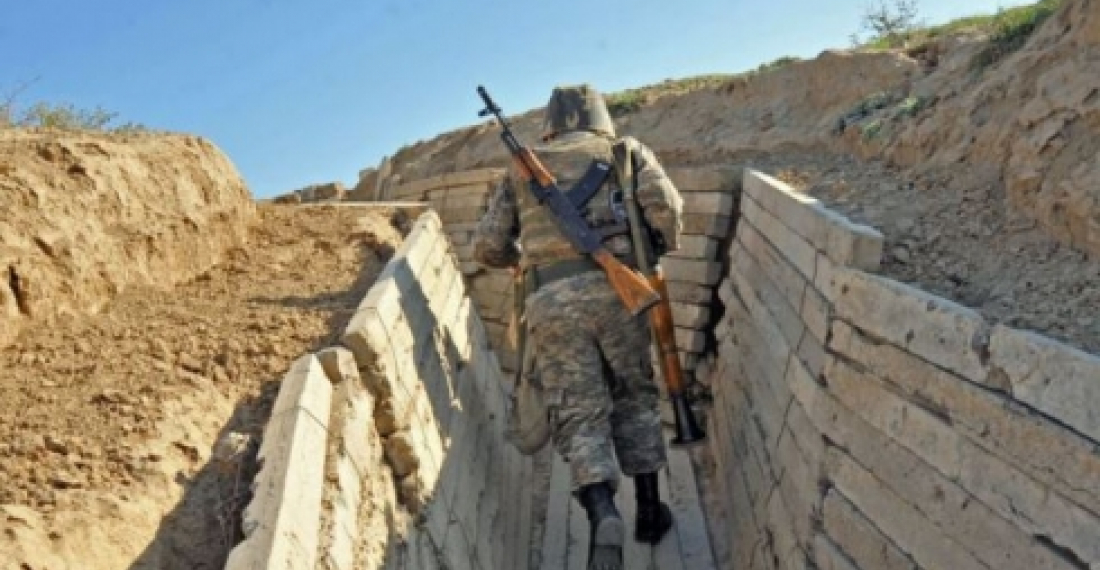
Year starts badly on Karabakh front line.The first month of the year has been marred with daily incidents and the the death of several persons.

The first month of 2014 is not yet over, but we can already say that this has been a bad month on the Karabakh front line - the line of contact separating thousands of Armenian and Azerbaijani forces who have been sitting in trenches facing each other for the last twenty years waiting for the politicians to resolve the conflict.

That this is far from being a frozen conflict is for everybody to see. Daily there are reports of cease fire violations, and these are now not sporadic incidents, or simply young conscripts letting off steam. The use of snipers by both sides has now started to take a serious toll on life. Both sides now also regularly accuse each other of incursions.

On Tuesday, the Armenian side reported that one of its soldiers had been killed. Karen Galstyan was just nineteen years old. Both sides had already reported other casualties earlier this month.

In the meantime the Azerbaijani side has said that it has captured an Armenian man who it says was acting as a scout for a commando group that was trying to penetrate through its lines. The Armenian side said that the man was a seventy-five year old local villager who had lost his way. The International Committee of the Red Cross is trying to get access to the man but as always in these circumstances establishing the true facts will remain difficult.

This situation is providing the back drop for the discussions that continue between the two sides. The meeting of the two foreign ministers held in Paris last week shows that at least the lines of communication remain open. Yet for the people who are loosing their life any solution will come too late. Many are asking, how many more people have to die before this conflict is resolved?

source: commonspace.eu

photo: A trench on the Karabakh front line (archive picture).

 

Related articles

Editor's choice
News
Sanction Israel: More than one hundred former British and French diplomats make public call for safeguarding the rule of law

Sanction Israel: More than one hundred former British and French diplomats make public call for safeguarding the rule of law

In response to Israel's policy of occupation and destruction, around one hundred former representatives of France and the United Kingdom urge their governments to act through a series of sanctions aimed at safeguarding the rule of law. A coalition of 102 former French and British diplomats is calling on their countries to jointly sanction Israel, warning in an open letter that Israeli policy in occupied Palestinian territory threatens to permanently erase the possibility of a Palestinian state. France and the United Kingdom “must act together to uphold international law in Palestine”, said the letter published on Saturday by French outlet Le Monde. It urged the two governments to push for “equal rights for Israelis and Palestinians”. The signatories include former British ambassadors to the United Nations, Jeremy Greenstock and Emyr Jones Parry, and former French Middle East directors, Yves Aubin de la Messuziere and Denis Bauchard, drawing on decades of diplomatic postings across the region. “Palestinian house demolitions and rampant settler violence – with the connivance of the Israeli army and police – amount to ethnic cleansing,” said the letter. “The world no longer sees Israel as a genuine democracy,” it added. Such language, said Nicholas Hopton, a former UK ambassador to Iran, Qatar and Yemen and one of the signatories, was not invented by the diplomats themselves. “The words are not our own,” he told Al Jazeera. “They are taken from the international legal bodies, the UN, those who have been observing from a neutral position and with expertise.” (click image to read in full)
Editor's choice
News
Russian attacks against Ukrainian civilians continue

Russian attacks against Ukrainian civilians continue

Rescuers in Ukraine are continuing their search for survivors in the wreckage of a big shopping centre hit by Russia on Friday. Sixteen people were killed and 130 injured when two drones hit the busy centre in Kryvyi Rih in quick succession in what is known as a double-tap strike. Four people are still missing. The search and rescue operation could last for another two days. President Volodymyr Zelensky condemned the "cynical and despicable" attack in which the second drone targeted emergency workers. The sides exchanged more fire overnight, with Ukrainian attacks said to have killed at least four people in Russia, including two children, and three people reported dead by Kyiv as a result of Russian strikes. The death toll from Friday's attack reached 16 after another body was retrieved from the rubble overnight, said Dnipropetrovsk regional head Oleksandr Hanzha. "We're doing everything possible to speed up... the search and rescue operation," he told Ukrainian TV on Saturday morning. (click image tio read more)

Popular

Editor's choice
Interview
Thursday Interview: Murad Muradov

Thursday Interview: Murad Muradov

Today, commonspace.eu starts a new regular weekly series. THURSDAY INTERVIEW, conducted by Lauri Nikulainen, will host  persons who are thinkers, opinion shapers, and implementors in their countries and spheres. We start the series with an interview with Murad Muradov, a leading person in Azerbaijan's think tank community. He is also the first co-chair of the Action Committee for a new Armenian-Azerbaijani Dialogue. Last September he made history by being the first Azerbaijani civil society activist to visit Armenia after the 44 day war, and the start of the peace process. Speaking about this visit Murad Muradov said: "My experience was largely positive. My negative expectations luckily didn’t play out. The discussions were respectful, the panel format bringing together experts from Armenia, Azerbaijan, and Turkey was particularly valuable during the NATO Rose-Roth Seminar in Yerevan, and media coverage, while varied in tone, remained largely constructive. Some media outlets though attempted to represent me as more of a government mouthpiece than an independent expert, which was totally misleading.  Overall, I see these initiatives as important steps in rebuilding trust and normalising professional engagement. The fact that soon a larger Azerbaijani civil society visits to Armenia followed, reinforces the sense that this process is moving in the right direction." (click the image to read the interview in full)


