


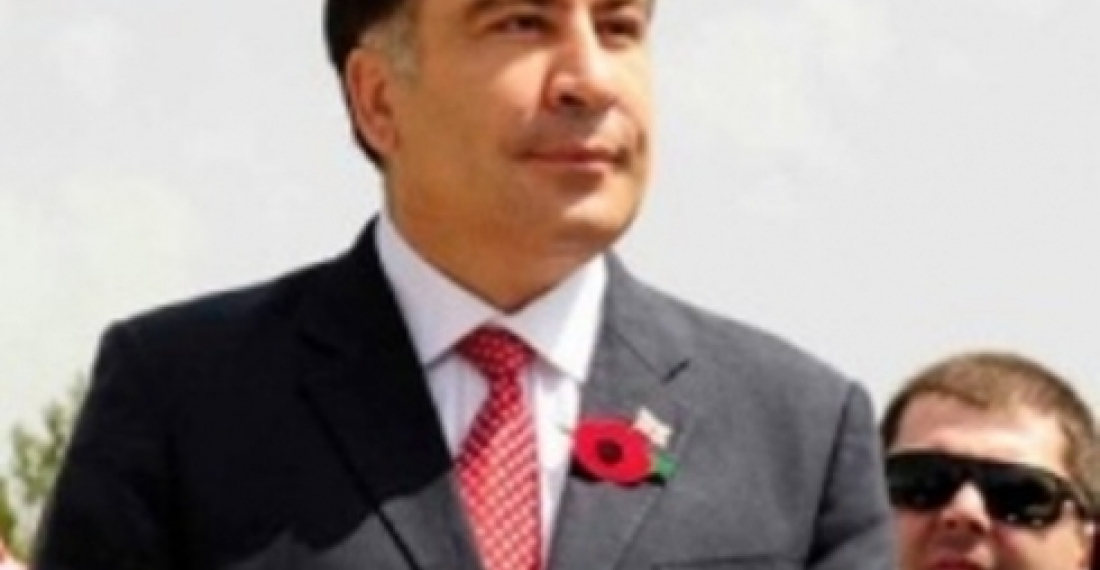
Saakashvili warns that appeasing Russia is a delusion The Georgian president speaks to Rustavi2 about dangers to Georgia's statehood.

Georgian President Mikheil President Saakashvili on Wednesday gave a lenghty interview to Rustavi 2 TV on the occasion of the fifth anniversary of the war with Russia.

The Georgian News portal civil.ge reports that Saakashvili said that he had done everything possible trying to prevent war with Russia five years ago including through offering Moscow significant concessions, among them rejecting NATO aspiration, downscaling cooperation with the U.S. and a plan to carve-up Abkhazia. Saakashvili said that all of his efforts were fruitless as Russia was preparing for the war, which aimed at "complete destruction" of Georgia.

Commenting on Russian PM Dmitry Medvedev's remarks in an interview with Rustavi 2 TV, Saakashvili said it was a clear message that Georgia should reconcile with losing of Abkhazia and South Ossetia, reject NATO integration and become a member of Eurasian Union if it wants to normalize relations with Russia.

"The Georgian nation... now faces a concrete choice - if the Georgian nation wants to say no to significant part of its territory, if the Georgian nation wants to say no to future development - that is saying no to Euro-Atlantic space... if Georgia is ready to say no to [freedom] of choice in internal [affairs], because Eurasian Union means imposing their rules, then of course there are certain possibilities with Russia," he said.

He said that the only right option for Georgia is to continue "dignified, fast-track development without bowing a head" to Russia. "The solution is to run - that implies fast development," he said.

Saakashvili said that if "we continue deluding ourselves" and hoping that trying to appease Russia would yield result, "it will lead us to losing the Georgian statehood."

A full report of President Saakashvili's interview, available on the Georgian News portal civil ge, is available here

source: civil.ge and Rustavi2 Television


Related stories on commonspace.eu

Russian leadership makes cautious comments on 5th anniversary of war with Georgia.

Op-ed: Dennis Sammut: A war without winners that copuld have been avoided and that must not be repeated. (published on 8 August 2013)

Interview with Dimitri Medoev, South Ossetia's envoy in Moscow (published on 7 August 2013)

Georgia marks fifth anniversary of war with Russia; Foreign Ministry Statement (published on 7 August 2013)

Never Again! Ten questions about the August 2008 Georgia-Russia War (published on 6 August 2013)

Russia builds an artificial fence in the heart of the Caucasus (published 5 August 2013)

Related articles

Editor's choice
News
10th anniversary of a failed coup that redefined Turkiye

10th anniversary of a failed coup that redefined Turkiye

Ten years ago, parts of the Turkish military attempted to overthrow the government of President Recep Tayyip Erdogan. The consequences of the failed coup continue to shape Turkiye to this day.  It was the evening of July 15, 2016. A warm summer day was coming to an end. Many people were spending their Friday evening with friends or family, looking forward to the weekend. There was nothing to suggest that Turkiye was about to be fundamentally transformed. Then, just a few hours later, tanks were rolling through the streets. Fighter jets flying over Ankara and Istanbul. Soldiers blocking the Bosphorus Bridge, the link between Europe and Asia. The parliament in Ankara came under fire. Turkish President Recep Tayip Erdogan called on the public via a video call broadcast to take to the streets and stop the coup. The coup attempt failed that very night, but its political consequences continue to impact the country The Turkish government blamed the Gulen movement for the coup attempt. Its founder, the Muslim cleric Fetullah Gulen was based in the United States. The government accused Gulen of having infiltrated the judiciary, police, military, and other state institutions with followers over decades in an effort to undermine the state. Gulen and his followers denied any involvement in the coup. Many high-ranking military officials with alleged ties to Gulen were arrested.. Gulen died in the US aged 83 in the US in 2024. In Turkey, July 15 is now a national holiday. The former Bosphorus Bridge was renamed the "Bridge of the Martyrs of July 15." It commemorates the people who lost their lives that night. According to official figures, 253 people died, most of them civilians. Many streets, squares and schools also bear the name "July 15". However, the anniversary is not just about commemorating the victims. It also marks a profound political turning point. The Gulen movement was designated a terrorist organization, and its alleged supporters were largely extracted from the state apparatus. Six days after the coup, parliament approved a state of emergency. It was initially limited to three months but did not end until July 19, 2018. During those two years, the president governed largely by emergency decrees, issuing 32 decrees in total. The consequences of these political purges have been enormous. More than 125,000 members of the civil service and the armed forces were dismissed. According to official figures, approximately 390,000 people had been detained or arrested between 2016 and 2025 on suspicion of ties to Gulen.
Editor's choice
News
Ukraine Intercepts Ballistic Missiles as Russia Continues Nationwide Air Assault

Ukraine Intercepts Ballistic Missiles as Russia Continues Nationwide Air Assault

Ukraine's air defenses intercepted five Russian ballistic missiles during a large-scale overnight attack on July 14–15, marking the first reported successful interceptions of ballistic missiles in nearly two weeks as Kyiv seeks to strengthen its air defense capabilities amid continuing Russian strikes. According to the Ukrainian Air Force, Russia launched eight Iskander-M/S-400 ballistic missiles, two Kh-59/69 cruise missiles, and 135 attack drones overnight. Ukrainian forces said they destroyed seven missiles, including five ballistic missiles, and intercepted 108 drones. However, several missiles and drones penetrated the country's defenses, damaging civilian infrastructure in Kyiv and other regions. In the capital, explosions were reported shortly after midnight, with President Volodymyr Zelensky saying that 16 sites were damaged, including a school and a civilian enterprise. Kyiv Mayor Vitali Klitschko reported fires at two warehouses. While no fatalities were recorded in the capital, Russian attacks elsewhere in the country killed at least seven people and injured 78, according to regional authorities. Casualties were reported in Kherson, Zaporizhzhia, Sumy, Dnipropetrovsk, Kharkiv, and Chernihiv oblasts, with critical infrastructure also struck in several regions. The successful interceptions come after weeks of concern over Ukraine's dwindling supply of interceptor missiles. Following a massive Russian strike on July 6, Ukrainian officials said they failed to intercept any of the 29 ballistic missiles launched, prompting Air Force spokesperson Yurii Ihnat to warn that the country lacked sufficient interceptor missiles to counter such attacks. Although the Ukrainian Air Force did not specify which system was used during the latest attack, the ballistic missiles were likely intercepted by U.S.-supplied Patriot systems, Ukraine's most effective defense against Russian ballistic threats. President Volodymyr Zelensky himself has repeatedly cautioned that Patriot interceptor stocks are critically low, a shortage that recently prompted the United States to approve a licensing agreement allowing the missiles to be produced in Ukraine with U.S. support. Speaking after the latest bombardment, Zelensky has once again renewed calls for tougher sanctions against Russia and urged the European Union to adopt its 21st sanctions package. "Every day sanctions are delayed gives Russia additional time to prepare. Everything Russia uses to prolong this war and attack people – chips, microelectronics, dual-use goods – must be stopped," Zelensky argued. He also reiterated the need to establish a European anti-ballistic missile defense system, describing it as a more affordable, mass-produced complement to the U.S.-made Patriot system. The appeal comes as Ukraine and its allies expand defense cooperation. During Bastille Day events in Paris on July 14, Zelensky announced the creation of a coalition of ten countries to develop a shared European ballistic missile shield. He said the initiative aims to create a more affordable, mass-produced system that would complement existing Patriot batteries. During the same gathering of the “coalition of the willing,” France also pledged additional military assistance, including advanced SAMP/T-NG air defense systems, Rafale fighter jets, and cooperation on domestic production of Western missiles and precision-guided munitions. The initiative follows a separate agreement with the United States, conceived at the NATO Summit in Ankara, allowing Ukraine to begin licensed production of Patriot interceptor missiles. 

Popular

Editor's choice
Interview
Thursday Interview: Murad Muradov

Thursday Interview: Murad Muradov

Today, commonspace.eu starts a new regular weekly series. THURSDAY INTERVIEW, conducted by Lauri Nikulainen, will host  persons who are thinkers, opinion shapers, and implementors in their countries and spheres. We start the series with an interview with Murad Muradov, a leading person in Azerbaijan's think tank community. He is also the first co-chair of the Action Committee for a new Armenian-Azerbaijani Dialogue. Last September he made history by being the first Azerbaijani civil society activist to visit Armenia after the 44 day war, and the start of the peace process. Speaking about this visit Murad Muradov said: "My experience was largely positive. My negative expectations luckily didn’t play out. The discussions were respectful, the panel format bringing together experts from Armenia, Azerbaijan, and Turkey was particularly valuable during the NATO Rose-Roth Seminar in Yerevan, and media coverage, while varied in tone, remained largely constructive. Some media outlets though attempted to represent me as more of a government mouthpiece than an independent expert, which was totally misleading.  Overall, I see these initiatives as important steps in rebuilding trust and normalising professional engagement. The fact that soon a larger Azerbaijani civil society visits to Armenia followed, reinforces the sense that this process is moving in the right direction." (click the image to read the interview in full)


