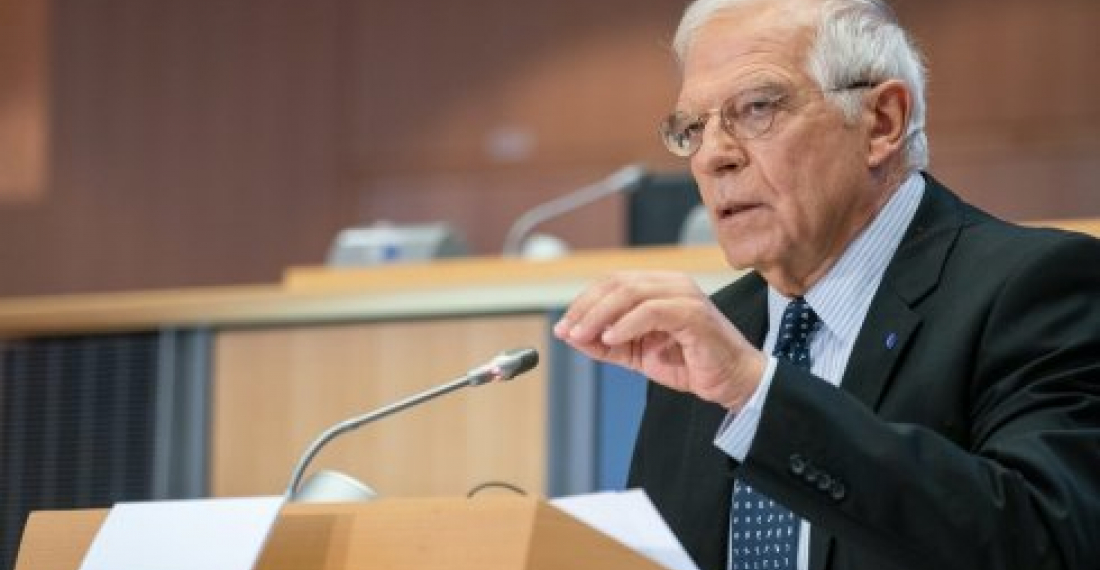
"Two months into the war against Ukraine there is no end in sight and Russia’s most recent actions even point to an intensification of the fight. The Russian leadership must stop the aggression and reconsider the unacceptable path it has chosen: for the sake of Ukraine, Russia, Europe and the wider world", says Josep Borrell, EU High Representative for foreign and security policy in this article which first appeared on his blog on the website of the European External Action Service on 26 April 2022. We are reproducing the article below in full.
Since the beginning of this war on 24 February, four Russian assumptions have proved clearly wrong: that the Ukrainian government would crumble and Russian forces would take Kyiv and other Ukrainian cities swiftly; that the European Union would be at pains to show resolve and respond to this aggression; that the “Western world” would be divided and uncertain in its reaction; and that the broader international community would not condemn Russia’s invasion.
A landmark in the consolidation of Ukraine as a sovereign nation
Instead, the Ukrainian government has rallied the whole nation in a fight against the invasion and has organised a fierce resistance, putting Russian troops in considerable difficulties and pushing back their offensive. Contrary to what President Putin might have expected, this war will be a landmark in the consolidation of Ukraine as a sovereign nation and in the reaffirmation of its identity, separated from that of Russia. This was the sentiment I strongly felt when meeting President Zelenskyy and the Ukrainian leadership in Kyiv.
The European Union reacted swiftly and robustly in support of the Ukrainian government. It adopted the most severe sanctions ever and keeps widening their scope and reach, as the war continues. The Union is making extensive financial and humanitarian support available to Ukraine and contributing to the financing of military equipment provided by member states. EU countries have welcomed close to five million refugees so far and will keep their borders open to all those fleeing the conflict. We are increasing our resilience and shedding dependencies on energy at a much faster pace than anyone could have envisioned before. The EU has strengthened itself as an international player and one can even speak of the birth of the geopolitical Union.
“The EU has strengthened itself as an international player and one can even speak of the birth of the geopolitical Union.”
The EU, together with the US, the UK, Canada, Japan and other like-minded partners and allies, have championed the international defence of Ukraine. The response was coordinated from day one, and even earlier, as intelligence was shared in unprecedented ways, to ensure awareness and preparedness. We provided abundant warnings of what our response would be, to discourage the Russian invasion and replied substantially to Russian security demands, hoping a true negotiation would ensue. Reassuring allies closest to the conflict with preventative deployments, the prudent - and yet firm - reaction of NATO conveys a clear message: the Alliance will not flinch in defending itself, yet it harbours no offensive intentions vis-à-vis Russia.
Finally, the international community has - notably on three occasions so far through the UN General Assembly - sent clear messages rejecting an invasion that contradicts the core principles of international coexistence as reflected in the UN Charter itself: the equal sovereignty of states, the peaceful solution of conflicts and the ban on the use of force in international relations. Most states, from all regions of the world, know that what is at stake, fundamentally, is the protection of weaker states from more powerful ones that could prey on them. The core principles of our international order, which UN Secretary General António Guterres will certainly underline when visiting Russia and Ukraine this week.
“Defending Ukraine from Russia’s invasion is rejecting the law of the jungle, the notion that ‘might makes right’”
Defending Ukraine from Russia’s invasion is rejecting the law of the jungle, the notion that “might makes right”. Being “neutral” is a false concept here. One country has invaded another one. Putting them on the same footing fails to differentiate between the attacker and the attacked. Such “neutrality” may respond, of course, to a variety of reasons, from hidden alignment to fear of reprisals, but it becomes in practice support to Russia and its war of aggression.
A war of choice
The present conflict is not the outcome of centuries old hatreds: it is a war of choice. It is the decision of one man, President Putin. Based on his own interpretation of history, it is not adapted to realities of the 21st century. But if the war started with a personal decision, it could also end the same way. The question is when the Russian President will accept that persevering in the military path he has chosen will bring more harm than good to his country, or to his own political role.
There are three factors to consider: the war’s impact on the Russian population, the fate of the war, and pressure from the international community. Up to now, polls coming from Russia show significant support to the war, or rather the “special military operation” as baptised by the Russian leadership. However, this support rests on false information. If the Russian population knew what is happening, they would not be backing this awful conflict.
The Duma has passed an impressive number of laws in the last weeks curtailing all possible freedom of reporting or expressing views on the war and imposing heavy penalties on anyone who does not accept the official version of events. Rallies against the war in multiple Russian cities have been repressed and the remaining free media have been fully silenced. The authorities continue to peddle a false narrative of de-Nazification, coupled with allusions to undetermined threats against Russian security. Atrocities committed by Russian forces in Ukraine are shamelessly re-attributed to the Ukrainians.
“Although the sanctions imposed by the EU and others may initially help build a bunker mentality, the reality of events will one day be clear to Russian citizens.”
Such an accumulation of lies and falsehoods will backfire at some point. The Russian society is paying a high price for this war in many ways, and although the sanctions imposed by the EU and others in trying to end the conflict may initially help build a bunker mentality, the reality of events will one day be clear to Russian citizens. Tens of thousands have already left the country due to the war, the stifling censorship and the repression.
In addition, this is even truer because so far military activities have not favoured Russia, despite its overwhelming military capacity when compared to Ukraine. Its Northern operation has been a failure and it has had to adjust its plans to concentrate its attacks on the Donbas and the South. History has repeatedly shown that wars of invasion are rarely successful. Even when weaker or less organised, the entire population of the invaded country often ends up rising against the invader or supporting those that fight against him.
“History has repeatedly shown that wars of invasion are rarely successful. Even when weaker, the entire population of the invaded country often ends up rising against the invader.”
To justify the war, Russia and those that support it have launched an international disinformation offensive. Old Cold War ghosts are being brought out of the closet. Blame for threats of food crises are being shifted towards sanctions imposed by the EU and allies, instead of being placed at the doorstep of the Russian leadership for initiating the war in the first place, blocking harbours in the Black Sea for Ukrainian wheat and fertiliser exports, destroying Ukrainian wheat production and suspending Russia’s own wheat exports.
Countering false narratives by presenting the facts
The EU, together with many partners, is countering such narratives by presenting the facts and by helping countries most in need through bilateral aid and the mobilisation of the World Food Program, the World Bank and the International Monetary Fund. In addition, the rapid activation of the International Criminal Court, and of the whole UN system, should help in exposing the realities of the conflict and the responsibilities involved. It should also bring to justice those responsible for war crimes and crimes against humanity. Haunting images of civilian deaths, that I could personally witness when visiting Bucha, or in Mariupol and other Ukrainian cities will leave a lasting mark on our collective memory. It shows the true face of the war waged against Ukraine.
“Haunting images of civilian deaths, in Bucha, Mariupol and other Ukrainian cities will leave a lasting mark on our collective memory. It shows the true face of the war waged against Ukraine.”
Tolerating aggression such as this will lead to a dangerous world, where countries with stronger militaries will impose their will on others and international rules are disregarded with impunity. This is not the international order that the European Union and many others have been trying to build in the last decades.
“We will continue to defend a multilateral order, based on common objectives and international law. Violating the basic principles of this international order, as Russia has just done, cannot be condoned.”
Global challenges, such as climate change, economic development, the fight against pandemics or the maintenance of international peace and security can only be solved by joining forces. This is why we will continue to defend a multilateral order, based on common objectives and international law. Violating the basic principles of this international order, as Russia has just done, cannot be condoned.
All countries, especially the most powerful ones, must contribute to preserving and strengthening this rules-based international order. Some have specific international responsibilities. China is a permanent member of the United Nations Security Council and has always stated its attachment to protecting the sovereignty of countries and the inviolability of borders. Bearing in mind its important economic relations with the European Union as well as with Ukraine, it would be logical for China to use its good relations with Russia to help bring President Putin to a path of law and peace. Unfortunately, we do not see any sign of this happening at the moment.
Looking at the future
Unless we choose to remain in perpetual tension or conflict, and this is certainly not the option preferred by the EU, we will need to find ways to reorganise the relationship between the EU and Russia and agree on security guarantees and mechanisms to allow for peaceful coexistence to take hold again. This will for sure be a very difficult and lengthy process. The Russian leadership must first understand that its own security cannot and will not be attained at the expense of broader European security and that of its neighbours.
“The Russian leadership must first understand that its own security cannot and will not be attained at the expense of broader European security and that of its neighbours.”
In fact, everything that Russia has done over the last years to “guarantee” its security has achieved just the opposite. By developing a system of unsolved conflicts in our common neighbourhood, Russia has poisoned the life of countries affected by them and undermined trust between the EU and Russia. Peace in Europe can only be built and should be built on solid ground, mindful of respective security interests and concerns, but equally respectful of national sovereignty and territorial integrity.
Putin’s decision to invade Ukraine should have been avoided. The EU, US and NATO replied carefully to Russian proposed treaties and letters. The message was clear on our side: we are ready to discuss all aspects of security, including the Russian references to “indivisibility” of security. But this cannot be done while military actions is taken, cities are bombarded and civilians are killed - and guns are literally pointed at one’s, or one’s friends, heads. The aggression needs to stop first. The question now is how many deaths and how much destruction it will take before President Putin agrees to follow this path instead of presenting what he knows are totally unacceptable conditions and false premises.
“Putin’s decision to invade Ukraine should have been avoided. The EU, US and NATO replied carefully to Russian proposed treaties and letters. The message was clear on our side: we are ready to discuss all aspects of security.”
Particularly as the UN Secretary General Guterres visits Russia today and Kyiv on Thursday, I wish to conclude once more with an appeal to the Russian leadership to end its aggression, to leave behind the demons of the past, to stop the bloodshed and destruction, and to embrace a future where reason and law prevail. Unfortunately, the prospects are not encouraging, far from it. When the Austrian chancellor Karl Nehammer – a leader from a non-NATO EU country - returned from his visit to Moscow earlier this month, the answer he received from President Putin was very clear: "No, I don't want to stop the war. We are going to keep fighting."
In this context, and having seen what the Russian leadership and its military forces have embarked on in the last weeks, my appeal to President Putin may perhaps seem naïve to some. However, despite these low prospects, we have to keep trying to find a diplomatic solution, to stop the suffering and the aggression as soon as possible. The real question is what price will need to be paid before this is achieved. Until then, the European Union and its partners will continue to fully support Ukraine’s fight for its sovereignty and freedom.