The South Caucasus countries have so far managed not to get entangled in US-China rivalry, but this may be about to change, writes Benyamin Poghosyan in this op-ed for commonspace.eu.
The post - COVID - 19 world is full of ambiguities. The future of global supply chains, and entire sectors such as tourism, face significant changes. However, amidst the uncertain predictions and assessments one thing stands apart in its clarity: US - China competition will be transformed into a strategic rivalry, and this will be the defining trend of 21st century's geopolitics. For sure, bilateral ties started to fray long before the pandemic, and the first signs of growing American concerns appeared during the second term of the Obama Presidency. However, the new American approach towards China crystallized in President Trump's 2017 National Security Strategy and 2018 National Defense Strategy. China, alongside Russia, was named as a revisionist power that wants to shape the world antithetical to U.S. values and interests, and Beijing was accused of having a desire to displace the United States in the Indo-Pacific region.
President Trump launched a trade war against China in 2018, but the two sides appeared to have reached a compromise in January 2020 when they signed the first phase of a mutual trade deal. Many hoped that this ceasefire will hold at least until the November 2020 US Presidential elections. However, COVID - 19 has changed everything. The colossal blow it struck on the United States where more than 100,000 people have died so far, and where the biggest economic decline since the Great Depression has been registered, brought China back into the American political debate. President Trump accuses the Chinese leadership of lack of transparency, and providing distorted information, also claiming that China is responsible for the terrific worldwide implications of the pandemic. Washington increased pressure on the Chinese economy, and in particular on its digital sector, putting in place tough measures against the technological giant Huawei. Simultaneously, the US demands its allies and partners decrease economic ties with China, to put more vigorous screening processes for Chinese investments, and to cancel any cooperation with Huawei.
China has made it clear it was not going to simply watch American anti-China measures, and was ready to defend its economic interests. Recent developments around Australia are in this context of great importance. Australia is among the few US allies that banned Huawei from participating in rolling out its 5G networks, and has actively supported the US demand to launch independent investigation on the origins of COVID - 19. Beijing responded by slapping 80 percent tariffs on Australian barley imports, a move that threatens to deal a 500 million USD annual blow to the Australian economy. Industry data shows China made up more than half of Australian barley exports in 2018-19. Meanwhile barley may be only the start. China hinted that it may consider changing the rules for another Australian export - iron ore. It should be mentioned that iron ore exports to China are worth almost 80 billion USD a year. These decisions are a sign of Beijing's resolve to protect its national interests and, if necessary, apply economic measures to punish other states for their alleged anti-China actions. This is a warning message also to EU member countries, since China is one of the top destinations for European exports. The same dilemma looms over Israel. Chinese companies are implementing up to 20 billion USD investment projects there, even as the US increases its pressure on Israel to significantly reduce its economic ties with Beijing. American allies and partners are increasingly being forced to make tough choices between keeping friendly relations with the US whilst simultaneously not harming mutually beneficial economic relations with China.
The South Caucasus seems distant from these geostrategic battles. The key geopolitical player in the region is Russia, while the US, and EU through its Eastern Partnership program, come behind Moscow. Neighboring Turkey and Iran have their strategic interests too, while China on the other hand has only just started to enter the region. The China led Asian Infrastructure and Investment Bank provided a 600 million USD loan to Azerbaijan for the construction of the TANAP gas pipeline, and a 114 million USD loan to Georgia for the construction of the East - West highway. Georgia signed a free trade agreement with China, and the Urumqi based Hualing group has invested up to 500 million USD in Georgia. Armenia signed a visa free travel agreement with China in May 2019, though this was subsequently suspended in February 2020 due to the pandemic. China is one of the key trade partners for all South Caucasian states. However, this activity mainly revolves around the import of Chinese goods through small and medium companies, and has no strategic dimension. The region is not involved in the Chinese "Belt and Road Initiative" (BRI), though Turkey, Azerbaijan, and Georgia seek to include a 'Middle Corridor" - China-Kazakhstan-Caspian Sea-Azerbaijan-Georgia-Turkey-Europe, or Georgia-Black Sea-Europe route into BRI.
The low profile of the region's economic ties with China may have so far spared the South Caucasus from getting entangled in the messy business of US - China rivalry. However, this may not be the case in the future. And the main factor here is the launch of the 5G networks. All three South Caucasian states need 5G to boost their economic performance and competitiveness. This is especially true for Armenia which has the ambition to become the region's Silicon Valley as a result of the rapid growth of its IT sector. To keep up the pace, and increase its visibility on the world digital map, Armenia needs 5G. The world leader in this sector, the Chinese firm Huawei, offers the best price compared to quality options. Viva - MTS, the number one mobile operator in Armenia, is owned by the Russian MTS, which in turn in June 2019 signed an MoU with Huawei to launch 5G in Russia. It is plausible that, through its partnership with Russia's MTS, Huawei may offer quite competitive telecommunication solutions to Armenia. Given the US ongoing crusade against that company, Washington will likely put pressure on the Armenian government not to sign any deals with Huawei, which in its turn may delay the launch of 5G in Armenia. Thus, Armenia inadvertently may find itself embroiled in US - China rivalry with no good options available.
source: Benyamin Poghosyan is the Founder and Chairman of the Center for Political and Economic Strategic Studies in Yerevan
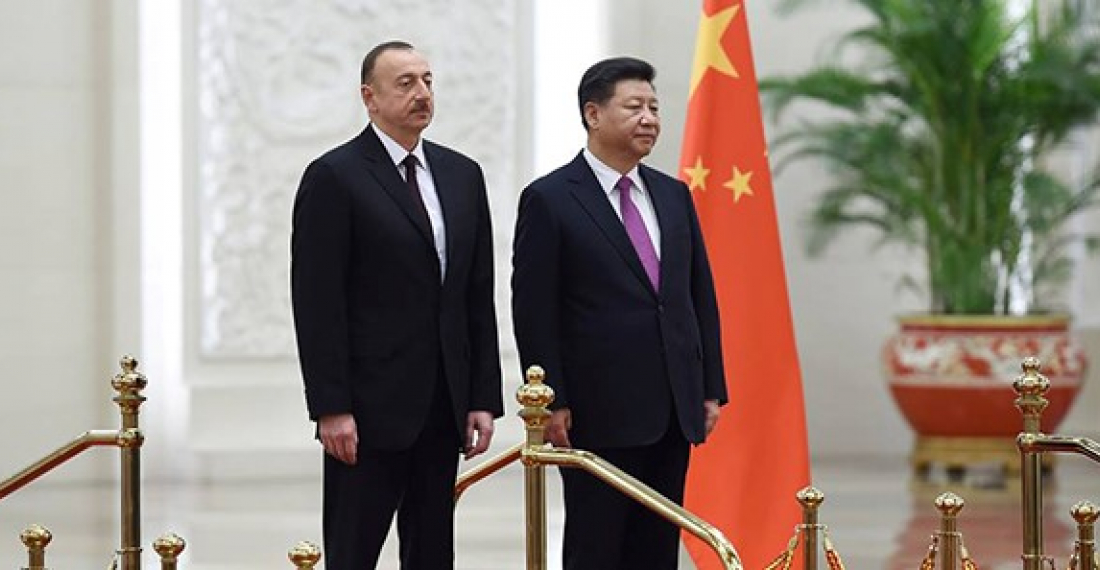
photo: Azerbaijan President Ilham Aliyev is welcomed by Chinese President Xi Jinping. (Archive Photo)
The views expressed in opinion pieces and commentaries do not necessarily reflect the position of commonspace.eu or its partners