Opinion: Kazakhstan’s "Yurts of Invincibility" are more than just a humanitarian initiative for Ukraine

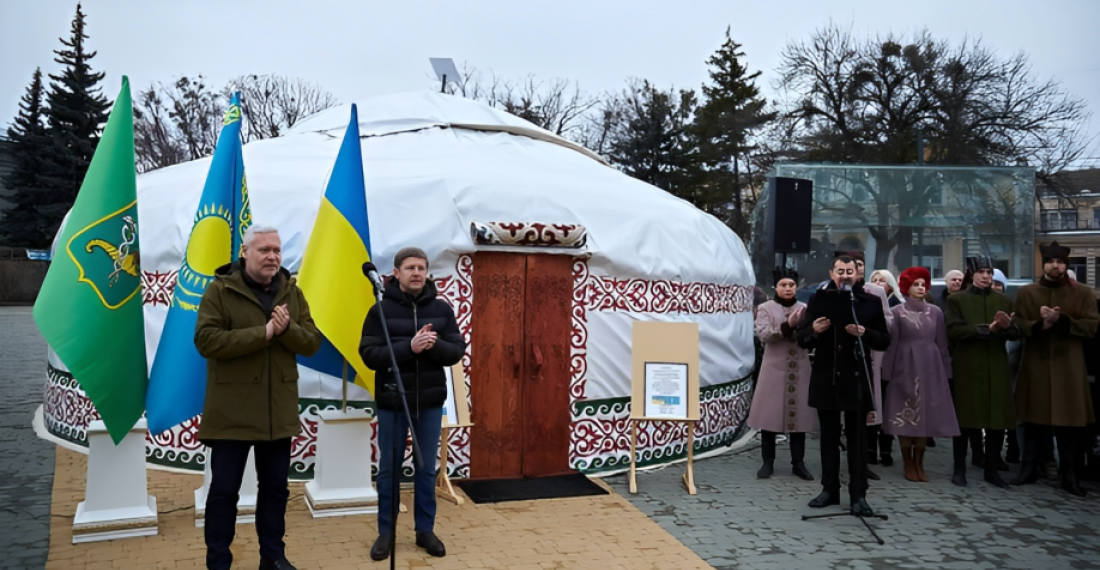
In early January 2023, amid the freezing temperatures and power blackouts of Bucha - the Kyiv suburb now infamous for it being the location of Russian massacres of Ukrainian civilians in early 2022 - there popped up a Kazakh yurt where residents were served free traditional Kazakh food and tea, could keep warm and could charge their electronic devices. Soon after, another yurt appeared in downtown Kyiv. This initiative, dubbed “Yurts of Invincibility”, financed by the Kazakh entrepreneur Daulet Nurzhanov and supported by the Kazakh diaspora, is more than just a humanitarian initiative for Ukrainians, writes commonspace.eu Deputy Editor Patrick Norén. “They are a very telling symbol of change and a poignant message of defiance, strength and confidence for Kazakhs too.”

Whether it be military hardware, humanitarian aid, financial support, or private initiatives, many countries from across the world have pitched in to help Ukraine over the past year. That Kazakhstan is doing the same is in this regard nothing remarkable. The “Yurts of Invincibility” are another gesture of the newfound solidarity that much of the Eurasian space has discovered for the embattled democracy since February 2022, and one which expresses the desire and belief of many countries that Ukraine can and will prevail over Russia. For Ukraine, it is a small gesture but a powerful message that demonstrates that their Kazakh friends are thinking of them and supporting them in their hour of need. 

For Kazakhstan on the other hand, the “Yurts of Invincibility” in Bucha, Kyiv, and most recently Kharkiv, are a cultural symptom of the dramatic shift in Central Asia’s geopolitical reality that has occurred over the past year. Not only a humanitarian gesture to Ukrainians, the “Yurts of Invincibility” are a very telling symbol of change and a poignant message of defiance, strength and confidence for Kazakhs too.

The yurt is perhaps the most enduring symbol of nomadic cultures, for which Central Asia and Kazakhstan in particular is famous. Having suffered during Soviet times, traditional nomadic culture is being increasingly celebrated in Kazakhstan as the country tries to create a strong cultural future entirely separate from the memory of its former imperial oppressor. Kazakhstan’s Ukrainian yurts are also a message to Kazakhs that they can find “invincibility” in the face of an existential threat by rediscovering and reimagining their country’s traditional cultures.

In the words of California-based Kazakh academic Azamat Jurisbai: “Yurts of Invincibility are poignant manifestations of post-colonial solidarity between Kazakhstan and Ukraine [...] As a Qazaq person, I am happy that the traditional nomadic dwellings of my ancestors are going up in Ukraine.” Incidentally, precisely this idea has underpinned the post-Euromaidan Ukrainian cultural revival too.

In other words, seeing their Ukrainian friends’ suffering and recognising their shared struggle against Russian and Soviet rule, Kazakhstan has taken the humble yurt and imbued it with contemporary connotations of strength, defiance, independence, and, yes, invincibility. It is a pointed message for Kazakhs just as much as it is a humanitarian initiative for Ukrainians.

After the yurt in Bucha had been opened, Ukrainian media reported that the project had been supported by the Embassy of Kazakhstan in Kyiv, and that some employees had also come to offer their help. Speaking to Radio Free Europe/Radio Liberty, volunteer Marat Darmenov said that diplomats had indeed come to help in an unofficial capacity as “concerned people”. 

The Russian response to this was somewhat predictable, once more betraying Moscow’s deep insecurities over things the rest of the world would regard as trivial. The Russian Ministry of Foreign Affairs spokeswoman Maria Zakharova said in a statement on 10 January that Moscow expected an official explanation from Kazakhstan about the yurts, “in order to avoid damaging the Russia-Kazakhstan strategic partnership and alliance.” 

One day later, the Kazakh Foreign Ministry spokesman Aibek Smadiyarov, responding to a question from an RFE/RL journalist, gave a response emblematic of the confidence with which Kazakhstan can operate internationally now the country is slipping out from underneath Moscow’s thumb.

“We do not see any problem in setting up a yurt. They set one up, and so what? A yurt is the traditional home of nomads, it is easy to assemble, can easily be moved to a new place and is environmentally friendly. This is probably why Kazakh businessmen chose this type of accommodation. This is a private initiative of Kazakh philanthropists who chose to help the Ukrainian people. We can neither comment on this nor forbid it. We don’t consider it necessary to give a special comment about this because we do not see any problem in setting up this yurt. On the contrary, we are proud that we have the yurt.”

The diplomatic tit-for-tat aside, this small Kazakh initiative taking a symbol of their traditional ancient culture and imbuing it with very different contemporary connotations - and ones that will rankle in Moscow too - is emblematic of the political and cultural changes that Russia’s failing invasion of Ukraine will herald for Kazakhstan and indeed Central Asia as a whole. One should be under no illusions that the Kazakh “Yurts of Invincibility” are in fact just as much a political and cultural message for Kazakhstan as they are a humanitarian initiative for Ukraine.

source: Patrick Norén is the Deputy Editor of commonspace.eu.
photo: Censor.net
The views expressed in opinion pieces and commentaries do not necessarily reflect the position of commonspace.eu or its partners.
 

Related articles

Editor's choice
News
UAE says it will withdraw from Yemen, but division emerges in Yemeni presidential council

UAE says it will withdraw from Yemen, but division emerges in Yemeni presidential council

In a move seen as an attempt to de-escalate a crises with Saudi Arabia, the United Arab Emirates, on Tuesday (30th December) announced that it was heeding a call to withdraw its troops from Southern Yemen. UAE says that its presence included counter-terrorism teams that were crucial in fighting against Islamist groups. UAE sources said that parts of Yemen not controlled by the Houthis have had Al Qaeda in the Arab Peninsula (AQAP) operatives using the territory to launch attacks on Europe, the US and Middle East. UAE teams have co-ordinated with American and British special forces and intelligence. The sources added that Emirati forces and their Yemeni allies also helped reverse Houthi gains in the south. including the liberation of Aden port. The small UAE contingent has remained in place since the UAE withdrew most of its military personnel in 2019. The leading English-language newspaper in Abu Dhabi, The National, said that the main UAE force was based at Riyan Mukalla International Airport, with access to fixed-wing aircraft and helicopters, but also operated smaller contingents in the port town Balhaf and Shabwa. "It is understood it also flew a number of drones from the airbase that were able to track terrorist movements, pass information back to its allies and assisted special forces' missions." Meanwhile a division has emerged in Yemen's presidential council after four members denounced what they called the 'unilateral decisions' by the chairman. Four of Yemen’s eight Presidential Leadership Council members on Tuesday denounced an announcement by the council’s chairman accusing him of breaching the governing agreement. Tension between Yemeni leaders has been rising for weeks, underscoring the fragility of the country's already fractured political landscape and further complicating efforts to confront the Iran-backed Houthi rebels. The latest rift took an unprecedented turn on Tuesday morning, marked by a Saudi-led coalition “limited operation” striking combat vehicles Riyadh linked to the Southern Transitional Council, which has three members in the PLC. The PLC Chairman, Rashad al Alimi, on Tuesday said that he was seeking to cancel the joint defence agreement with the UAE. “What has been issued … constitutes a clear violation of the Declaration of the Transfer of Power [agreement], which explicitly stipulates that the Presidential Leadership Council is a collective body whose decisions are taken by consensus, or by majority when consensus is not possible,” the statement by the four members said. “It does not, under any circumstances, allow for unilateral decision-making on sovereign, military, or major political matters." The statement was signed by STC chief Aidarous Al Zubaidi, Faraj Al Bahsani, Tariq Saleh and Abu Zaraa al Muharrami. (click the picture to read the full article).

Popular

Editor's choice
News
UAE says it will withdraw from Yemen, but division emerges in Yemeni presidential council

UAE says it will withdraw from Yemen, but division emerges in Yemeni presidential council

In a move seen as an attempt to de-escalate a crises with Saudi Arabia, the United Arab Emirates, on Tuesday (30th December) announced that it was heeding a call to withdraw its troops from Southern Yemen. UAE says that its presence included counter-terrorism teams that were crucial in fighting against Islamist groups. UAE sources said that parts of Yemen not controlled by the Houthis have had Al Qaeda in the Arab Peninsula (AQAP) operatives using the territory to launch attacks on Europe, the US and Middle East. UAE teams have co-ordinated with American and British special forces and intelligence. The sources added that Emirati forces and their Yemeni allies also helped reverse Houthi gains in the south. including the liberation of Aden port. The small UAE contingent has remained in place since the UAE withdrew most of its military personnel in 2019. The leading English-language newspaper in Abu Dhabi, The National, said that the main UAE force was based at Riyan Mukalla International Airport, with access to fixed-wing aircraft and helicopters, but also operated smaller contingents in the port town Balhaf and Shabwa. "It is understood it also flew a number of drones from the airbase that were able to track terrorist movements, pass information back to its allies and assisted special forces' missions." Meanwhile a division has emerged in Yemen's presidential council after four members denounced what they called the 'unilateral decisions' by the chairman. Four of Yemen’s eight Presidential Leadership Council members on Tuesday denounced an announcement by the council’s chairman accusing him of breaching the governing agreement. Tension between Yemeni leaders has been rising for weeks, underscoring the fragility of the country's already fractured political landscape and further complicating efforts to confront the Iran-backed Houthi rebels. The latest rift took an unprecedented turn on Tuesday morning, marked by a Saudi-led coalition “limited operation” striking combat vehicles Riyadh linked to the Southern Transitional Council, which has three members in the PLC. The PLC Chairman, Rashad al Alimi, on Tuesday said that he was seeking to cancel the joint defence agreement with the UAE. “What has been issued … constitutes a clear violation of the Declaration of the Transfer of Power [agreement], which explicitly stipulates that the Presidential Leadership Council is a collective body whose decisions are taken by consensus, or by majority when consensus is not possible,” the statement by the four members said. “It does not, under any circumstances, allow for unilateral decision-making on sovereign, military, or major political matters." The statement was signed by STC chief Aidarous Al Zubaidi, Faraj Al Bahsani, Tariq Saleh and Abu Zaraa al Muharrami. (click the picture to read the full article).