US tells Russia in no uncertain terms: Don't do it!

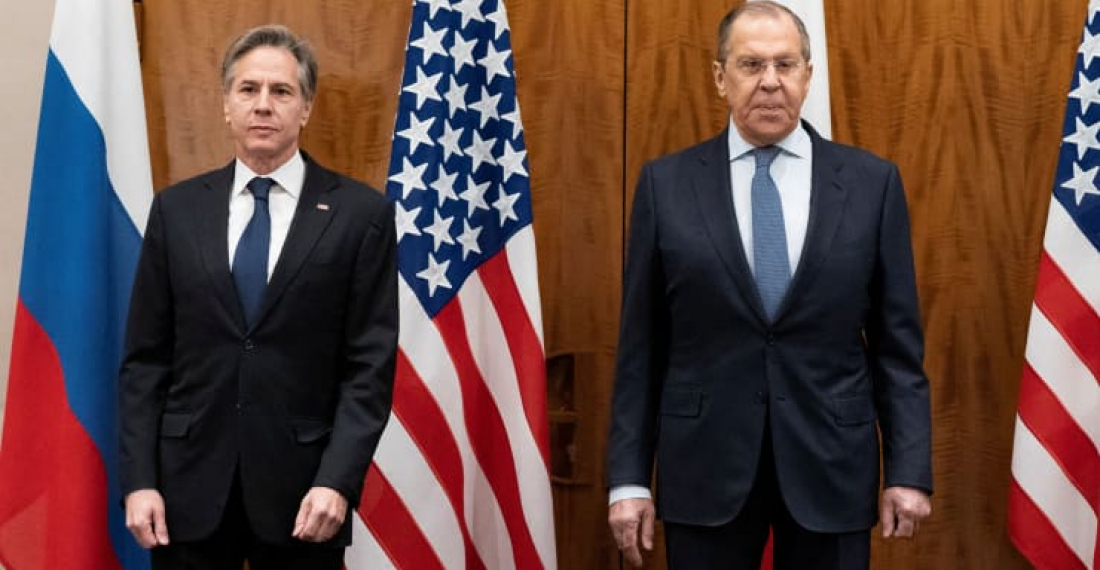
The hastily organised meeting between the US Secretary of State, Antony Blinken and Russia's foreign minister, Sergei Lavrov, took place in Geneva on Friday (21 January). On the agenda was the current tension in Europe provoked by a massive Russian military build up on the borders of Ukraine.

The US, NATO, the EU and their members and partners believe Russia is about to intervene militarily in Ukraine. The message from Blinken to Lavrov on Friday during one and a half hours of talks was clear and simple, "Don't do it, because the consequences will be swift and severe".

Speaking after the meeting Blinken told journalists:

This was not a negotiation but a candid exchange of concerns and ideas.  I made clear to Minister Lavrov that there are certain issues and fundamental principles that the United States and our partners and allies are committed to defend.  That includes those that would impede the sovereign right of the Ukrainian people to write their own future.  There is no trade space there – none.

Blinken told journalists that the preferred route for the US and its European allies and partners was diplomacy, but that if Russia pursued another route the response will be swift and severe:

To the extent that Russia’s engaged for now in diplomacy, but at the same time continues to take escalatory actions, continues to build its forces on Ukraine’s borders, continues to plan for aggressive action against Ukraine, we and all of our allies and partners are equally committed to make sure we are doing everything possible to make clear to Russia that there will be, as I said, a swift, severe, and united response to any form of aggression by Russia directed toward Ukraine.

During the meeting Russia and the US agreed to continue discussions on issues related to the future of European security. Secretary of State Blinken said that he also discussed with Lavrov the way forward:

Let me say as well that he heard from us and from me that what is for us an inviolable rule: nothing about Ukraine without Ukraine, nothing about NATO without NATO, nothing about Europe without Europe.  Based on our discussion, I believe we can carry forward this work of developing understanding agreements together that ensure our mutual security, but that’s contingent on Russia stopping its aggression toward Ukraine. So that’s the choice that Russia faces now.  It can choose the path of diplomacy that can lead to peace and security or the path that will lead only to conflict, severe consequences, and international condemnation.  The United States and our allies and partners in Europe stand ready to meet Russia on either path, and we will continue to stand with Ukraine.

Blinken told journalists that he will now return to Washington to brief president Biden, the National Security Council and Congress, and to hold further consultations with allies.
source: commonspace.eu with the press office of the US Department of State

Related articles

Editor's choice
News
Council of Europe launches new International Claims Commission for Ukraine

Council of Europe launches new International Claims Commission for Ukraine

Thirty-four countries and the European Union have signed a new convention establishing an International Claims Commission for Ukraine at a diplomatic conference co-hosted by the 46-nation Council of Europe and the Netherlands in the Hague. The diplomatic conference was attended by leaders and high-level representatives from over 50 states, including the President of Ukraine, Volodymyr Zelenskyy, the President of the Republic of Moldova, Maia Sandu, and the Prime Minister of the Netherlands, Dick Schoof.  “Today marks a major step forward in ensuring accountability for Ukraine. The International Claims Commission represents justice and hope for tens of thousands of victims—our determination that those who have suffered will not be forgotten. I call for quick ratifications so we can get the commission rapidly up and running for the people of Ukraine,” said Council of Europe Secretary General Alain Berset. Ukrainian President Volodymyr Zelenskyy said: “We expect that every mechanism for compensation from the Register of Damage and Claims Commission to the actual payments – will start working and receive strong and sufficient international support, so that people can truly feel that any kind of damage caused by the war can be compensated. This war, and Russia’s responsibility for it, MUST become a clear example – so that others learn not to choose aggression.” “Accountability is about creating the conditions for peace that endures. And therefore, accountability is a condition of security – today and for the future. But accountability is not only about Ukraine. And it is not only about one aggressor and one victim. Accountability is about Europe. About every country in Europe. It is about whether Europe, as a whole, is willing to defend its peace,” said Maia Sandu, President of the Republic of Moldova, which currently holds the Presidency of the Council of Europe’s Committee of Ministers. The Prime Minister of the Netherlands, Dick Schoof, said: “Every day Russia is deliberately bombarding homes, destroying businesses and damaging infrastructure in Ukraine. Russia must compensate Ukraine for the damage caused. That is why we have launched the International Claims Commission for Ukraine and we are honoured to host it.” The International Claims Commission will be the second part of a comprehensive compensation mechanism related to Russia’s war of aggression, building on the existing Register of Damage for Ukraine. The claims commission will be established within the framework of the Council of Europe and will also be open to other countries. The Register of Damage for Ukraine, created in 2023, collects and records compensation claims submitted by individuals, organisations and public bodies in Ukraine. Forty-four states and the European Union have so far joined the Register, which has already received 86,000 claims. The International Claims Commission will review, assess and decide upon claims submitted to the Register of Damage for Ukraine and determine the amount of compensation, if any, which is due in each case. The convention establishing the commission will enter into force once it has been ratified by 25 signatories, as long as sufficient funds have been secured to support its initial work.

Popular

Editor's choice
News
Council of Europe launches new International Claims Commission for Ukraine

Council of Europe launches new International Claims Commission for Ukraine

Thirty-four countries and the European Union have signed a new convention establishing an International Claims Commission for Ukraine at a diplomatic conference co-hosted by the 46-nation Council of Europe and the Netherlands in the Hague. The diplomatic conference was attended by leaders and high-level representatives from over 50 states, including the President of Ukraine, Volodymyr Zelenskyy, the President of the Republic of Moldova, Maia Sandu, and the Prime Minister of the Netherlands, Dick Schoof.  “Today marks a major step forward in ensuring accountability for Ukraine. The International Claims Commission represents justice and hope for tens of thousands of victims—our determination that those who have suffered will not be forgotten. I call for quick ratifications so we can get the commission rapidly up and running for the people of Ukraine,” said Council of Europe Secretary General Alain Berset. Ukrainian President Volodymyr Zelenskyy said: “We expect that every mechanism for compensation from the Register of Damage and Claims Commission to the actual payments – will start working and receive strong and sufficient international support, so that people can truly feel that any kind of damage caused by the war can be compensated. This war, and Russia’s responsibility for it, MUST become a clear example – so that others learn not to choose aggression.” “Accountability is about creating the conditions for peace that endures. And therefore, accountability is a condition of security – today and for the future. But accountability is not only about Ukraine. And it is not only about one aggressor and one victim. Accountability is about Europe. About every country in Europe. It is about whether Europe, as a whole, is willing to defend its peace,” said Maia Sandu, President of the Republic of Moldova, which currently holds the Presidency of the Council of Europe’s Committee of Ministers. The Prime Minister of the Netherlands, Dick Schoof, said: “Every day Russia is deliberately bombarding homes, destroying businesses and damaging infrastructure in Ukraine. Russia must compensate Ukraine for the damage caused. That is why we have launched the International Claims Commission for Ukraine and we are honoured to host it.” The International Claims Commission will be the second part of a comprehensive compensation mechanism related to Russia’s war of aggression, building on the existing Register of Damage for Ukraine. The claims commission will be established within the framework of the Council of Europe and will also be open to other countries. The Register of Damage for Ukraine, created in 2023, collects and records compensation claims submitted by individuals, organisations and public bodies in Ukraine. Forty-four states and the European Union have so far joined the Register, which has already received 86,000 claims. The International Claims Commission will review, assess and decide upon claims submitted to the Register of Damage for Ukraine and determine the amount of compensation, if any, which is due in each case. The convention establishing the commission will enter into force once it has been ratified by 25 signatories, as long as sufficient funds have been secured to support its initial work.