Trump lashes out at both Zelensky and Putin over ceasefire talks

US President Donald Trump lashed out at the leaders of both warring parties in Russia's invasion of Ukraine, expressing frustration as efforts to kick-start ceasefire talks remain deadlocked. Trump is trying to broker a ceasefire between Ukraine and its Russian invader, and has been pushing Zelensky to sign an agreement to give US firms exclusive access to Ukrainian rare earth minerals.

Trump first criticised Russian President Vladimir Putin for questioning the credibility of Ukraine's Volodymyr Zelensky as a negotiating partner, saying he was "very angry, pissed off" with the Kremlin chief. But the US leader later softened his tone on Putin and instead turned his ire on Zelensky, warning him Ukraine would have "big, big problems" if he got cold feet over a deal to sign over mineral rights to the United States.

Earlier, NBC News journalist Kristen Welker said Trump had called her to express his fury over Putin questioning Zelensky's future - something Trump himself has done - and threatening secondary tariffs on firms dealing in Russian oil. Later, Trump spoke to reporters on his plane flying back to Washington from his Mar-a-Lago resort in Florida, and toned down some of his criticism.  

Trump then turned his fire on Zelensky, saying: "I see he's trying to back out of the rare earth deal. And if he does that, he's got some problems. Big, big problems. "We made a deal on rare earth, and now he's saying, well, you know, I want to renegotiate the deal. He wants to be a member of NATO. Well, he was never going to be a member of NATO. He understands that. So if he's looking to renegotiate the deal, he's got big problems."

The US president has been pushing for a speedy end to the more than three-year war since taking office, but his administration has failed to reach a breakthrough despite negotiations with both sides. Putin rejected a joint US-Ukrainian plan for a 30-day ceasefire, and on Friday suggested Zelensky be removed from office as part of the peace process.

Warming ties between Washington and Moscow since Trump's return to office and his threats to stop supporting Kyiv have bolstered Russia on the battlefield as it pursues its floundering invasion. Ukraine has accused Russia of dragging out talks with no intention of halting its offensive, with fresh attacks on the northeastern border city of Kharkiv.

Six strikes hit overnight Saturday into Sunday, wounding personnel undergoing treatment at a military hospital and killing at least two people in a residential building, according to Ukrainian officials. Russian forces also captured a village just seven kilometers from the border of Ukraine's central Dnipropetrovsk region in their latest advance, Moscow said Sunday.

The Kremlin's troops have not crossed the boundary of the region since their offensive began in 2022, but they have been grinding toward it for months in the hope of a breakthrough. Putin, in power for 25 years and repeatedly elected in votes with no competition, has often questioned Zelensky's "legitimacy" as president, after the Ukrainian leader's initial five-year mandate ended in May 2024.

Under Ukrainian law, elections are suspended during times of major military conflict, and Zelensky's domestic opponents have all said no ballots should be held until after the conflict.
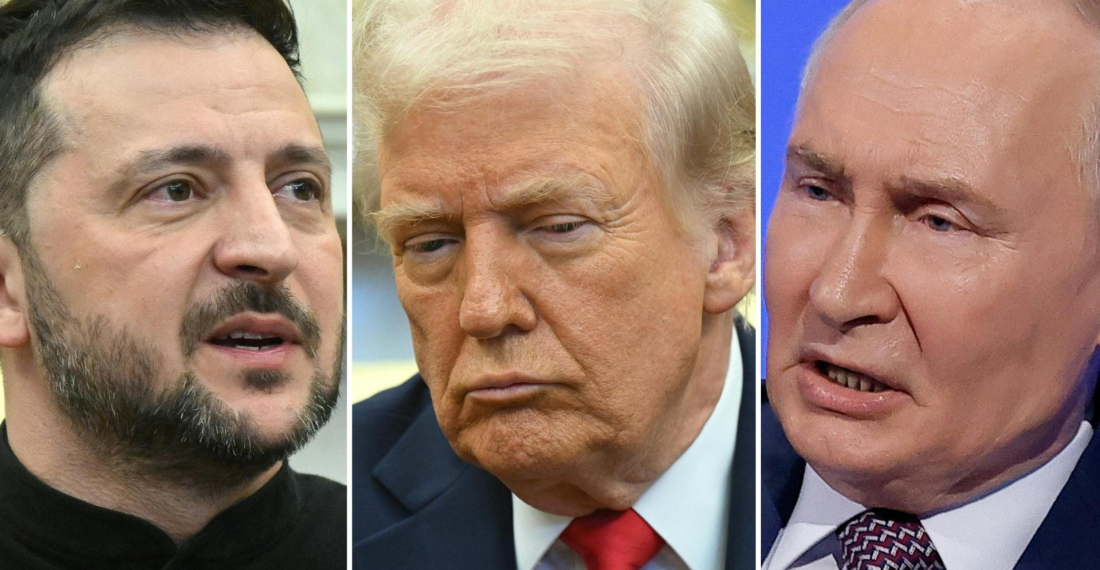
Source: commonspace.eu with agencies. Photo: IPIAFP file photos: Ukraine's President Volodymyr Zelensky, US President Donald Trump, Russian President Vladimir Putin

Related articles

Editor's choice
News
Borrell tells the European Parliament that the situation in Afghanistan was critical, but the EU will remain engaged

Borrell tells the European Parliament that the situation in Afghanistan was critical, but the EU will remain engaged

Borrell underlined that the European Union will make every effort to support the peace process and to remain a committed partner to the Afghan people. "Of course, we will have to take into account the evolving situation, but disengagement is not an option.  We are clear on that: there is no alternative to a negotiated political settlement, through inclusive peace talks.
Editor's choice
News
Germany accuses Russia of cyberattacks and disinformation campaign

Germany accuses Russia of cyberattacks and disinformation campaign

The German government holds Russia responsible for a cyberattack on German air traffic control, and for targeted disinformation campaigns before the last federal election. According to the German Foreign Office in Berlin, the incidents could be clearly attributed to the Russian military intelligence service, the GRU. In response, the Russian ambassador to Berlin was summoned to the Foreign Ministry. "We have been observing a massive increase in threatening hybrid activities by Russia for some time now," a spokesperson for the Foreign Ministry stated. These range from disinformation campaigns and espionage to cyberattacks and sabotage attempts. The aim is to divide society, sow distrust, and undermine confidence in democratic institutions. The spokesperson added that with these actions, Russia is "very concretely threatening our security, not only through its war of aggression against Ukraine, but also here in Germany."  The Foreign Ministry spokesperson explained that the cyberattack on air traffic control in August 2024 was clearly attributed to the hacker collective "APT28," known as "Fancy Bear," and to the responsibility of the Russian military intelligence service, the GRU. Furthermore, it could now be "conclusively stated" that Russia had attempted "to influence and destabilize both the last Federal election and the ongoing internal affairs of the Federal Republic of Germany." There was "absolutely irrefutable evidence" for this". The so-called "Storm 1516" campaign, which has been running since 2024, is allegedly backed by "reliable information" that the Moscow-based think tank "Center for Geopolitical Expertise" is behind it. The Center is also said to be supported by Russian military intelligence. Its primary aim is to influence democratic elections in the West. (Click the image to read more).

Popular

Editor's choice
News
Germany accuses Russia of cyberattacks and disinformation campaign

Germany accuses Russia of cyberattacks and disinformation campaign

The German government holds Russia responsible for a cyberattack on German air traffic control, and for targeted disinformation campaigns before the last federal election. According to the German Foreign Office in Berlin, the incidents could be clearly attributed to the Russian military intelligence service, the GRU. In response, the Russian ambassador to Berlin was summoned to the Foreign Ministry. "We have been observing a massive increase in threatening hybrid activities by Russia for some time now," a spokesperson for the Foreign Ministry stated. These range from disinformation campaigns and espionage to cyberattacks and sabotage attempts. The aim is to divide society, sow distrust, and undermine confidence in democratic institutions. The spokesperson added that with these actions, Russia is "very concretely threatening our security, not only through its war of aggression against Ukraine, but also here in Germany."  The Foreign Ministry spokesperson explained that the cyberattack on air traffic control in August 2024 was clearly attributed to the hacker collective "APT28," known as "Fancy Bear," and to the responsibility of the Russian military intelligence service, the GRU. Furthermore, it could now be "conclusively stated" that Russia had attempted "to influence and destabilize both the last Federal election and the ongoing internal affairs of the Federal Republic of Germany." There was "absolutely irrefutable evidence" for this". The so-called "Storm 1516" campaign, which has been running since 2024, is allegedly backed by "reliable information" that the Moscow-based think tank "Center for Geopolitical Expertise" is behind it. The Center is also said to be supported by Russian military intelligence. Its primary aim is to influence democratic elections in the West. (Click the image to read more).