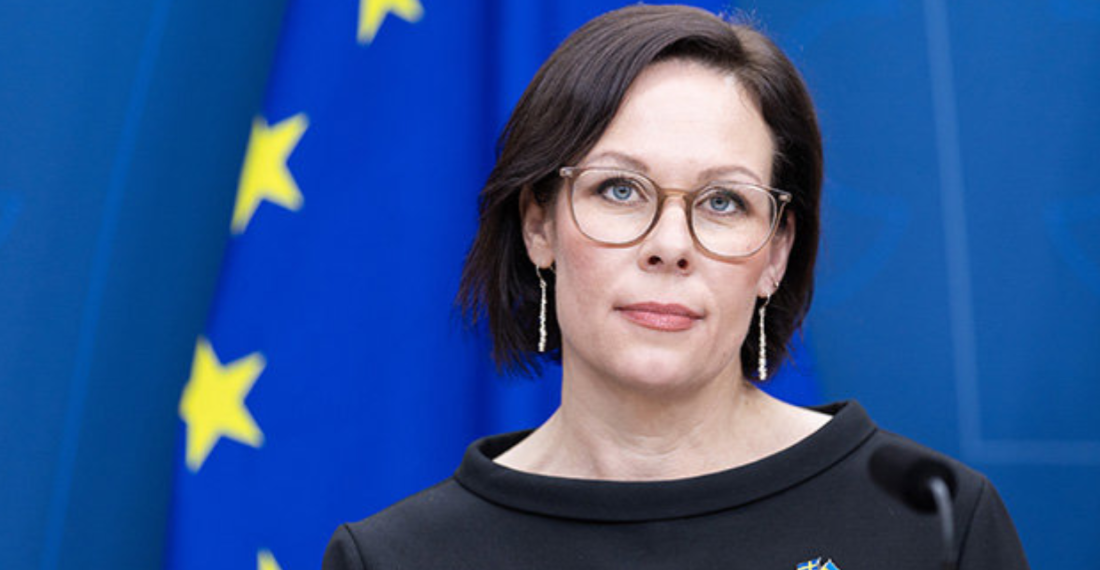
The European Union should harden its stance against Israel and follow in the footsteps of the United Kingdom and other Western allies by issuing sanctions against far-right members of Israeli Prime Minister Benjamin Netanyahu’s Cabinet, Sweden’s foreign minister told Politico. Maria Malmer Stenergard said after meeting in Brussels with Kaja Kallas, the EU’s top diplomat, that the EU now needs to take a stronger position and increase pressure on the Israeli government.
Brussels has so far stopped short of echoing sanctions recently announced by the U.K., Canada and Australia, which target Israeli National Security Minister Itamar Ben-Gvir and Finance Minister Bezalel Smotrich, accusing both of inciting extremist violence and abuses of Palestinian human rights.
“We have also been pushing for the sanctioning of extremist settlers, but we now take the next step to also push for sanctioning individual extremist ministers, because we need to see things happening on the ground,” Malmer Stenergard said.
In order to pass sanctions against Israeli government ministers, the EU would need unanimous backing from its 27 member countries. That is noiit going to happen easily due to expected opposition from staunch backers of Israel such as Hungary.
The political mood toward Israel has been shifting in recent weeks, with a majority of countries, including France and Germany, throwing their weight behind a Dutch-led call last month to review the EU-Israel Association Agreement over the humanitarian situation caused by Israel’s actions in Gaza.
“The mood toward Israel sounds a lot different now than it did only a couple of weeks ago and this is due to the fact that so many countries like Sweden are frustrated to see the suffering of the millions,” Malmer Stenergard added as quoted by Politico.
While acknowledging that the EU is unlikely to reach unanimous agreement on sanctions in the short term, she added that “we’ve seen a shift in many capitals, including in Stockholm. And I want to emphasize that we are true friends of the Israeli people, but it is still our obligation to put pressure now on the Israeli government.”
Malmer Stenergard pressed this view in a letter addressed to Kallas, seen by Politico, in which she asked that the European Council “urgently decide on targeted sanctions against Israeli ministers who promote illegal settlement activities and actively work against a negotiated two-state solution, and additional sanctions against extremist settlers.”
In a briefing last week, European Council President António Costa said he expected the review would find that Israel had fallen short of its humanitarian obligations. The next steps, however, remain to be seen: The Swedish minister said she expected to see “proposals” on what to do next if Israel fell short.
Another matter of concern, according to Politico, is the U.S. sanctions against four judges from the International Criminal Court over what President Donald Trump’s administration claimed was their politicized approach to justice.
Malmer Stenergard said Stockholm was “willing to explore” an EU blocking statute that would block U.S. sanctions. “I know that the host nation, the Netherlands, is also looking into ways to make sure that the sanctioned judges can carry on their important work, and we support that.”
Any EU-level action against the Israeli ministers is likely to cause further conflict with the U.S., which on Tuesday sent a diplomatic démarche discouraging governments from participating in an upcoming UN conference on the two-state solution, Reuters reported. The communication warned of diplomatic consequences for acting against U.S. foreign policy interests.
Source: commonspace.eu with Politico , Reuters and agencies. Photo: Swedish Foreign Minister Maria Malmer Stenergard /Sweden Foreign Ministry