Protests grow in Türkiye over detention of Istanbul mayor

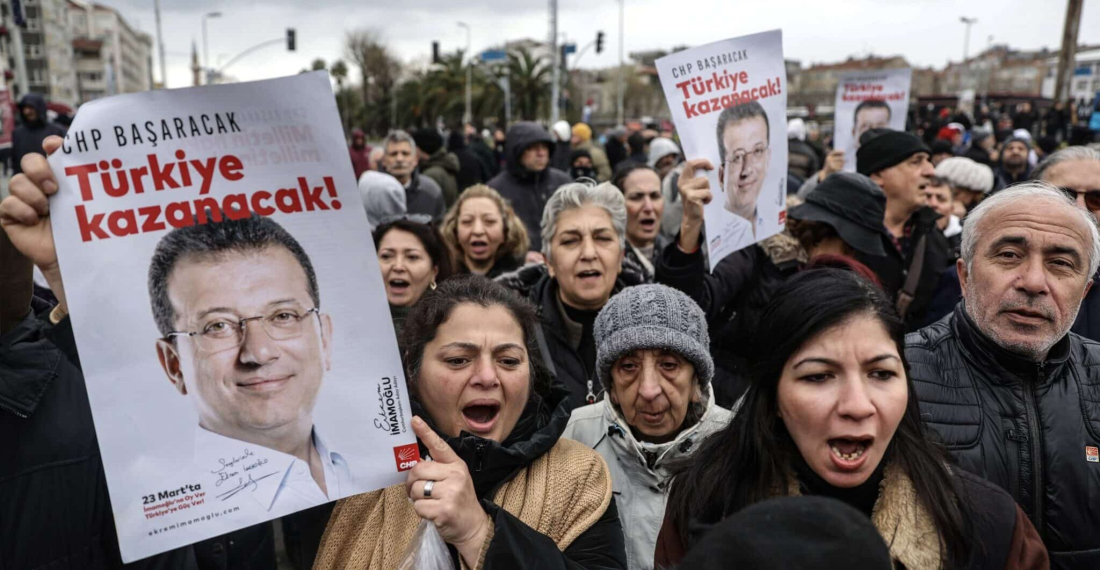
Istanbul Mayor Ekrem Imamoglu appeared before police for questioning on terror-related charges on Saturday, a day after his interrogation over corruption allegations. His arrest this week has sparked widespread protests across Türkiye, with demonstrators rallying in multiple cities to voice their opposition. The mayor, who is a popular opposition figure and seen as a top challenger to President Recep Tayyip Erdogan, was detained on Wednesday following a dawn raid on his residence over allegations of financial crimes and links to Kurdish militants.

Turkish Interior Minister Ali Yerlikaya posted on social media that 343 suspects had been detained in protests in major cities on Friday night, adding “There will be no tolerance for those who seek to violate societal order, threaten the people’s peace and security, and pursue chaos and provocation.” The cities listed included Istanbul, Ankara, Izmir, Adana, Antalya, Canakkale, Eskisehir, Konya and Edirne.

Dozens of other prominent figures, including two district mayors, were also detained. Many view the arrest as a politically driven attempt to remove a popular opposition figure and key challenger to Erdogan in the next presidential race, currently scheduled for 2028. Government officials reject accusations that legal actions against opposition figures are politically motivated and insist that Türkiye’s courts operate independently.

On Saturday, police questioned Imamoglu for some five hours as part of an investigation into allegations of aiding the outlawed Kurdistan Workers’ Party, or PKK, the Cumhuriyet newspaper reported. A day earlier he was questioned for four hours over the corruption accusations. The mayor rejected all charges during both interrogations. He was expected to be transferred to a courthouse later on Saturday for questioning by prosecutors and to face possible charges.

His arrest has ignited protests that have steadily increased in intensity. On Friday, police in Istanbul used pepper spray, tear gas and rubber bullets to push back hundreds of protesters who tried to break through a barricade in front of the city’s historic aqueduct while hurling flares, stones and other objects at officers. Police also dispersed groups that had rallied outside of the city hall for a third night running, after the opposition Republican People’s Party leader, Ozgur Ozel, delivered a speech in support of the mayor.

Simultaneously, police broke up demonstrations in Ankara, the capital, as well as in the Aegean coastal city of Izmir, resorting to forceful measures at times, according to television images. Thousands marched in several other cities calling on the government to resign.

Earlier, Erdogan said the government would not tolerate street protests and accused the opposition party of links to corruption and terror organizations. Authorities in Ankara and Izmir meanwhile announced a five-day ban on demonstrations, following a similar measure imposed earlier in Istanbul.

In a message posted on his social media account Saturday, Imamoglu described his arrest as a “coup” and accused the government of exploiting the judiciary and worsening the country’s troubled economy. “With your support, we will first defeat this coup, and then we will send packing those who caused this,” he wrote on the social media platform X.
Source: commonspace.eu with agencies. Photo: Supporters shout slogans and hold posters depicting Istanbul Mayor Ekrem Imamoglu near the Istanbul Police Department following Imamoglu’s arrest, 19 March 2025. Photo: EPA-EFE/ERDEM SAHIN

Related articles

Editor's choice
News
Borrell tells the European Parliament that the situation in Afghanistan was critical, but the EU will remain engaged

Borrell tells the European Parliament that the situation in Afghanistan was critical, but the EU will remain engaged

Borrell underlined that the European Union will make every effort to support the peace process and to remain a committed partner to the Afghan people. "Of course, we will have to take into account the evolving situation, but disengagement is not an option.  We are clear on that: there is no alternative to a negotiated political settlement, through inclusive peace talks.
Editor's choice
News
Germany accuses Russia of cyberattacks and disinformation campaign

Germany accuses Russia of cyberattacks and disinformation campaign

The German government holds Russia responsible for a cyberattack on German air traffic control, and for targeted disinformation campaigns before the last federal election. According to the German Foreign Office in Berlin, the incidents could be clearly attributed to the Russian military intelligence service, the GRU. In response, the Russian ambassador to Berlin was summoned to the Foreign Ministry. "We have been observing a massive increase in threatening hybrid activities by Russia for some time now," a spokesperson for the Foreign Ministry stated. These range from disinformation campaigns and espionage to cyberattacks and sabotage attempts. The aim is to divide society, sow distrust, and undermine confidence in democratic institutions. The spokesperson added that with these actions, Russia is "very concretely threatening our security, not only through its war of aggression against Ukraine, but also here in Germany."  The Foreign Ministry spokesperson explained that the cyberattack on air traffic control in August 2024 was clearly attributed to the hacker collective "APT28," known as "Fancy Bear," and to the responsibility of the Russian military intelligence service, the GRU. Furthermore, it could now be "conclusively stated" that Russia had attempted "to influence and destabilize both the last Federal election and the ongoing internal affairs of the Federal Republic of Germany." There was "absolutely irrefutable evidence" for this". The so-called "Storm 1516" campaign, which has been running since 2024, is allegedly backed by "reliable information" that the Moscow-based think tank "Center for Geopolitical Expertise" is behind it. The Center is also said to be supported by Russian military intelligence. Its primary aim is to influence democratic elections in the West. (Click the image to read more).

Popular

Editor's choice
News
Germany accuses Russia of cyberattacks and disinformation campaign

Germany accuses Russia of cyberattacks and disinformation campaign

The German government holds Russia responsible for a cyberattack on German air traffic control, and for targeted disinformation campaigns before the last federal election. According to the German Foreign Office in Berlin, the incidents could be clearly attributed to the Russian military intelligence service, the GRU. In response, the Russian ambassador to Berlin was summoned to the Foreign Ministry. "We have been observing a massive increase in threatening hybrid activities by Russia for some time now," a spokesperson for the Foreign Ministry stated. These range from disinformation campaigns and espionage to cyberattacks and sabotage attempts. The aim is to divide society, sow distrust, and undermine confidence in democratic institutions. The spokesperson added that with these actions, Russia is "very concretely threatening our security, not only through its war of aggression against Ukraine, but also here in Germany."  The Foreign Ministry spokesperson explained that the cyberattack on air traffic control in August 2024 was clearly attributed to the hacker collective "APT28," known as "Fancy Bear," and to the responsibility of the Russian military intelligence service, the GRU. Furthermore, it could now be "conclusively stated" that Russia had attempted "to influence and destabilize both the last Federal election and the ongoing internal affairs of the Federal Republic of Germany." There was "absolutely irrefutable evidence" for this". The so-called "Storm 1516" campaign, which has been running since 2024, is allegedly backed by "reliable information" that the Moscow-based think tank "Center for Geopolitical Expertise" is behind it. The Center is also said to be supported by Russian military intelligence. Its primary aim is to influence democratic elections in the West. (Click the image to read more).