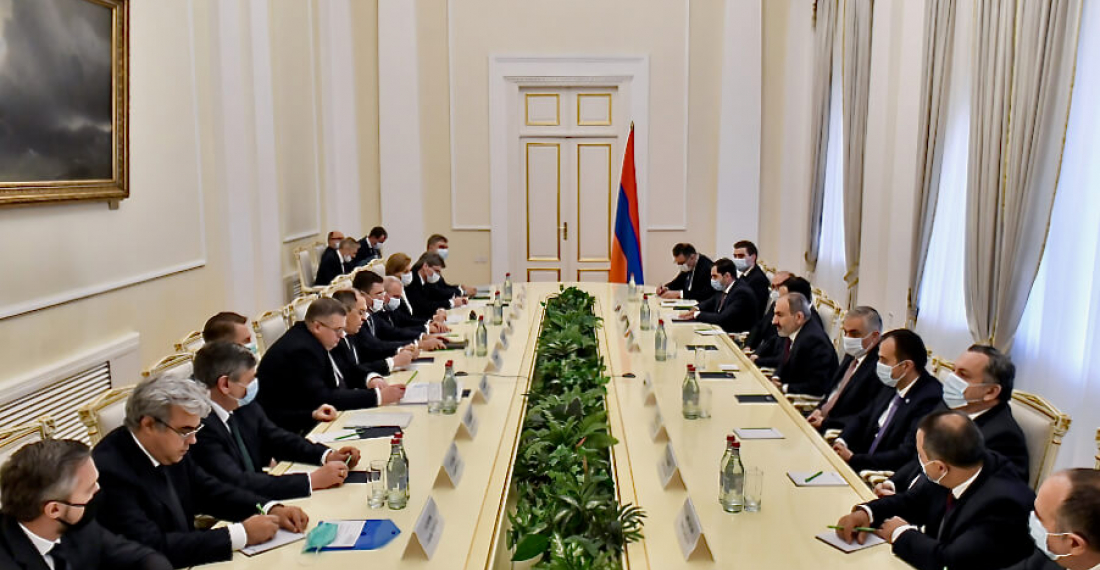
It felt as if Russian Ministers were raining on the South Caucasus on Saturday (21 November) as different members of the Russian government descended on Yerevan and Baku to consolidate Moscow's gains in the region following the Karabakh War.
Among those arriving was Defence Minister Sergei Shoigu, Foreign Minister Sergei Lavrov, Deputy Prime Minister of the Russian Federation Alexei Overchuk, Head of the Ministry of Health of the Russian Federation Mikhail Murashko, head of Rospotrebnadzor Anna Popova,and Emergency Situations Minister, Yevgeny Zinichev.
The Ministers appeared arrive seperately or in groups, and held one to one meetings with counterparts, as well as in groups.
Their mission appears to be to quickly consolidate Russia's success in securing the agreement of Armenia and Azerbaijan to end the Karabakh War and deploy a military force to oversee the new Russian peace.
On Friday (20 November) Vladimir Putin convened another meeting of senior Russian ministers to discuss the Karabakh situation.
Conflicts like this, their settlement is particularly important to us. It has special significance for us and plays a special role. These are not empty words for us. I am referring to the fact that millions of Armenians and Azerbaijanis live in Russia. We are linked with their republics by centuries-long ties, without exaggeration. This also has a domestic political dimension for us and is very important for our domestic security and politics. The CIS is our foreign policy priority, an obvious fact for everyone. This matters a lot for the economy as well. We all know well that we have special relations with these republics: deep cooperation and interchangeability. I will not list all the components of this extremely important direction on the CIS track.
Putin said the priority task is to support and help the residents of this region who sustained heavy damage from the hostilities:
"An Interdepartmental Centre for Humanitarian Response is being created to resolve the problems at hand. I am aware that, given the tasks facing the centre, specialised divisions are now being formed.
I would like to take this opportunity to point out the precise and well-coordinated work of the Russian peacekeepers. Prompt demining has made it possible to establish reliable communications in the region, and deploying our peacekeeping forces made it possible to stop the bloodshed and avoid more casualties. Our military is maintaining effective control over the ceasefire, which is being observed by both sides. Overall, the situation has stabilised. In addition, the Russian service personnel is escorting refugees and bringing residential buildings, roads, and social facilities up to code. They are ensuring security for convoys with humanitarian supplies as well.
Let me emphasise that our humanitarian efforts and aid should benefit both the Armenian and Azerbaijani peoples. We empathise with everyone who is in trouble.
You may be aware that I am in constant touch with my colleagues in Armenia and Azerbaijan. I agreed with both leaders that a Russian interdepartmental delegation consisting of the heads of a number of ministries and departments would be sent to Armenia and Azerbaijan soon. Its goal is to review the most pressing issues of implementing the trilateral statement of November 9, including, of course, humanitarian issues. I hope that the upcoming consultations will help us make significant progress in these areas.
Mobilisation and international assistance are of particular importance. Our peacekeepers have created the basis for this. I am aware that people in many countries are concerned about the situation in Nagorno-Karabakh and empathise with the people in this plight. However, safe conditions for humanitarian organisations have been created, and there remains much to accomplish."
source: commonspace.eu with kremlin.ru and agencies
photo: Russian Ministers meet Armenian prime minister Nikol Pashinyan and other officials during their visit to Yerevan on 21 November 2020 (picture courtesy of Armenpress, Yerevan)