


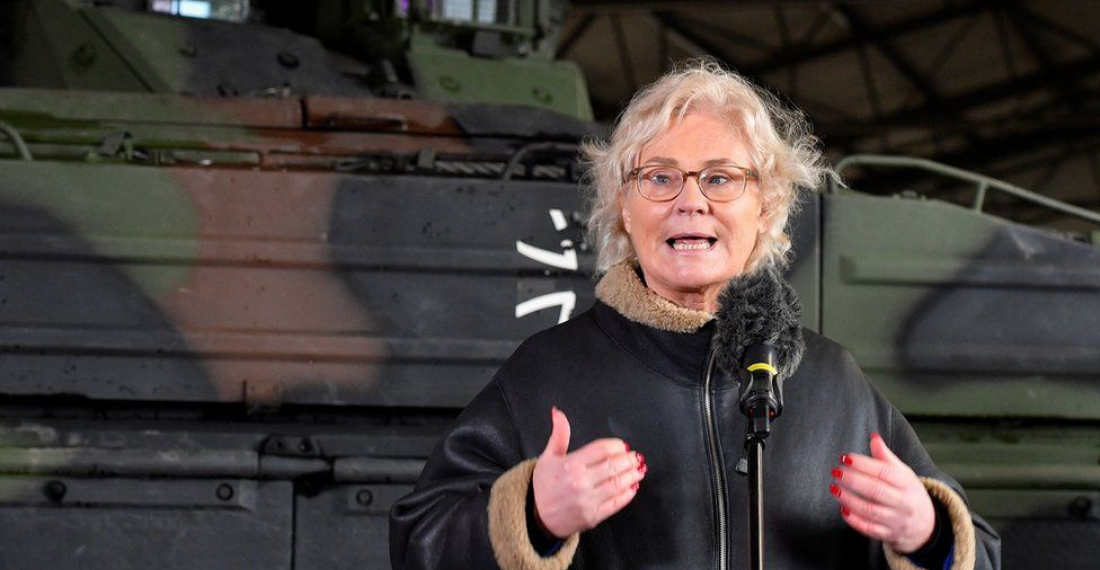
German Defence Minister Christine Lambrecht resigns

The German Defence Minister Christine Lambrecht has resigned after months of criticism over her handling of the German response to Russia's full-scale invasion of Ukraine.

In a resignation statement, Ms Lambrecht said: "Months of media focus on me doesn't allow for fact-based reporting and discussion about soldiers, the army and security policy in the interest of German citizens [...] The valuable work of the soldiers and many motivated people in the defence area needs to be in the foreground."

The formal announcement on Monday (16 January) ended last week's speculation that Ms. Lambrecht intended to resign following a New Year's Eve message criticised as "tone-deaf".

In the short video, the former Defence Minister spoke about the positive personal encounters she had experienced during the "war raging in the middle of Europe", barely audible over the sound of fireworks exploding around her.

In January last year, some four-weeks before Russia's 24 February invasion, Ms. Lambrecht was also ridiculed when she announced that Germany would send Ukraine 5,000 military helmets amid fears of a full-scale invasion, arguing that the offer sent "a very clear signal: we are on your side". Before that announcement, Ukraine's ambassador in Berlin had urged the German government to send at least 100,000 helmets and protective vests.

She has also been widely criticised for failing to improve Germany's armed forces, described by the BBC's Berlin correspondent Jenny Hill as "notoriously ill-equipped". This was despite a €100bn fund being announced by Chancellor Olaf Scholz in a speech on 27 February.

Last month during a training exercise, 18 Puma infantry vehicles deployed had to be withdrawn from service because of technical difficulties, despite them being one of the military's most advanced pieces of equipment.

Furthermore, in May last year she came under fire after it emerged that she had taken her 21-year old son for a ride in a military helicopter. At the time, the defence ministry insisted that they had travelled together and denied that it was a private trip.

Ms. Lambrecht's resignation comes as Germany is facing renewed pressure to approve the re-export of the German-built Leopard 2 tanks.

Berlin has so far resisted calls to approve the export, arguing that western tanks should only be supplied to Ukraine if an agreement can be reached among Kyiv's allies, including the USA.
source: commonspace.eu with BBC, Deutsche Welle, Euronews, The Guardian
photo: Reuters

Related articles

Editor's choice
News
European leaders set out their plan for Ukraine

European leaders set out their plan for Ukraine

The leaders of Germany, Denmark, Finland, France, Italy, Netherlands, Norway, Poland, Sweden, and United Kingdom, together with the President of the European Council, and the President of the European Commission, o  Monday (15 December) issued a statement, outlining their plan for Ukraine. In their statement, Chancellor Merz, Prime Minister Frederiksen, President Stubb, President Macron, Prime Minister Meloni, Prime Minister Schoof, Prime Minister Støre, Prime Minister Tusk, Prime Minister Kristersson, Prime Minister Starmer, as well as President Costa and President von der Leyen spoke about "Peace for Ukraine". The Leaders welcomed significant progress on President Trump’s efforts to secure a just and lasting peace in Ukraine. They also welcomed the close work between President Zelenskyy’s and President Trump’s teams as well as European teams over the recent days and weeks. They agreed to work together with President Trump and President Zelenskyy to get to a lasting peace which preserves Ukrainian sovereignty and European security. Leaders appreciated the strong convergence between the United States, Ukraine and Europe. Leaders agreed that ensuring the security, sovereignty, and prosperity of Ukraine was integral for wider Euro-Atlantic security. They were clear that Ukraine and its people deserved a prosperous, independent, and sovereign future, free from fear of future Russian aggression. Both the US and European leaders committed to work together to provide robust security guarantees and economic recovery support measures for Ukraine in the context of an agreement on ending the war. This would include commitments to: Provide sustained and significant support to Ukraine to build its armed forces, which should remain at a peacetime level of 800,000 to be able to deter conflict and defend Ukraine’s territory. A European-led ‘multinational force Ukraine’ made up from contributions from willing nations within the framework of the Coalition of the Willing and supported by the US. It will assist in the regeneration of Ukraine’s forces, in securing Ukraine’s skies, and in supporting safer seas, including through operating inside Ukraine. (Click the image to read the statement in full).

Popular

