


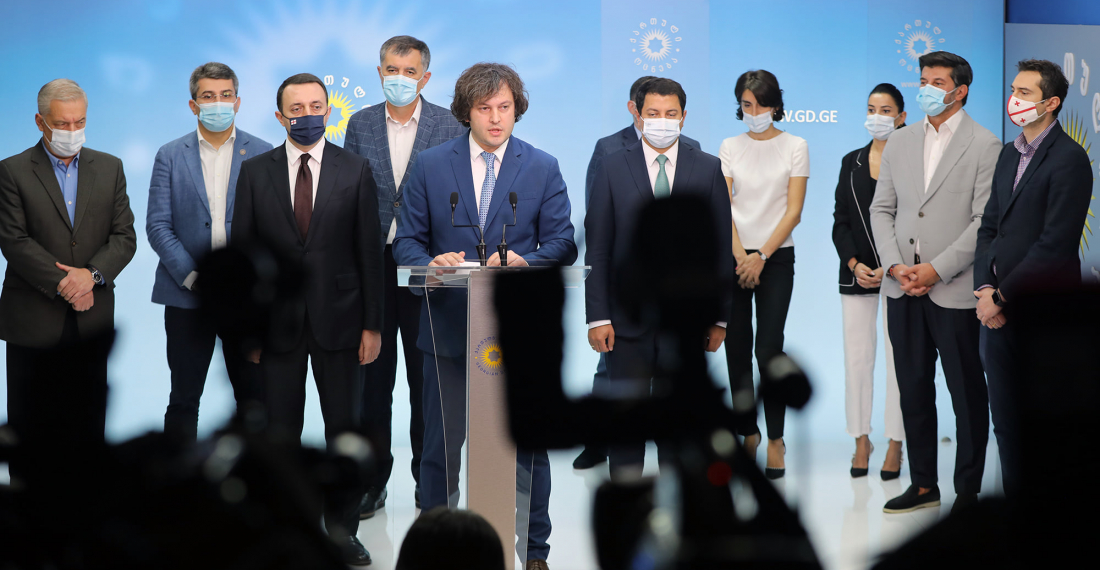
Georgian opposition outraged as ruling party tears up EU brokered deal

It always looked wobbly, and with little chance that it would succeed in resolving Georgia's deep political crisis. But on Wednesday (28 July), the ruling Georgian Dream (GD) party finally sunk the so called "Michel Agreement" signed with much fanfare on 19 April. The Georgian opposition is outraged, and things are back to square one, if not worse.

Georgian Dream party chair Irakli Kobakhidze announced the EU-brokered April 19 deal as “annulled,” claiming it “served its mission and exhausted itself” 100 days after signing..

“We can see our international partners do not find it necessary to strictly demand from the radical opposition to sign and participate in implementing the document,” said MP Kobakhidze. “One-sided loyalty to the April 19 agreement is insulting for our party, and our voters will not forgive us this.”

Kobakhidze pointed out that the opposition parties that had signed the agreement received only 10% of the votes in the October 2020 parliamentary elections, while the electoral bloc led by the largest opposition United National Movement party, as well as the Alliance of Patriots, European Georgia and Labor party, the four opposition groups that received parliamentary mandates, refused to join the deal. 

The decision leaves a number of political parties and individual MPs who had signed the agreement in a very difficult position.

David Bakradze, a moderate opposition politician said the Georgian Dream has officially ended the opportunity to move the country forward through reforms and the country is facing a new, acute threat of civil and political confrontation.

"After many months of political crisis, the April 19 agreement created an opportunity to end the crisis, get the country out of the phase of the sharpest confrontation, open the parliament and, together with our European and American partners, move forward through agreed reforms and steps. Unfortunately, today the Georgian Dream has officially ended this opportunity - the country, already in a swamp of polarization and violence, is facing a new, acute threat of civil and political confrontation.

No less alarming is the fact that this decision could significantly damage our relationship with our European and American allies. Any such confrontation poses a problem for the country's European and Euro-Atlantic perspective and inevitably leads Georgia to Russia, which is a disastrous scenario for the future of our country. Today, the Georgian Dream has crossed a dividing line, on one side of which the ruling team is left alone and the Russian future is threatened, and on the other side, the Georgian society, the opposition and our Western partners must stand together. It is the duty of each of us not to allow the possibility of confrontation with our friends and deviation from the Western course”, Bakradze said.

According to him, in the current situation, it is necessary for the opposition to act responsibly and prudently.

Mamuka Khazaradze, Lelo party leader, condemned the GD for “betraying our Western partners, the Georgian people, peace and stability.” He invited opposition parties for holding consultations on the way forward, “that could include boycotting the local elections.” Local elections are scheduled to take place in Georgia in October, and under the provisions of the 19 April agreement if the ruling party did not get 43% of the votes it would then move to early parliamentary elections.
 
source: commonspace.eu with agencies
photo: Georgian Dream Chairman Irakli Kobakhidze; Georgian Dream facebook

Related articles

Editor's choice
News
Council of Europe launches new International Claims Commission for Ukraine

Council of Europe launches new International Claims Commission for Ukraine

Thirty-four countries and the European Union have signed a new convention establishing an International Claims Commission for Ukraine at a diplomatic conference co-hosted by the 46-nation Council of Europe and the Netherlands in the Hague. The diplomatic conference was attended by leaders and high-level representatives from over 50 states, including the President of Ukraine, Volodymyr Zelenskyy, the President of the Republic of Moldova, Maia Sandu, and the Prime Minister of the Netherlands, Dick Schoof.  “Today marks a major step forward in ensuring accountability for Ukraine. The International Claims Commission represents justice and hope for tens of thousands of victims—our determination that those who have suffered will not be forgotten. I call for quick ratifications so we can get the commission rapidly up and running for the people of Ukraine,” said Council of Europe Secretary General Alain Berset. Ukrainian President Volodymyr Zelenskyy said: “We expect that every mechanism for compensation from the Register of Damage and Claims Commission to the actual payments – will start working and receive strong and sufficient international support, so that people can truly feel that any kind of damage caused by the war can be compensated. This war, and Russia’s responsibility for it, MUST become a clear example – so that others learn not to choose aggression.” “Accountability is about creating the conditions for peace that endures. And therefore, accountability is a condition of security – today and for the future. But accountability is not only about Ukraine. And it is not only about one aggressor and one victim. Accountability is about Europe. About every country in Europe. It is about whether Europe, as a whole, is willing to defend its peace,” said Maia Sandu, President of the Republic of Moldova, which currently holds the Presidency of the Council of Europe’s Committee of Ministers. The Prime Minister of the Netherlands, Dick Schoof, said: “Every day Russia is deliberately bombarding homes, destroying businesses and damaging infrastructure in Ukraine. Russia must compensate Ukraine for the damage caused. That is why we have launched the International Claims Commission for Ukraine and we are honoured to host it.” The International Claims Commission will be the second part of a comprehensive compensation mechanism related to Russia’s war of aggression, building on the existing Register of Damage for Ukraine. The claims commission will be established within the framework of the Council of Europe and will also be open to other countries. The Register of Damage for Ukraine, created in 2023, collects and records compensation claims submitted by individuals, organisations and public bodies in Ukraine. Forty-four states and the European Union have so far joined the Register, which has already received 86,000 claims. The International Claims Commission will review, assess and decide upon claims submitted to the Register of Damage for Ukraine and determine the amount of compensation, if any, which is due in each case. The convention establishing the commission will enter into force once it has been ratified by 25 signatories, as long as sufficient funds have been secured to support its initial work.

Popular

Editor's choice
News
Council of Europe launches new International Claims Commission for Ukraine

Council of Europe launches new International Claims Commission for Ukraine

Thirty-four countries and the European Union have signed a new convention establishing an International Claims Commission for Ukraine at a diplomatic conference co-hosted by the 46-nation Council of Europe and the Netherlands in the Hague. The diplomatic conference was attended by leaders and high-level representatives from over 50 states, including the President of Ukraine, Volodymyr Zelenskyy, the President of the Republic of Moldova, Maia Sandu, and the Prime Minister of the Netherlands, Dick Schoof.  “Today marks a major step forward in ensuring accountability for Ukraine. The International Claims Commission represents justice and hope for tens of thousands of victims—our determination that those who have suffered will not be forgotten. I call for quick ratifications so we can get the commission rapidly up and running for the people of Ukraine,” said Council of Europe Secretary General Alain Berset. Ukrainian President Volodymyr Zelenskyy said: “We expect that every mechanism for compensation from the Register of Damage and Claims Commission to the actual payments – will start working and receive strong and sufficient international support, so that people can truly feel that any kind of damage caused by the war can be compensated. This war, and Russia’s responsibility for it, MUST become a clear example – so that others learn not to choose aggression.” “Accountability is about creating the conditions for peace that endures. And therefore, accountability is a condition of security – today and for the future. But accountability is not only about Ukraine. And it is not only about one aggressor and one victim. Accountability is about Europe. About every country in Europe. It is about whether Europe, as a whole, is willing to defend its peace,” said Maia Sandu, President of the Republic of Moldova, which currently holds the Presidency of the Council of Europe’s Committee of Ministers. The Prime Minister of the Netherlands, Dick Schoof, said: “Every day Russia is deliberately bombarding homes, destroying businesses and damaging infrastructure in Ukraine. Russia must compensate Ukraine for the damage caused. That is why we have launched the International Claims Commission for Ukraine and we are honoured to host it.” The International Claims Commission will be the second part of a comprehensive compensation mechanism related to Russia’s war of aggression, building on the existing Register of Damage for Ukraine. The claims commission will be established within the framework of the Council of Europe and will also be open to other countries. The Register of Damage for Ukraine, created in 2023, collects and records compensation claims submitted by individuals, organisations and public bodies in Ukraine. Forty-four states and the European Union have so far joined the Register, which has already received 86,000 claims. The International Claims Commission will review, assess and decide upon claims submitted to the Register of Damage for Ukraine and determine the amount of compensation, if any, which is due in each case. The convention establishing the commission will enter into force once it has been ratified by 25 signatories, as long as sufficient funds have been secured to support its initial work.

