There is still a wide gap between East and West Germany, writes Marcel Furstenau on the website of the German broadcaster, Deutsche Welle. There is still a wide gap even amongst young people who have only ever lived in a unified country. The new commissioner for eastern Germany, Elisabeth Kaiser, attempts to explain why.
Elisabeth Kaiser is from Gera, in the eastern state of Thuringia. When the federal commissioner for eastern Germany was born in 1987, Germany was still divided. Two years later, the Berlin Wall fell, and on October 3, 1990, the communist GDR became history.
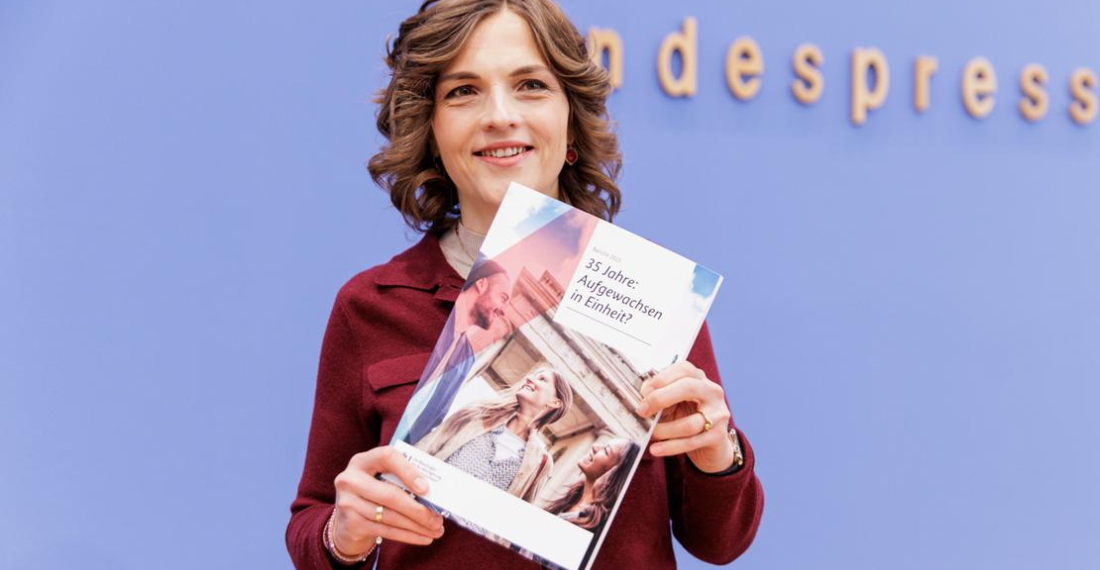
"I did not consciously experience the period of reunification, but the stories of my parents and grandparents have shaped me," Kaiser wrote in an annual report presented in Berlin just in time for the 35th anniversary of German Unity Day. For the 38-year-old member of the centre-left Social Democratic Party (SPD) this is a first, as she has only been in office since May 2025, when the new federal government was formed.
In her report, the political scientist focuses on how younger people are experiencing a Germany that has been united for 35 years. Yet the title she gave it hints at the gap between the former west and east, "Growing up in unity?"
Formally, the answer is "yes," because there is now only one German nation.
"We children of the late 1980s and 1990s are the first generation to have been socialized in a unified Germany," Kaiser writes in the report's foreword. "Nevertheless, for young people growing up there, 'the East' is still much more than a compass point. It is a space that shapes identities and influences lives," she stressed.
East German identity
Kaiser, who studied at the University of Potsdam in the eastern state of Brandenburg sees differences between herself and younger people from former West Germany.
"Many young people... cannot relate to the label 'West German' — especially if they live on the coast or near the Alps. In contrast, young eastern Germans identify themselves as Ossis far more often," she wrote, using a slang term for people from the former East.
Kaiser believes there are good reasons for this. Even though young Germans have all been grown up in the same country for three and a half decades, the conditions of their upbringing still differ in important ways.
"This is especially true outside the eastern German cities," she said.
Lower incomes, more welfare
In her report, Kaiser references a study on equality between the former East and West. It shows that in small towns and rural regions, public transportation and medical facilities are no longer comprehensively guaranteed in eastern states. In addition, people earn below-average incomes and are more likely to be dependent on social benefits.
"Wealth is also lower in the east than in the west," Kaiser added.
"This shapes the lives of many eastern Germans well into adulthood," she wrote, because they are less likely to be able to rely on their parents for financial support throughout their lives.
In addition, the aging of the population in rural regions of eastern Germany is more pronounced than in western areas. The proportion of young people is well below the national average.
Rich West, poor East
When presenting her report, Kaiser elaborated on this aspect: "To this day, young people in the east are disadvantaged because wealth is mainly passed on through inheritance," which most east Germans cannot expect.
The figures published by the Federal Statistical Office for 2024 underline this: The tax offices in western states reported more than €106 billion ($124.5 billion) in inherited or gifted wealth. In the east, including Berlin, the figure was less than seven billion. That amounts to almost four times more in the west per capita. Kaiser finds this problematic and believes that a serious debate over changes to inheritance laws may be warranted.
One idea that has been floated is the "inheritance for everyone" proposal first put forward by the German Institute for Economic Research (DIW) several years ago. This would see all young people in Germany receive an "inheritance" of €20,000 to finance education, start a business or invest in real estate. It would be financed by taxes on larger inheritances.
However, the topic is still unpopular with a lot of conservatives, including some in Chancellor Friedrich Merz Cristian Democratic Union (CDU).
In the end, Kaiser's assessment is a mixed bag. Eastern Germany has developed well in many areas, the economy has grown, there is a vibrant start-up scene, and the region is a pioneer in the expansion of renewable energies.
But in the long run, all this will not be enough to close the gap. And this is likely to become even more difficult to change in the future due to the aging population in the east and the exodus of many young people to the west.
While Berlin's population has not decreased, the east has lost two million people since reunification in 1990 — a decline of 16%. Currently, the five eastern German states still have just under 12.5 million inhabitants.
During the same period, the population in western Germany grew by 10%, to almost 68 million people.
This article was originally written in German.
source: commonspace.eu with Deutche Welle (Cologne)
photo: Elizabeth Kaiser