Force will not resolve the conflict. "EU Council President ends his visit to the South Caucasus"

Herman Van Rompuy, President of the European Council, has concluded his official visit to the South Caucasus with meetings in Azerbaijan.  He held talks with President Ilham Aliyev, then with Parliamentary Speaker Ogtay Asadov, followed by a visit to Baku's University of Foreign Languages, where Mr Van Rompuy was awarded the degree of Doctoris Honoris Causa.

In a statement to the press after his morning meeting with President Aliyev, Mr Van Rompuy commented on the strengthening of ties between the EU and Azerbaijan, particularly with regard to energy cooperation. Azerbaijan is a key player in the development of new oil and gas pipelines in the region, and the EU has welcomed the formalisation of Azerbaijani-Turkish cooperation on the Southern Corridor project. Despite progress already made, Mr Van Rompuy pressed President Aliyev "to make better use of the opportunities provided by the Eastern Partnership for Azerbaijan", which includes the promotion of trade and investment and the gradual liberalisation of visa regimes.

With regard to the Nagorno-Karabakh conflict, meanwhile, he repeated remarks he made the day before in Yerevan, emphasising the EU's capacity for confidence-building and reconciliation measures: 
"Military force will not resolve the conflict. Only a peaceful, negotiated settlement can allow the entire region to move beyond the status quo toward a secure and prosperous future. If a secure and stable regional environment can be prepared, the benefits will be for all in Azerbaijan...Both Azerbaijan and Armenia need to take decisions to reach a lasting and peaceful settlement based on the Madrid principles. Both countries need to fully implement the commitments made by their Presidents in the framework of the OSCE Minsk Group. Both sides should also strictly respect the ceasefire and exercise restraint on the ground and refrain from hostile rhetoric in public statements...The appointment of Ambassador [Philippe] Lefort as the new EU Special Representative for the South Caucasus and the crisis in Georgia demonstrates the increased commitment of the EU to the settlement of the conflict and contributing to all aspects of any solution package."
Mr Van Rompuy's first visit to Baku was welcomed by the country's President as "an important indicator of partnership and friendship between Azerbaijan and the European Union". Mr Aliyev also took the opportunity at the joint press conference to reiterate that a fifth of Azerbaijan's territory remains under Armenian occupation, with the result that over a million people are living as refugees and internally displaced persons.

source: commonspace.eu


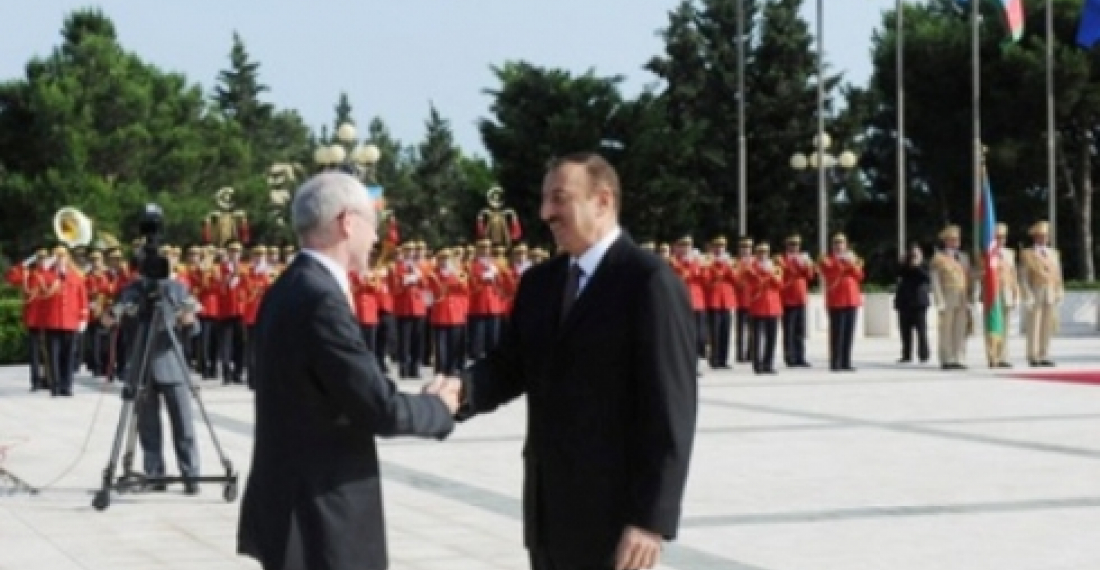
photo: President Aliev welcoming Herman Van Rompuy in Baku on 5 July 2012 (picture courtesy of the press service of the president of Azerbaijan.)
Related articles

Editor's choice
News
European leaders set out their plan for Ukraine

European leaders set out their plan for Ukraine

The leaders of Germany, Denmark, Finland, France, Italy, Netherlands, Norway, Poland, Sweden, and United Kingdom, together with the President of the European Council, and the President of the European Commission, o  Monday (15 December) issued a statement, outlining their plan for Ukraine. In their statement, Chancellor Merz, Prime Minister Frederiksen, President Stubb, President Macron, Prime Minister Meloni, Prime Minister Schoof, Prime Minister Støre, Prime Minister Tusk, Prime Minister Kristersson, Prime Minister Starmer, as well as President Costa and President von der Leyen spoke about "Peace for Ukraine". The Leaders welcomed significant progress on President Trump’s efforts to secure a just and lasting peace in Ukraine. They also welcomed the close work between President Zelenskyy’s and President Trump’s teams as well as European teams over the recent days and weeks. They agreed to work together with President Trump and President Zelenskyy to get to a lasting peace which preserves Ukrainian sovereignty and European security. Leaders appreciated the strong convergence between the United States, Ukraine and Europe. Leaders agreed that ensuring the security, sovereignty, and prosperity of Ukraine was integral for wider Euro-Atlantic security. They were clear that Ukraine and its people deserved a prosperous, independent, and sovereign future, free from fear of future Russian aggression. Both the US and European leaders committed to work together to provide robust security guarantees and economic recovery support measures for Ukraine in the context of an agreement on ending the war. This would include commitments to: Provide sustained and significant support to Ukraine to build its armed forces, which should remain at a peacetime level of 800,000 to be able to deter conflict and defend Ukraine’s territory. A European-led ‘multinational force Ukraine’ made up from contributions from willing nations within the framework of the Coalition of the Willing and supported by the US. It will assist in the regeneration of Ukraine’s forces, in securing Ukraine’s skies, and in supporting safer seas, including through operating inside Ukraine. (Click the image to read the statement in full).

Popular