EU Special Representative outlines approach to unresolved conflicts in the South Caucasus

"The European Union has a fundamental interest in the Nagorno-Karabakh conflict. We want good relations with both Armenia and Azerbaijan and have agreements with both. We want to make a constructive contribution to the resolution of the conflict........But one cannot separate the issue of status from that of technical support in the conflict zone. This can only be done when the co-chair of the Minsk process, and the two sides in the conflict, agree that it is time to do so. Until then I don't see the EU stepping sideways". This was stated by the European Union Special Representative for the South Caucasus, Toivo Klaar, when addressing a Policy Dialogue in Brussels on Monday, 26 February.

The policy dialogue  with the theme "Conflict resolution and peace building in the South Caucasus: the role and impact of the EU" was organised by the European Policy Centre and LINKS (Dialogue, Analysis and Research), and was chaired by Amanda Paul.

Klaar said that the unresolved conflicts have a negative impact on the region - in security terms, in the economic sphere and in the overall development of the region. He said that some international actors seem to think they can benefit from the present situation, by for example selling weapons. The European Union is involved in the resolution of the conflicts in the region in different ways. In the Nagorno-Karabakh conflict, the EU supports the efforts of the Minsk Group, and engages with the sides to push important messages, such as the need to reduce tensions, support negotiations and encourage people to people contacts. In an increasingly polorised situation the EU intentionally puts more focus on civil society and values. Since 2009, the EU's EPNK programme has sought to widen the engagement of vulnerable stakeholders to issues related to the peace process.

Klaar also addressed the EU's engagement with the conflicts in Georgia. The EU brokered the 2008 cease fire, but has a fundamental disagreement with Russia on how to move forward. There is no peace plan. But the Geneva international talks are important for managing the conflict. The EU has a number of tools in dealing with the conflicts in Georgia, such as the EUMM, but its biggest contribution should be pushing values such as Human rights, the rule of law, market economy and developing regional connections. The EU has pulling power, and sometimes it does not make full use of it, Klaar said. 

Another speaker in the policy dialogue was Roxana Cristescu from Conflict Managment Initiative (CMI). She said that people in the region have very high expectations of what the EU and other international organisations can do to resolve the conflict. In fact most of the tools available to the international community are for managing the conflicts rather than solving them. Civil society organisations are involved in keeping lines of communication open. In order to move to conflict transformation there must be a more long-term approach with broader participation. She said that peace processes pass through three phases: cease fire, negotiations and implementation. Refering to the role of the EU, Cristescu said that the role of the EU Special Representative should not be underestimated, especially by working in a regional framework. She highlighted the fact that the conflicts have evolved in a wider regional context, and the role of the EU is impacted by the wider relations between the EU and Russia.

source: commonspace.eu

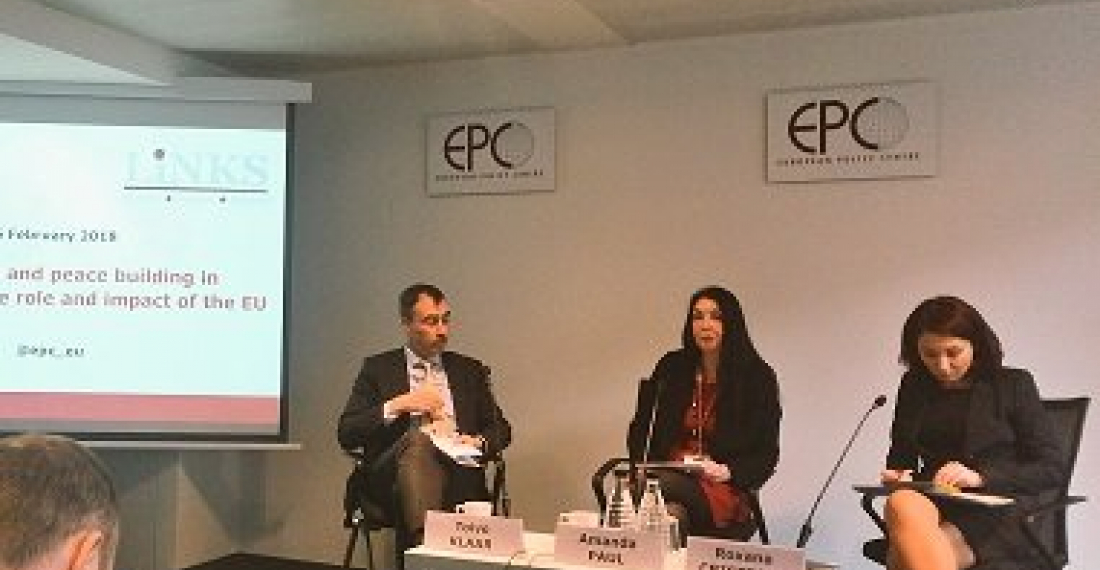
photo: Speakers at the EPC-LINKS policy dialogue held in Brussels on 26 February 2018 (picture courtesy of the EPC twitter feed, @EPC_EU
Related articles

Editor's choice
News
Council of Europe launches new International Claims Commission for Ukraine

Council of Europe launches new International Claims Commission for Ukraine

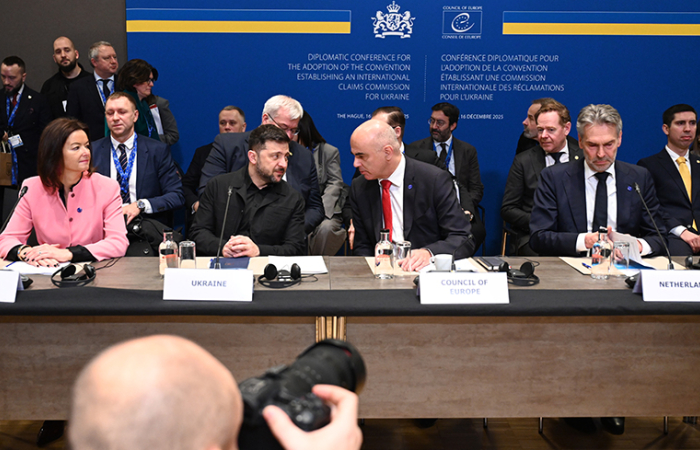
Thirty-four countries and the European Union have signed a new convention establishing an International Claims Commission for Ukraine at a diplomatic conference co-hosted by the 46-nation Council of Europe and the Netherlands in the Hague. The diplomatic conference was attended by leaders and high-level representatives from over 50 states, including the President of Ukraine, Volodymyr Zelenskyy, the President of the Republic of Moldova, Maia Sandu, and the Prime Minister of the Netherlands, Dick Schoof.  “Today marks a major step forward in ensuring accountability for Ukraine. The International Claims Commission represents justice and hope for tens of thousands of victims—our determination that those who have suffered will not be forgotten. I call for quick ratifications so we can get the commission rapidly up and running for the people of Ukraine,” said Council of Europe Secretary General Alain Berset. Ukrainian President Volodymyr Zelenskyy said: “We expect that every mechanism for compensation from the Register of Damage and Claims Commission to the actual payments – will start working and receive strong and sufficient international support, so that people can truly feel that any kind of damage caused by the war can be compensated. This war, and Russia’s responsibility for it, MUST become a clear example – so that others learn not to choose aggression.” “Accountability is about creating the conditions for peace that endures. And therefore, accountability is a condition of security – today and for the future. But accountability is not only about Ukraine. And it is not only about one aggressor and one victim. Accountability is about Europe. About every country in Europe. It is about whether Europe, as a whole, is willing to defend its peace,” said Maia Sandu, President of the Republic of Moldova, which currently holds the Presidency of the Council of Europe’s Committee of Ministers. The Prime Minister of the Netherlands, Dick Schoof, said: “Every day Russia is deliberately bombarding homes, destroying businesses and damaging infrastructure in Ukraine. Russia must compensate Ukraine for the damage caused. That is why we have launched the International Claims Commission for Ukraine and we are honoured to host it.” The International Claims Commission will be the second part of a comprehensive compensation mechanism related to Russia’s war of aggression, building on the existing Register of Damage for Ukraine. The claims commission will be established within the framework of the Council of Europe and will also be open to other countries. The Register of Damage for Ukraine, created in 2023, collects and records compensation claims submitted by individuals, organisations and public bodies in Ukraine. Forty-four states and the European Union have so far joined the Register, which has already received 86,000 claims. The International Claims Commission will review, assess and decide upon claims submitted to the Register of Damage for Ukraine and determine the amount of compensation, if any, which is due in each case. The convention establishing the commission will enter into force once it has been ratified by 25 signatories, as long as sufficient funds have been secured to support its initial work.

Popular

Editor's choice
News
Council of Europe launches new International Claims Commission for Ukraine

Council of Europe launches new International Claims Commission for Ukraine

Thirty-four countries and the European Union have signed a new convention establishing an International Claims Commission for Ukraine at a diplomatic conference co-hosted by the 46-nation Council of Europe and the Netherlands in the Hague. The diplomatic conference was attended by leaders and high-level representatives from over 50 states, including the President of Ukraine, Volodymyr Zelenskyy, the President of the Republic of Moldova, Maia Sandu, and the Prime Minister of the Netherlands, Dick Schoof.  “Today marks a major step forward in ensuring accountability for Ukraine. The International Claims Commission represents justice and hope for tens of thousands of victims—our determination that those who have suffered will not be forgotten. I call for quick ratifications so we can get the commission rapidly up and running for the people of Ukraine,” said Council of Europe Secretary General Alain Berset. Ukrainian President Volodymyr Zelenskyy said: “We expect that every mechanism for compensation from the Register of Damage and Claims Commission to the actual payments – will start working and receive strong and sufficient international support, so that people can truly feel that any kind of damage caused by the war can be compensated. This war, and Russia’s responsibility for it, MUST become a clear example – so that others learn not to choose aggression.” “Accountability is about creating the conditions for peace that endures. And therefore, accountability is a condition of security – today and for the future. But accountability is not only about Ukraine. And it is not only about one aggressor and one victim. Accountability is about Europe. About every country in Europe. It is about whether Europe, as a whole, is willing to defend its peace,” said Maia Sandu, President of the Republic of Moldova, which currently holds the Presidency of the Council of Europe’s Committee of Ministers. The Prime Minister of the Netherlands, Dick Schoof, said: “Every day Russia is deliberately bombarding homes, destroying businesses and damaging infrastructure in Ukraine. Russia must compensate Ukraine for the damage caused. That is why we have launched the International Claims Commission for Ukraine and we are honoured to host it.” The International Claims Commission will be the second part of a comprehensive compensation mechanism related to Russia’s war of aggression, building on the existing Register of Damage for Ukraine. The claims commission will be established within the framework of the Council of Europe and will also be open to other countries. The Register of Damage for Ukraine, created in 2023, collects and records compensation claims submitted by individuals, organisations and public bodies in Ukraine. Forty-four states and the European Union have so far joined the Register, which has already received 86,000 claims. The International Claims Commission will review, assess and decide upon claims submitted to the Register of Damage for Ukraine and determine the amount of compensation, if any, which is due in each case. The convention establishing the commission will enter into force once it has been ratified by 25 signatories, as long as sufficient funds have been secured to support its initial work.