


Economic issues top agenda at CIS summit in Kazakhstan

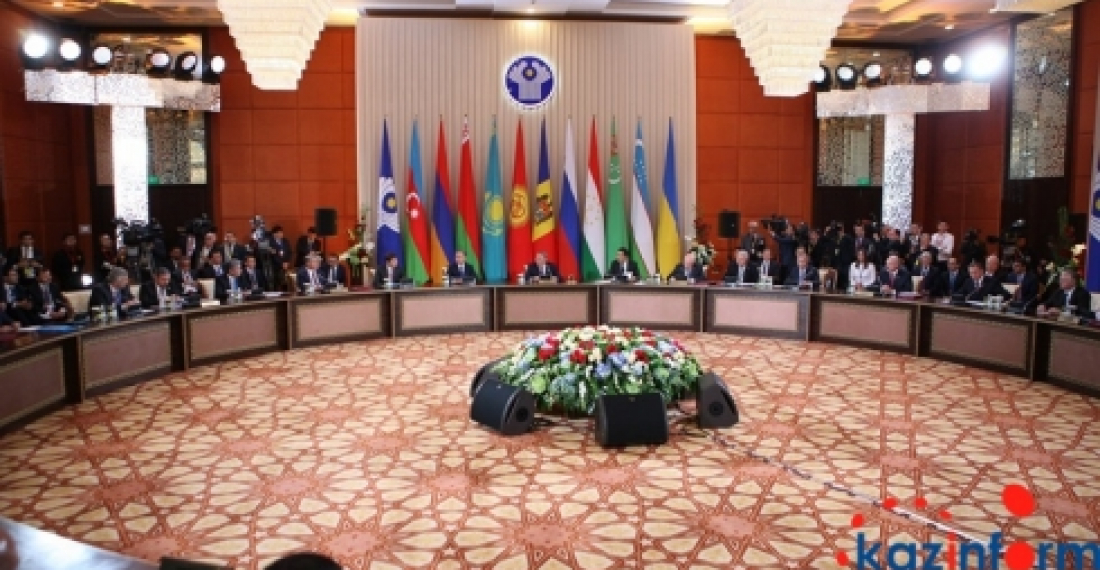
A summit of the Commonwealth of Independent States (CIS), was held in Kazakhstan on Friday, 16 October, with the participation of Russian president Vladimir Putin and other Heads of State and Government from the member states. Economic issues dominated the agenda.

Outgoing Chairman of the CIS, Kazakh President Nursultan Nazarbyev told the session of the CIS Heads of State Council that "frankly speaking, we had a difficult time of presidency in terms of the economic situation, but we tried to fulfill our mission. All the events planned within the CIS framework have been held."

The Kazakh President also informed that the 10th CIS Forum of Creative and Academic Intellectuals would be held in Astana this month and the CIS Heads of Government Council was scheduled to be held in Dushanbe soon.

"These events round up our presidency. Using this opportunity I would like to thank all our CIS partners for understanding and support of our presidency," the President concluded.

The presidency in the CIS in 2016 goes to Kyrgyzstan and the next sitting of the CIS Heads of State Council would be held in Kyrgyzstan on September 16, 2016.

In his speech, Russian President Vladimir Putin also focused on economic issues. Putin proposed to the leaders to "switch more actively to sub-national currencies in mutual settlements".

The Russian president reminded about the agreement on free-trade zone in CIS signed in 2011. "We should use its potential to the fullest and maximally simplify conditions for movement of goods and investment flows," Putin said. He noted that aggregate GDP of CIS countries decreased in the first quarter of 2015 as well as investment in capital stock. "Trade turnover between our countries has also decreased. In this situation, it is important to think about the package of measures on lowering dependence of national economics from foreign markets and think about reviving business ties inside the Commonwealth," he added.

Putin noted that Russia is finishing the ratification of the Agreement on CIS integrated currency market. The document was signed in Ashgabat in December 2012 by Armenia, Belarus, Kazakhstan, Kyrgyzstan, Russia and Tajikistan. "The enforcement of the document will allow us to conduct coordinated currency policy, and in the future maybe even form CIS common financial market," the Russian president said.

source: commonspace.eu with Kazinform News Agency (Kazakhstan) and Itar-Tass news Agency (Russia).

photo: The opening session of the CIS Heads of Government Council held in Burabai, Kazakhstan on Friday, 16 October 2015. (picture courtesy of Kazinform news Agency).




Related articles

Editor's choice
News
Borrell tells the European Parliament that the situation in Afghanistan was critical, but the EU will remain engaged

Borrell tells the European Parliament that the situation in Afghanistan was critical, but the EU will remain engaged

Borrell underlined that the European Union will make every effort to support the peace process and to remain a committed partner to the Afghan people. "Of course, we will have to take into account the evolving situation, but disengagement is not an option.  We are clear on that: there is no alternative to a negotiated political settlement, through inclusive peace talks.
Editor's choice
News
Germany accuses Russia of cyberattacks and disinformation campaign

Germany accuses Russia of cyberattacks and disinformation campaign

The German government holds Russia responsible for a cyberattack on German air traffic control, and for targeted disinformation campaigns before the last federal election. According to the German Foreign Office in Berlin, the incidents could be clearly attributed to the Russian military intelligence service, the GRU. In response, the Russian ambassador to Berlin was summoned to the Foreign Ministry. "We have been observing a massive increase in threatening hybrid activities by Russia for some time now," a spokesperson for the Foreign Ministry stated. These range from disinformation campaigns and espionage to cyberattacks and sabotage attempts. The aim is to divide society, sow distrust, and undermine confidence in democratic institutions. The spokesperson added that with these actions, Russia is "very concretely threatening our security, not only through its war of aggression against Ukraine, but also here in Germany."  The Foreign Ministry spokesperson explained that the cyberattack on air traffic control in August 2024 was clearly attributed to the hacker collective "APT28," known as "Fancy Bear," and to the responsibility of the Russian military intelligence service, the GRU. Furthermore, it could now be "conclusively stated" that Russia had attempted "to influence and destabilize both the last Federal election and the ongoing internal affairs of the Federal Republic of Germany." There was "absolutely irrefutable evidence" for this". The so-called "Storm 1516" campaign, which has been running since 2024, is allegedly backed by "reliable information" that the Moscow-based think tank "Center for Geopolitical Expertise" is behind it. The Center is also said to be supported by Russian military intelligence. Its primary aim is to influence democratic elections in the West. (Click the image to read more).

Popular

Editor's choice
News
Germany accuses Russia of cyberattacks and disinformation campaign

Germany accuses Russia of cyberattacks and disinformation campaign

The German government holds Russia responsible for a cyberattack on German air traffic control, and for targeted disinformation campaigns before the last federal election. According to the German Foreign Office in Berlin, the incidents could be clearly attributed to the Russian military intelligence service, the GRU. In response, the Russian ambassador to Berlin was summoned to the Foreign Ministry. "We have been observing a massive increase in threatening hybrid activities by Russia for some time now," a spokesperson for the Foreign Ministry stated. These range from disinformation campaigns and espionage to cyberattacks and sabotage attempts. The aim is to divide society, sow distrust, and undermine confidence in democratic institutions. The spokesperson added that with these actions, Russia is "very concretely threatening our security, not only through its war of aggression against Ukraine, but also here in Germany."  The Foreign Ministry spokesperson explained that the cyberattack on air traffic control in August 2024 was clearly attributed to the hacker collective "APT28," known as "Fancy Bear," and to the responsibility of the Russian military intelligence service, the GRU. Furthermore, it could now be "conclusively stated" that Russia had attempted "to influence and destabilize both the last Federal election and the ongoing internal affairs of the Federal Republic of Germany." There was "absolutely irrefutable evidence" for this". The so-called "Storm 1516" campaign, which has been running since 2024, is allegedly backed by "reliable information" that the Moscow-based think tank "Center for Geopolitical Expertise" is behind it. The Center is also said to be supported by Russian military intelligence. Its primary aim is to influence democratic elections in the West. (Click the image to read more).

