B-1s integrate with Ukrainian and Turkish aircraft for first time in missions over Black Sea

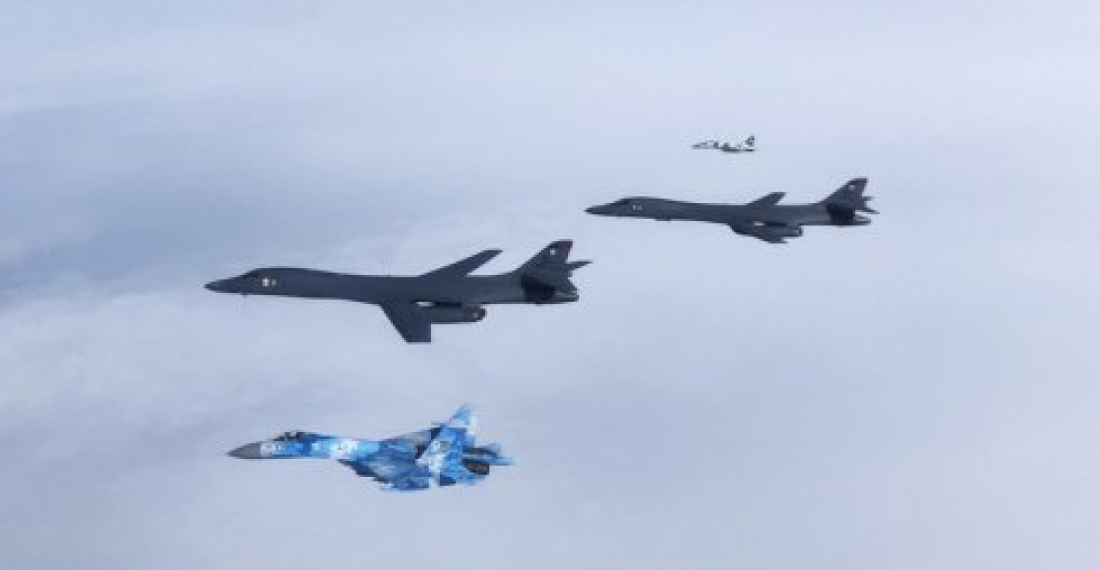
Two B-1B Lancers from Ellsworth Air Force Base, South Dakota, conducted a long-range, long duration strategic Bomber Task Force mission throughout Europe and the Black Sea region, May 29, 2020. This marked the first time that a Bomber Task Force mission integrated with Ukrainian Su-27 Flankers and MiG-29 Fulcrums and Turkish KC-135s.

This was stated in a statement issued by the Command of US Air Force Europe, on Friday 29 May.

"Bomber Task Force missions to Europe demonstrate commitment to our allies and partners all while providing a clear deterrence message to any adversary," said Gen. Jeff Harrigian, U.S. Air Forces in Europe and Air Forces Africa commander. "The integration of our strategic bomber presence across Europe proves that the U.S., alongside any ally or partner, stands ready to deter, and if needed, can employ these capabilities together."

The flight also included integration and interoperability training with Polish F-16s and MiG-29s and Romanian F-16s and MiG-21s, which provided escort and combat patrol overwatch in the Black Sea region.

A KC-135 Stratotanker from the 100th Air Refueling Wing, RAF Mildenhall, England, Turkish and U.S. KC-135s based out of Incirlik Air Base, Turkey, and other NATO aerial refueling aircraft enabled the B-1 to complete the round trip from Ellsworth Air Force Base without delay, while also providing aerial refueling support to our partner-nation aircraft.

Additionally, the B-1s integrated with Greek F-16 air policing for an overflight of Skopje, North Macedonia.

"The Bomber Task Force missions demonstrate to our NATO Allies, including our newest member - North Macedonia - that these strategic missions enhance the readiness and training necessary to respond to any potential crisis or challenge around the globe," said Gen. Tod D. Wolters, U.S. European Command commander. "The integration and interoperability with our NATO Allies during these missions, be it aerial tanker support or fighter escorts, are indelible actions that show the Alliance is as strong as I've ever witnessed."

Bomber missions familiarize aircrew with air bases, airspace, and operations in different geographic combatant commands. These missions build proficiency and confidence, and they demonstrate the credibility of our forces to address a global security environment that is more diverse and uncertain than at any other time in our history.

In Moscow, the Russian Foreign Ministry said Russian Air Force  Su-27 and Su-30 fighter jets were scrambled to intercept the US Air Force B-1B strategic bombers "over the neutral waters of the Black Sea". "Su-27P and Su-30SM fighters from the air defense alert quick reaction forces of the Southern Military District were scrambled to intercept the targets. The flights of the Russian combat planes proceeded in strict compliance with the international rules of using the airspace," the ministry said.

After accomplishing their mission, the Russian fighter jets safely returned to their airbases, it added.

source: commonspace.eu with the press service of the US Airt Force Command Europe and TASS (Moscow).

photo: Ukrainian fighter planes escort US B-1 bomber aircraft on a training mission  over the Black Sea on 29 May 2020 (picture courtesy of the Ukrainian Air Force)

Related articles

Editor's choice
News
Borrell tells the European Parliament that the situation in Afghanistan was critical, but the EU will remain engaged

Borrell tells the European Parliament that the situation in Afghanistan was critical, but the EU will remain engaged

Borrell underlined that the European Union will make every effort to support the peace process and to remain a committed partner to the Afghan people. "Of course, we will have to take into account the evolving situation, but disengagement is not an option.  We are clear on that: there is no alternative to a negotiated political settlement, through inclusive peace talks.
Editor's choice
News
NATO Chief says war is on Europe's doorstep, and warns against complacency

NATO Chief says war is on Europe's doorstep, and warns against complacency

Russia could attack a Nato country within the next five years, the Secretary General of NATO, Mark Rutte, said in a stark new warning. "Nato's own defences can hold for now," Rutte warned in Berlin, but conflict was "next door" to Europe and he feared "too many are quietly complacent, and too many don't feel the urgency, too many believe that time is on our side. "Russia is already escalating its covert campaign against our societies," Rutte said in a speech in Germany. "We must be prepared for the scale of war our grandparents or great-grandparents endured." Earlier this month, Russia's President Vladimir Putin said his country was not planning to go to war with Europe, but it was ready "right now" if Europe wanted to - or started a war. But similar reassurances were given by Moscow in 2022, just before 200,000 Russian troops crossed the border and invaded Ukraine. Putin has accused European countries of hindering US efforts to bring peace in Ukraine - a reference to the role Ukraine's European allies have recently played in trying to change a US peace plan to end the war, whose initial draft was seen as favouring Russia. But Putin was not sincere, Nato's secretary-general said in the German capital, Berlin. Supporting Ukraine, he added, was a guarantee for European security. "Just imagine if Putin got his way; Ukraine under the boot of Russian occupation, his forces pressing against a longer border with Nato, and the significantly increased risk of an armed attack against us." Russia's economy has been on a war footing for more than three years now - its factories churn out ever more supplies of drones, missiles and artillery shells. According to a recent report by the Kiel Institute for the World Economy, Russia has been producing each month around 150 tanks, 550 infantry fighting vehicles, 120 Lancet drones and more than 50 artillery pieces. The UK, and most of its Western allies, are simply not anywhere near this point. Analysts say it would take years for Western Europe's factories to come close to matching Russia's mass-production of weapons. "Allied defence spending and production must rise rapidly, our armed forces must have what they need to keep us safe," the Nato chief said.

Popular

Editor's choice
News
NATO Chief says war is on Europe's doorstep, and warns against complacency

NATO Chief says war is on Europe's doorstep, and warns against complacency

Russia could attack a Nato country within the next five years, the Secretary General of NATO, Mark Rutte, said in a stark new warning. "Nato's own defences can hold for now," Rutte warned in Berlin, but conflict was "next door" to Europe and he feared "too many are quietly complacent, and too many don't feel the urgency, too many believe that time is on our side. "Russia is already escalating its covert campaign against our societies," Rutte said in a speech in Germany. "We must be prepared for the scale of war our grandparents or great-grandparents endured." Earlier this month, Russia's President Vladimir Putin said his country was not planning to go to war with Europe, but it was ready "right now" if Europe wanted to - or started a war. But similar reassurances were given by Moscow in 2022, just before 200,000 Russian troops crossed the border and invaded Ukraine. Putin has accused European countries of hindering US efforts to bring peace in Ukraine - a reference to the role Ukraine's European allies have recently played in trying to change a US peace plan to end the war, whose initial draft was seen as favouring Russia. But Putin was not sincere, Nato's secretary-general said in the German capital, Berlin. Supporting Ukraine, he added, was a guarantee for European security. "Just imagine if Putin got his way; Ukraine under the boot of Russian occupation, his forces pressing against a longer border with Nato, and the significantly increased risk of an armed attack against us." Russia's economy has been on a war footing for more than three years now - its factories churn out ever more supplies of drones, missiles and artillery shells. According to a recent report by the Kiel Institute for the World Economy, Russia has been producing each month around 150 tanks, 550 infantry fighting vehicles, 120 Lancet drones and more than 50 artillery pieces. The UK, and most of its Western allies, are simply not anywhere near this point. Analysts say it would take years for Western Europe's factories to come close to matching Russia's mass-production of weapons. "Allied defence spending and production must rise rapidly, our armed forces must have what they need to keep us safe," the Nato chief said.