

Lavrov in Yerevan to discuss Karabakh and bilateral relations.

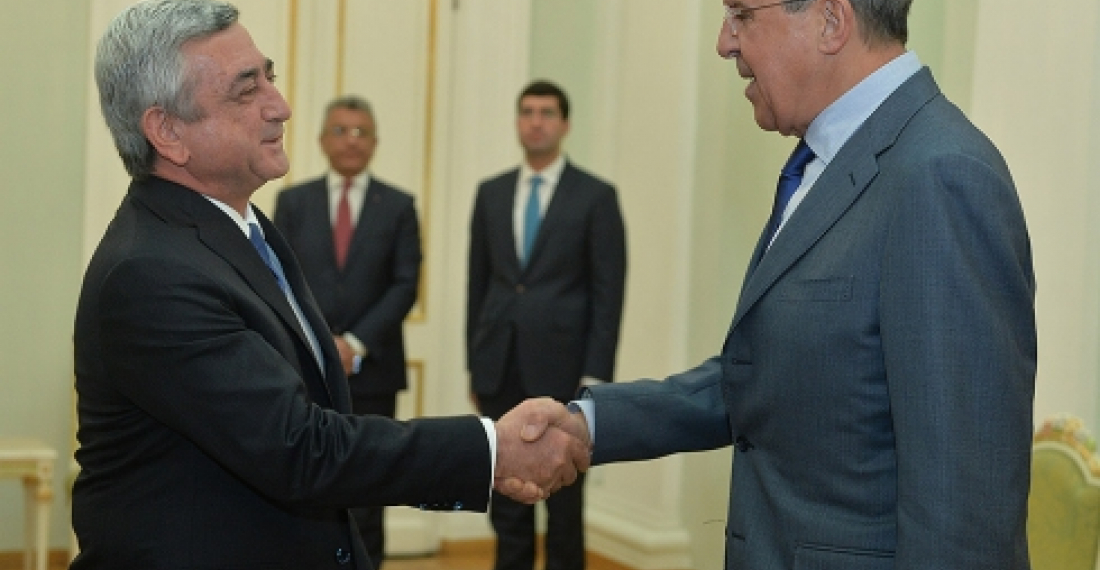
Russian Foreign Minister Sergei Lavrov on Monday paid an unannounced visit to Yerevan. In Yerevan Lavrov met with President Serzh Sargsyan and Foreign Minister Edward Nalbandian.

Karabakh was one of the issues on the agenda in meetings between the head of Russian diplomacy and Armenian leaders. Speaking at a Press Conference,  Armenian Foreign Minister Eduard Nalbandyan said Armenia appreciates Russia's efforts to reach a solution to the Nagorno-Karabakh conflict,."[We] discussed the issue of the Nagorno-Karabakh settlement," he said. "Armenia highly appreciates Russia's efforts aimed at resolving the Nagorno-Karabakh conflict by peaceful means. We will continue working in this vein" the Minister was quoted by the Russian agency Itar-Tass as saying.

The Russian Foreign Minister Sergey noted that Russia is opposed to discussing Nagorno-Karabakh settlement at international venues not designed for that purpose."We, the co-chairmen of the Minsk process - Russia, the United States and France - speak out against the attempts to raise this issue at various international venues, which did not engage in the settlement," he said, answering a question on the evaluation of a report by the PACE Committee on Political Affairs and Democracy on the situation around the Nagorno-Karabakh region.

Lavrov said that the co-chairmen of the Minsk group maintained regular dialogue on the Nagorno-Karabakh conflict. "This is a very complex issue with its own history," Lavrov said.

Nalbandyan also expressed condolences the Russian plane crash over Egypt's Sinai Peninsula and thanked Lavrov for the assistance in transporting home the bodies of Armenian citizens who lost their lives in the air crash in South Sudan. "Today's meeting was another good opportunity to discuss the implementation of the agreements reached at the level of heads of our states," Nalbandyan said.

source: commonspace.eu with agencies.

Phoito: President Sargsyan of Armenia welcomes Russian Foreign Minister Lavrov in Yerevan on Monday, 8 November 2015 (picture courtesy of the press Service of the President of Armenia).
Related articles

Editor's choice
News
Pashinyan says that he wants peace treaty with Azerbaijan by 2031

Pashinyan says that he wants peace treaty with Azerbaijan by 2031

Armenia should sign and ratify a peace treaty with Azerbaijan before 2031, Armenian Prime Minister Nikol Pashinyan said. He described the objective as the top priority for his administration. Earlier, the Armenian prime minister also spoke about a possible land-swap with Azerbaijan Armenia and Azerbaijan should agree to establish a clear, conventional border without enclaves or exclaves, Prime Minister Nikol Pashinyan said. Armenia controls three Azeri enclaves inside its borders while Baku controls one Armenian enclave – those could be subject to a land swap, Pashinyan announced.
Editor's choice
News
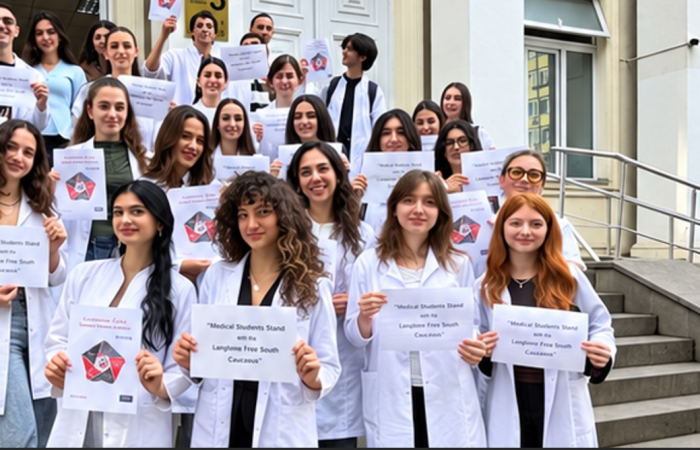
Medical Students stand for a Landmine Free South Caucasus

Medical Students stand for a Landmine Free South Caucasus

Medical Students in Tbilisi have participated in the campaign LANDMINE FREE SOUTH CAUCASUS 2026. The regional’ Landmine Free South Caucasus’ (LFSC) campaign was initiated by LINKS Europe Foundation in 2018 to address the critical issue of landmine and unexploded ordnance contamination in Armenia, Azerbaijan and Georgia. With significant landmine contamination in the region posing an ongoing threat to life and eliciting high economic costs, LFSC advocated for a regional, holistic approach to complete clearance.  Future Doctors Join the Conversation on Friday, 16 October in Tbilisi. "As part of the Landmine Free South Caucasus 2026 campaign, an informative and interactive meeting was held in Tbilisi with medical students. The session was conducted by George Simonishvili, South Caucasus Co-ordinator for LINKS Europe.  The meeting focused on the humanitarian consequences of landmines and other explosive remnants of war in Armenia, Azerbaijan, and Georgia, with particular attention to the Red Bridge minefield near the borders of the three countries, and emphasised that these dangers remain a current humanitarian challenge. It also underlined that future medical professionals will encounter the long-term effects of explosion injuries and can play a role in awareness and prevention.  Students actively engaged throughout the discussion, showing strong interest in the humanitarian impact and the need for cooperation. Under the slogan "Future Doctors for a Landmine Free South Caucasus," the event encouraged students to support public awareness, solidarity with survivors, and a safer South Caucasus free from landmine threats.  The event was organised by LINKS Europe as part of LFSC26.  "Medical Students Stand for a Landmine Free South Caucasus," "Future Doctors, Safer Futures: Together Against Landmines." "Future Doctors for a Landmine Free South Caucasus".

Popular

Editor's choice
Interview
Thursday Interview: Murad Muradov

Thursday Interview: Murad Muradov

Today, commonspace.eu starts a new regular weekly series. THURSDAY INTERVIEW, conducted by Lauri Nikulainen, will host  persons who are thinkers, opinion shapers, and implementors in their countries and spheres. We start the series with an interview with Murad Muradov, a leading person in Azerbaijan's think tank community. He is also the first co-chair of the Action Committee for a new Armenian-Azerbaijani Dialogue. Last September he made history by being the first Azerbaijani civil society activist to visit Armenia after the 44 day war, and the start of the peace process. Speaking about this visit Murad Muradov said: "My experience was largely positive. My negative expectations luckily didn’t play out. The discussions were respectful, the panel format bringing together experts from Armenia, Azerbaijan, and Turkey was particularly valuable during the NATO Rose-Roth Seminar in Yerevan, and media coverage, while varied in tone, remained largely constructive. Some media outlets though attempted to represent me as more of a government mouthpiece than an independent expert, which was totally misleading.  Overall, I see these initiatives as important steps in rebuilding trust and normalising professional engagement. The fact that soon a larger Azerbaijani civil society visits to Armenia followed, reinforces the sense that this process is moving in the right direction." (click the image to read the interview in full)