German Foreign Minister Frank-Walter Steinmeier visited Azerbaijan and Armenia on 22 and 23 October. The short but high profile visit is seen as a sign of increased German and European engagement with the South Caucasus. Earlier this year Steimeier also visited Georgia, accompanied by the French Foreign Minister, Roland Fabius.
In Azerbaijan, Foreign Minister Steinmeier on Wednesday (22 October) met President Ilham Aliyev and Foreign Minister Elmar Mammadyarov. In Baku Steinmeier discussed with the Azerbaijani leadership the current state of EU-Azerbaijan relations, as well as bilateral issues The following day in Armenia, Steinmeier held talks with President Serzh Sargsyan and his opposite number, Edward Nalbandian. The visit was the first by a senior western politician to Yerevan since Armenia signed the accession treaty to join the Russian-led Eurasian Economic Union. Germany is the second biggest bilateral donor to Armenia, after the United States. Within the framework of the intergovernmental consultations on development cooperation held in October 2014, Germany pledged 109.8 million euros of funding for financial cooperation.
According to the German Foreign Ministry the situation around the Nagorno-Karabakh conflict was in focus duirng the visit of the head of the German diplomacy to the South Caucasus. The Ministry stated that Germany and its EU partners support the negotiation efforts of the Minsk Group of the OSCE (Organization for Security and Co-operation in Europe) and encourage the authorities in Azerbaijan and Armenia to find a peaceful and mutually-acceptable solution to the conflict. Steinmeier's visit comes days before the Presidents of Armenia and Azerbaijan are due to meet in Paris under the auspices of French President Francois Hollande in a new attempt to revitalise the negotiations on the peaceful resolution of the conflict.
Commonspace.eu political editor said in a comment that Steinmeier's visit to Baku and Yerevan was both timely and significant. On Nagorno-Karabakh there are some hopes that the negotiations between Armenia and Azerbaijan can achieve a breakthrough at the Paris summit. Germany has thrown its full weight behind the talks Steinmeier has urged the leaders of both countries to do what it takes to move the peace process forward. The visit also indicates a higher visibility for Germany on issues related to European security in the Eastern neighbourhood. German diplomacy has drawn lessons from events in Ukraine in recent months and there are signs of a more assertive German engagement with the region, particularly the South Caucasus. This will add credibility to the overall European Union policy and strategy toward the region. During his visit Steinmeier pointed out that an experienced German diplomat was now the European Union's Special Representative to the region. Sources in diplomatic circles also say that Germany is likely to have a prominent role in the OSCE in the near future.
source: commonspace.eu
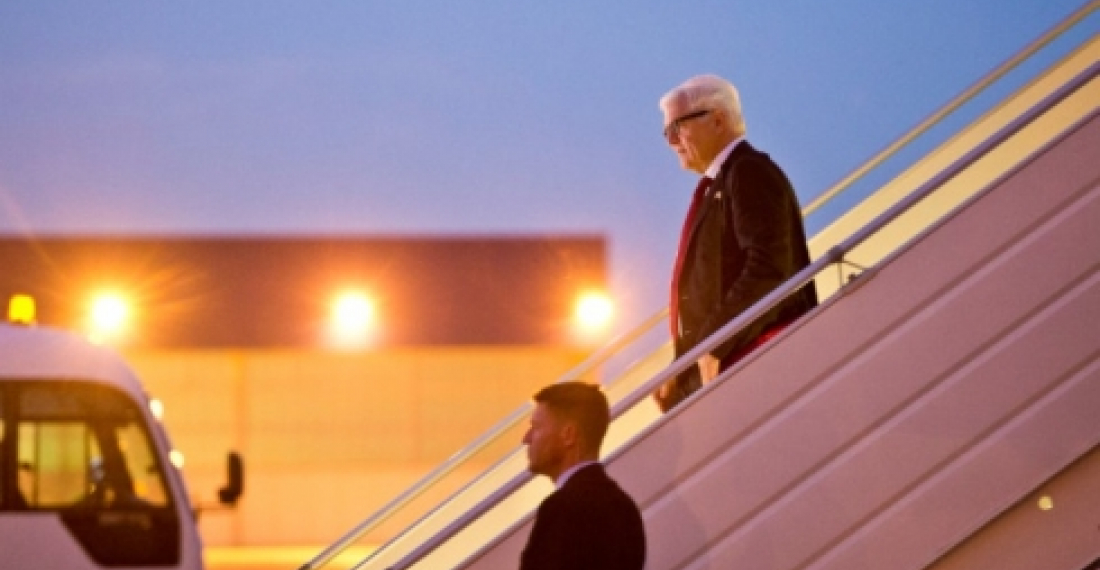
photo: German Foreign Minister Frank-Walter Steinmeier arriving in Baku earlier this week at the start of a short but significant visit to the South Caucasus. (picture courtesy of the German Foreign Ministry).