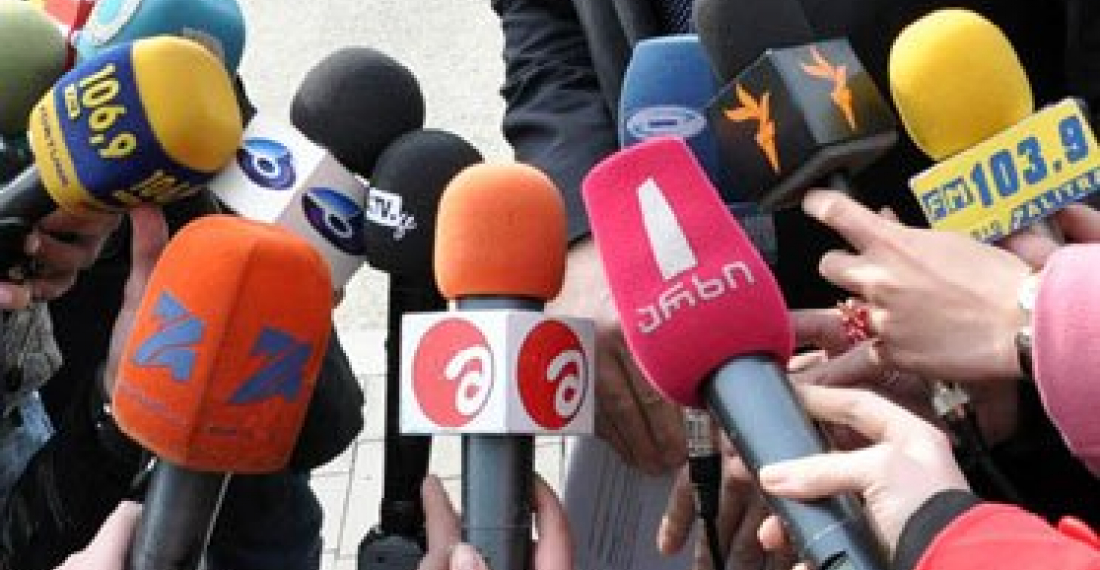
Georgia has a free media in comparison to many of its neighbours. Overt censorship is rare. But journalists face challenges of a more subtle form.
"Sometimes I think the Patriarch is even more valued than God," says Dato Parulava, a journalist for Liberali, a Georgian magazine with a liberal and pro-western perspective.
"If you say something about God, people say ‘may God forgive you'. But if you say something about the Patriarch, you might get bashed."
Despite the many ways in which Georgia has modernised since the fall of the Soviet Union, the Church is still powerful, and has a close relationship with the state.
Parulava recently wrote an article about Russian influences on the Georgian Orthodox Church. When the article appeared online, many of the comments were insulting and threatening.
"They are a closed and reclusive organisation, and they receive a lot of funding from government," said Parulava. "As a journalist, it's not easy to get a comment from them."
But Parulava is keen to stress he does not feel personally threatened, and that Georgians do criticise about the Church openly.
In 2016, Georgia ranked 64th out of 180 countries for press freedom, according to figures put together by Reporters Without Borders. This is higher than Armenia, and far higher than Azerbaijan, Russia or Turkey.
BRIBES AND DRUNK OFFICIALS
 Ramaz Samkharadze is founder of Radio Hereti, which has channels in Tbilisi and in Kakheti in eastern Georgia. He is also upbeat about media freedom in Georgia, but open about the difficulties.
His station was founded in Kakheti in 1998, when he tried and failed to get a radio licence in the capital.
"At the time [former president] Shevernadze was in power, corruption was rampant, and we were asked to give a bribe of $75,000 for the licencing. By that time frequencies were scarce and they were not given out," Samkharadze said.
Hereti is now a successful operation, operating in Tbilisi for almost a year, and reaching a potential audience of almost two million people across Georgia.
"The problem now is less this kind of overt censorship, but instead is about problems relating to public officials and projects," said Samkharadze, highlighting a recent case where his station reported that a councillor in Lagodekhi, Kakheti province, had been drunk at meetings.
"We [said] such people should not be in office ... but the guy was yelling and shouting ‘you are against the government!'"
SOFT CENSORSHIP
Under Georgia's previous two presidents, it was not unknown for officials to intervene directly if a particular story was not to their liking, by having a "quiet word" with the relevant journalist or editor.
This kind of direct censorship no longer happens, says Samkharadze, but government control of the media still happens in more subtle ways.
International bodies say "soft censorship" of the media by governments comes in five main forms: subsidies, paid news, state advertising, bribery, and ‘other administrative pressures'.
Subsidies can be indirect, such as via advertising. Some of Radio Hereti's rivals benefit from government funded advertising contracts. In exchange they exercise self-censorship, and tone down their criticism of the government, according to Hereti's boss.
Last year while trying to secure a frequency for the Tbilisi branch of his radio station, he ran into difficulties when one of his competitors, a government official, wanted the same spot.
Knowing it is illegal for public officials to own a media outlet, he went directly to the prime minister and the European Union, and eventually took his case to court. He won the case, and Radio Hereti is now blaring out on 93.5 FM in Tbilisi as well as on 102.8 in Kakheti
"IF A STRAIGHT MAN IS HAVING SEX, IT'S OK..."
Sexuality is another battleground for the Georgian media.
Sakaharadze says his station openly covers the International Day Against Homophobia and Transphobia (IDAHO), which is marked each year on May 17 by supportive demonstrations. But the counter-demonstrations are far larger.
IDAHO day in 2013 saw a few dozen gay rights activists met by around 20,000 opponents. They broke through a police cordon, and assaulted demonstrators. Since then, LGBT groups have been more cautious about marking IDAHO day.
The internet makes it easier for liberal groups to organise, and for liberal journalists to operate. But it can also make things easier for reactionary forces in Georgian society.
In March, videos emerged of sexual encounters allegedly involving senior politicians and media figures. The source was never verified.
Some blamed governments past and present, but encouragingly, there was public outcry, and the president and prime minister strongly condemned the incident.
"Whoever was responsible is targeting people, mostly women and gays," says Parulava. "If you target a straight man, the man doesn't care, because we have a very masculine culture. If a straight man is having sex it's OK, so they're targeting women and gays."
Both Hereti and Liberali have received substantial funding from western sources, such as the Open Society Foundation and the European Union, although Hereti has been self-financing for two years.
Some in Georgia think these western-backed outlets are pushing an agenda that runs against mainstream public opinion.
THE LEGAL BATTLE OVER RUSTAVI 2
In some cases, Georgian media outlets are still funded by those close to power. For instance, GDS TV is owned by Bera Ivanishvili, son of former prime minister Bidzina, Ivanishvili who remains an influential force in Georgian politics despite not holding any official position
Rustavi 2, Georgia's most popular channel, is seen as anti-government and pro-UNM. It has been locked in a contentious legal battle over the past year.
Kibar Khalvashi, who owned the channel between 2004-2006, launched a legal bid claiming the government of former president Mikhail Saakashvili forcibly took the station from him a decade ago.
Last November, a court ruled that ownership should transferred back to Khalvashi, with the channel taken from new owners Levan and Gia Karamanashvil. This decision was upheld on appeal in June.
Supporters of Rustavi 2 and the UNM have said the legal battle is an attempt to silence the channel's anti-government output ahead of October's elections, but despite the fact that the election campaign is already half way through, Rustavi 2 continues to broadcast unimpeded.
MODERNITY AND ITS DISCONTENTS
Some outlets in Georgia are firmly pro-government, while others are firmly pro-opposition. The situation is better than in neighbouring countries, where opposition views are rarely heard. But true neutrality and objectivity would be better.
The sex tape leaks and the Rustavi 2 battles are symptomatic of a wider phenomenon. Georgia's media landscape is now far more fractured and complex than ever before. It is changing beyond recognition, and it is difficult for anyone, government or opposition, to control.
A decade ago, a public official or oligarch who wanted to influence public opinion could simply buy a TV channel or a newspaper. Now, this is harder. The Georgian media, and the country in general, are becoming much freer.
As journalists are deploying modern technology and modern social values to shine a light on the powerful, the powerful are finding modern ways to hit back. But many young Georgian journalists are more ready to challenge than ever before.
source: This is the first in a series of three articles prepared for commonspace.eu by Joseph d'Urso on alternative media in the South Caucasus. The next article, will be published next week.