


Georgia-Armenia relations are in many ways exemplary.

This is a commentary prepared by the editorial team of commonspace.eu.

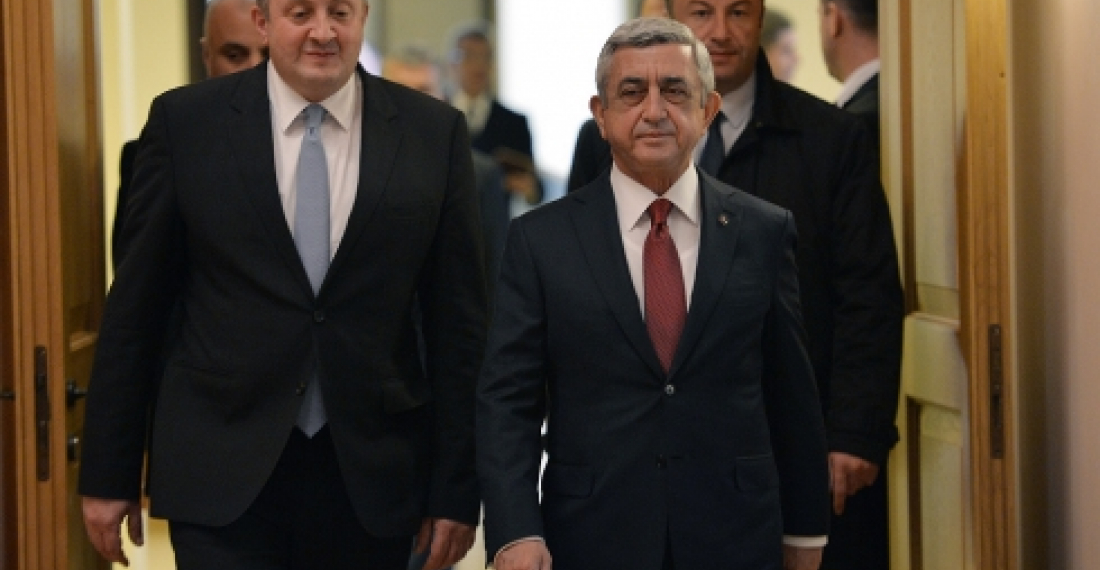
President Serzh Sargsyan of Armenia on Friday visited Georgia on an official visit during which he met with President Giorgi Marghvelashvili, Prime Minister Irakli Gharibashvili, and Parliament Chairman David Usupashvili.

The visit was the latest in an exchange of official visits between the two neighbouring countries that go beyond protocol niceties, and emphasises that the two countries have embarked on a process of co-operation on a number of tangible issues.

Armenia and Georgia are neighbouring countries with a shared common history. Their people have interacted, inter-married and lived together for many centuries. A competitive spirit between them whilst at times healthy could also at other times be unnecessarily divisive.

In the current geo-political context the two countries have chosen diametrically different paths - Georgia as an associate member of the European Union with aspirations for full EU and NATO membership; Armenia as a full member already of the Russia-led Eurasian Economic Union and Collective Security Treaty Organisation (CSTO). Some feared the two countries could become the fault line between two competing blocs. The leaders of both Armenia and Georgia have made it clear that they do not want this to happen, and the friendly visit of the Armenian President to Tbilisi has re-affirmed this once again. President Sargsyan, speaking after his meeting with president Marghvelashvili underscored this, stating that "our mutual understanding in such issues is first of all conditioned by the acknowledgment of the supremacy of the Armenian-Georgian brotherhood, as well as by our ability to think long-term. Furthermore, the active interstate dialogue anchored in our peoples' deep ties creates serious prerequisites to outline new dimensions for comprehensive partnership".

Georgia is currently pursuing an active policy in the wider Caucasus Region. This means strong bilateral relations with Armenia and Azerbaijan, as well as expanding relations with Turkey and Iran. Georgia's relations with Russia remain troubled by Russia's support for protectorate states in Abkhazia and South Ossetia. Georgia can benefit much from expanded regional co-operation, and even its role as an EU associated state will be much enhanced by an active and positive Caucasus policy. The current Georgian leadership has understood this and is pursuing this policy actively.

As for Armenia, the situation is somewhat different. The country is locked in a war with Azerbaijan and in a historical confrontation with Turkey which persists and clouds contemporary relations. For Armenia maintaining a good relationship with Georgia is a strategic priority which successive Armenian leaders have understood.

There are issues in Georgia-Armenian relations, and proximity and interaction bring with them also the potential for disputes. Yet both countries have wisely agreed to work to manage these problems not to try to exacerbate them. The relations between Georgia and Armenia are therefore in many ways exemplary. They have the potential to expand further. And both sides need to be careful not to be complacent, because they are not without their problems. For the moment however both countries have wisely decided to turn, what could have been an awkward situation, to their advantage.

source: This is a commentary prepared by the editorial team of commonspace.eu

photo: The President of Armenia Serzh Sargsyan with Georgia's President Giorgi Marghvelashvili at the Presidential Palace in Tbilisi on Friday, 30 October 2015 (picture courtesy of the press service of the President of Armenia).


Related articles

Editor's choice
News
Council of Europe launches new International Claims Commission for Ukraine

Council of Europe launches new International Claims Commission for Ukraine

Thirty-four countries and the European Union have signed a new convention establishing an International Claims Commission for Ukraine at a diplomatic conference co-hosted by the 46-nation Council of Europe and the Netherlands in the Hague. The diplomatic conference was attended by leaders and high-level representatives from over 50 states, including the President of Ukraine, Volodymyr Zelenskyy, the President of the Republic of Moldova, Maia Sandu, and the Prime Minister of the Netherlands, Dick Schoof.  “Today marks a major step forward in ensuring accountability for Ukraine. The International Claims Commission represents justice and hope for tens of thousands of victims—our determination that those who have suffered will not be forgotten. I call for quick ratifications so we can get the commission rapidly up and running for the people of Ukraine,” said Council of Europe Secretary General Alain Berset. Ukrainian President Volodymyr Zelenskyy said: “We expect that every mechanism for compensation from the Register of Damage and Claims Commission to the actual payments – will start working and receive strong and sufficient international support, so that people can truly feel that any kind of damage caused by the war can be compensated. This war, and Russia’s responsibility for it, MUST become a clear example – so that others learn not to choose aggression.” “Accountability is about creating the conditions for peace that endures. And therefore, accountability is a condition of security – today and for the future. But accountability is not only about Ukraine. And it is not only about one aggressor and one victim. Accountability is about Europe. About every country in Europe. It is about whether Europe, as a whole, is willing to defend its peace,” said Maia Sandu, President of the Republic of Moldova, which currently holds the Presidency of the Council of Europe’s Committee of Ministers. The Prime Minister of the Netherlands, Dick Schoof, said: “Every day Russia is deliberately bombarding homes, destroying businesses and damaging infrastructure in Ukraine. Russia must compensate Ukraine for the damage caused. That is why we have launched the International Claims Commission for Ukraine and we are honoured to host it.” The International Claims Commission will be the second part of a comprehensive compensation mechanism related to Russia’s war of aggression, building on the existing Register of Damage for Ukraine. The claims commission will be established within the framework of the Council of Europe and will also be open to other countries. The Register of Damage for Ukraine, created in 2023, collects and records compensation claims submitted by individuals, organisations and public bodies in Ukraine. Forty-four states and the European Union have so far joined the Register, which has already received 86,000 claims. The International Claims Commission will review, assess and decide upon claims submitted to the Register of Damage for Ukraine and determine the amount of compensation, if any, which is due in each case. The convention establishing the commission will enter into force once it has been ratified by 25 signatories, as long as sufficient funds have been secured to support its initial work.

Popular

Editor's choice
News
Council of Europe launches new International Claims Commission for Ukraine

Council of Europe launches new International Claims Commission for Ukraine

Thirty-four countries and the European Union have signed a new convention establishing an International Claims Commission for Ukraine at a diplomatic conference co-hosted by the 46-nation Council of Europe and the Netherlands in the Hague. The diplomatic conference was attended by leaders and high-level representatives from over 50 states, including the President of Ukraine, Volodymyr Zelenskyy, the President of the Republic of Moldova, Maia Sandu, and the Prime Minister of the Netherlands, Dick Schoof.  “Today marks a major step forward in ensuring accountability for Ukraine. The International Claims Commission represents justice and hope for tens of thousands of victims—our determination that those who have suffered will not be forgotten. I call for quick ratifications so we can get the commission rapidly up and running for the people of Ukraine,” said Council of Europe Secretary General Alain Berset. Ukrainian President Volodymyr Zelenskyy said: “We expect that every mechanism for compensation from the Register of Damage and Claims Commission to the actual payments – will start working and receive strong and sufficient international support, so that people can truly feel that any kind of damage caused by the war can be compensated. This war, and Russia’s responsibility for it, MUST become a clear example – so that others learn not to choose aggression.” “Accountability is about creating the conditions for peace that endures. And therefore, accountability is a condition of security – today and for the future. But accountability is not only about Ukraine. And it is not only about one aggressor and one victim. Accountability is about Europe. About every country in Europe. It is about whether Europe, as a whole, is willing to defend its peace,” said Maia Sandu, President of the Republic of Moldova, which currently holds the Presidency of the Council of Europe’s Committee of Ministers. The Prime Minister of the Netherlands, Dick Schoof, said: “Every day Russia is deliberately bombarding homes, destroying businesses and damaging infrastructure in Ukraine. Russia must compensate Ukraine for the damage caused. That is why we have launched the International Claims Commission for Ukraine and we are honoured to host it.” The International Claims Commission will be the second part of a comprehensive compensation mechanism related to Russia’s war of aggression, building on the existing Register of Damage for Ukraine. The claims commission will be established within the framework of the Council of Europe and will also be open to other countries. The Register of Damage for Ukraine, created in 2023, collects and records compensation claims submitted by individuals, organisations and public bodies in Ukraine. Forty-four states and the European Union have so far joined the Register, which has already received 86,000 claims. The International Claims Commission will review, assess and decide upon claims submitted to the Register of Damage for Ukraine and determine the amount of compensation, if any, which is due in each case. The convention establishing the commission will enter into force once it has been ratified by 25 signatories, as long as sufficient funds have been secured to support its initial work.

