


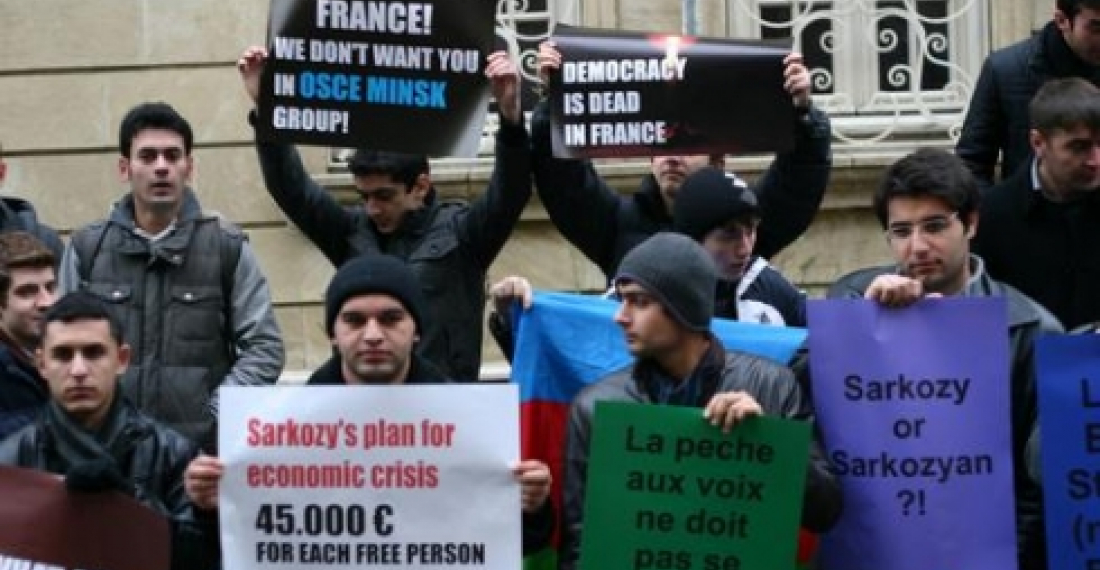
IRELI takes to the streets of Baku. Better known for its great parties and for its Gucci dressed leaders Azerbaijan's biggest youth group changes tactics

It has been better known for its great parties and for its Gucci dressed leaders, so the sight of members of IRELI demonstrating on the streets of Baku to protest at the recent decision of the French senate criminalising the Armenian genocide is a good indicator of feelings in Azerbaijan on this issue.

IRELI is a youth organisation that was founded soon after Ilham Aliev took over as president of Azerbaijan, and has close connections with the presidential administration. In some ways it is modelled on a similar organisation in Russia - "NASHI" in that it sees itself as a focal point for youth support for the president, but offers a space for those not wanting to get involved in party politics. Here however the comparisons end. NASHI has been in the past on the front line of pro Kremlin manifestations, providing the shock troops for many controversial events. IRELI has been much more genteel in its approach. But it seems things are changing.

Speaking to the media before the protest in front of the French Embassy, the Chairman of IRELI, Ceyhun Osmanli, who is also a member of parliament said that Azerbaijani youth don't want to see France as a co-chair country of the OSCE Minsk Group. He questioned the French company ‘Total' ownership of shares in the oil and gas fields of Azerbaijan. "We think expedient to review this issue within the international legislation", he said. Osmanli also proposed a boycott of French goods and said that the will not be using the services of French airlines anymore.

IRELI's protest can be dismissed as insignificant, yet of the many protests held in front of the French Embassy in Baku over the last couple of days, the appearance of IRELI may well be the most indicative of Baku's irritation with French policies.

source: commonspace.eu with news.az

photo: The protest of IRELI in front of the French Embassy in Baku on 24 January 2012 (photo courtesy of news.az)
Related articles

Editor's choice
News
Situation in South Yemen strains relations between Saudi Arabia and UAE

Situation in South Yemen strains relations between Saudi Arabia and UAE

The relations between Saudi Arabia and the United Arab Emirates (UAE) are increasingly strained as a result of the different approach of the two countries towards Yemen. Whilst both countries were initially together in resisting the Houthi take over in Yemen, the UAE subsequently focused on the South of the country, backing the Southern Movement (STC), which seeks to restore the independence of South Yemen. South Yemen became an independent country in 1967, at the end of British rule, and only unified with the north in 1990. The Saudi-led “Coalition to Support Legitimacy in Yemen” on Tuesday, 30 December, said it conducted a “limited” airstrike targeting two ships “that smuggled weapons and other military hardware into Mukalla in southern Yemen”. The ships originated in the UAE port of Furjeirah. In a statement carried by the Saudi Press Agency (SPA), the Coalition Forces spokesman, Major General Turki Al-Maliki, said that two ships coming from the port of Fujairah in the United Arab Emirates entered the Port of Mukalla in Hadramaut without obtaining official permits from the Joint Forces Command of the Coalition. He stressed the Coalition's "continued commitment to de-escalation and enforcing calm in the governorates of Hadramawt and Al-Mahra, and to prevent any military support from any country to any Yemeni faction without coordination with the legitimate Yemeni government and the Coalition. The Southern Transitional Council (STC), launched a sweeping military campaign early in December, seizing the governorates of Hadramaut along the Saudi border and the eastern governorate of Al-Mahra in Yemen’s border with Oman. The UAE-backed STC forces captured the city of Seiyun, including its international airport and the presidential palace. They also took control of the strategic PetroMasila oilfields, which account for a massive portion of Yemen’s remaining oil wealth. (click the image to read the article in full).

Popular

