Commentary: There is a lot of good-will towards Armenia in the EU, but Russia remains the elephant in the room

This is a commentary prepared by the political editor of Commonspace.eu

Armenian President Serzh Sargsyan will on Monday (27 February) start an official visit to the European institutions in Brussels. The visit comes as Armenia and the EU finalise a new framework agreement that will form the basis of their relations for the next decade. 

In 2013 Armenia was close to signing an Association Agreement with the EU, but at the last moment abandoned the idea and joined instead the Russia led Eurasian Economic Union. There is therefore considerable interest in what the new agreement will look like, and why it will be acceptable to Russia, in a way that the proposed 2013 agreement was not.

There is in Europe a lot of good-will towards Armenia. This is based on a sense of shared Christian history; respect for an ancient culture, and not least the work of successful Armenian communities in many of the EU member states. There is also a sense of guilt in liberal European circles connected with the genocide of Armenians in the early 20th century. On the negative side this good-will also feeds from a certain Islamophobia and Turkophobia that exists whether we like it or not, in many European societies.

Prima facie Armenia's relations with European countries, and European society are excellent. Armenia has good bilateral ties with many of the EU member states; it maintains very strong relations with the Catholic Church; Armenia is a full member of La Francophonie - a grouping of mainly French-speaking countries, and its relations with the European Union over the last twenty-five years have covered many sectors.

Russia, not the European Union, is the bedrock of Russia's foreign policy

Armenia foreign policy and security bedrock and pivot however is not the European Union; it is Russia. This has been the case since independence in 1991, however this policy has been considerably consolidated under the team Serzh Sargsyan-Eduard Nalbandian at the head of Armenian policy and diplomacy since 2008. For example in August 2010, Armenia agreed to the  extension of the lease of the Russian base in Gyumri from 25 to 49 years (until 2044). In September 2013 Armenian President abruptly announced during a visit to Moscow that Armenia will not sign an Association Agreement with the EU, but would instead join the Russia led Eurasian Economic Union. In March 2014, Armenia was only one of ten countries (including North Korea, Zimbabwe, Sudan and a few others) to support Russia in the UN General Assembly vote on the territorial integrity of Ukraine. In November 2016 Armenia and Russia announced the creation of a joint group of forces under a unified command.

Every other Armenian foreign policy action or initiative is either ancillary to, or complimentary, or at least not in direct competition - but never in contradiction to this primacy of Russia in Armenian foreign policy. 

This policy is driven by necessity, but aspects of it are a matter of political choice. Certainly Armenia feels vulnerable; the fear of being surrounded by enemies is historically deep-rooted and forms part of the Armenia political psyche. Security is therefore a paramount consideration. It is also possible to accept the argument that Russia is at the moment the only security provider that can realistically offer Armenia the security cover that it needs. However it is also possible to argue that the way this has been managed is a matter of choice.  How Armenia has negotiated with Russia over the last nine years, and what it has got in return for its policy is now a matter of open debate in Armenia, with many Armenians highlighting the asymmetry of the relationship, and the arrogance with which Russia is seen dealing with Armenia as particularly sore points.

Armenia's Russia policy remains largely supported by the people in Armenia who are conditioned by a siege mentality, but it is for the first time being questioned by an increasingly vocal but articulate minority. President Sargsyan remains fully committed to this Russia policy. But his views on this are no longer unchallenged and he finds himself needing to defend and justify them. A case in point was his speech earlier this week to the upper echelons of the military where he spoke about how Armenians and Russians had never been in the trenches against each other, and of how Armenia's remains committed to the CSTO despite all the recent shenanigans surrounding Armenia's position in the organisation

Negotiating with the EU, with one eye on Moscow

In Europe, at least until recently, Armenia's strategic relationship with Russia has been accepted as a fact and a necessity for Armenia, and has not been a major factor determining relations. However as the EU sought to deepen relations with Armenia, and as relations with Russia deteriorated over the last five years, the limitations determined by Armenia's hard core Russia policy became evident.  After the disappointments of 2013, both sides agreed to turn the page and a new agreement is now in the final stages of negotiation. We don't know the details of the new agreement, but whatever it is the only way it can avoid a repetition of 2013 is if it is not in contradiction to Armenia's Russia policy. One of the key negotiators on the EU side working on the new framework agreement, recently told an audience in Brussels that the Armenian negotiating team work very diligently but that the "Armenians negotiate with one eye looking at Moscow".

This notwithstanding, a new agreement between Armenia and the EU is a positive development and will benefit both sides. The more substance that can be put into this agreement the better. However it is important that no one gives the impression that what is being signed is of the same quality and substance to that proposed in 2013. It is not, and this must be spelt out by the EU in order not to mislead the Armenian people. 

European society in general can and should remain more ambitious in their thinking, so that when Armenian society is ready we can take the relationship to a different level. This requires that we don't look at the present state of relations with a smug sense of satisfaction, but with a critical eye, with a view to being able to respond swiftly and adequately when the opportunity arises.

This commentary was prepared by the political editor of commonspace.eu

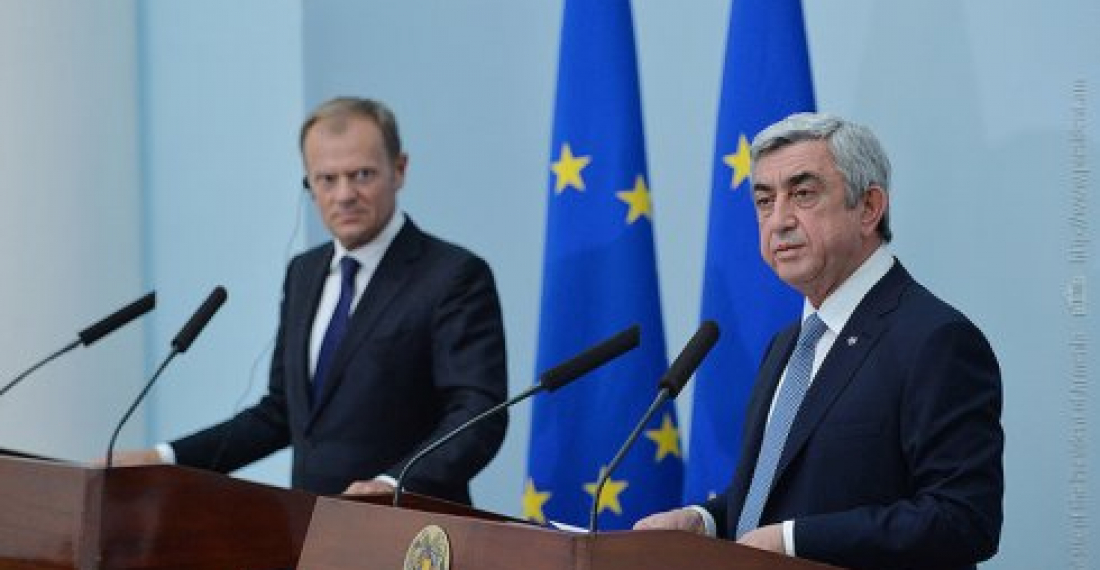
photo: Armenian president Serzh Sargsyan with the President of the European Council, Donald Tusk at their meeting in Yerevan in 2015 (archive picture)
Related articles

Editor's choice
News
Council of Europe launches new International Claims Commission for Ukraine

Council of Europe launches new International Claims Commission for Ukraine

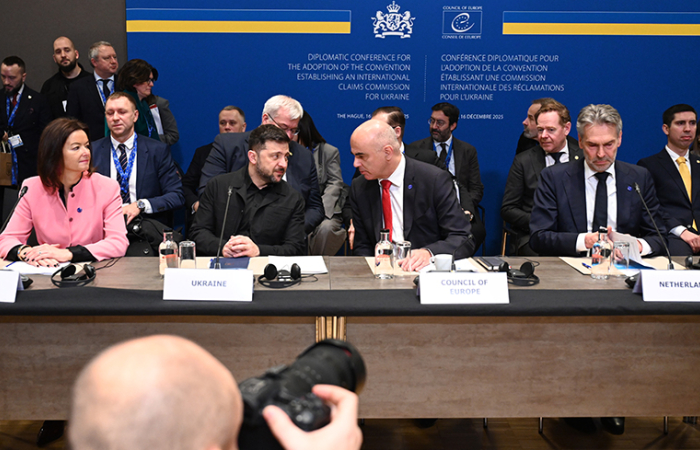
Thirty-four countries and the European Union have signed a new convention establishing an International Claims Commission for Ukraine at a diplomatic conference co-hosted by the 46-nation Council of Europe and the Netherlands in the Hague. The diplomatic conference was attended by leaders and high-level representatives from over 50 states, including the President of Ukraine, Volodymyr Zelenskyy, the President of the Republic of Moldova, Maia Sandu, and the Prime Minister of the Netherlands, Dick Schoof.  “Today marks a major step forward in ensuring accountability for Ukraine. The International Claims Commission represents justice and hope for tens of thousands of victims—our determination that those who have suffered will not be forgotten. I call for quick ratifications so we can get the commission rapidly up and running for the people of Ukraine,” said Council of Europe Secretary General Alain Berset. Ukrainian President Volodymyr Zelenskyy said: “We expect that every mechanism for compensation from the Register of Damage and Claims Commission to the actual payments – will start working and receive strong and sufficient international support, so that people can truly feel that any kind of damage caused by the war can be compensated. This war, and Russia’s responsibility for it, MUST become a clear example – so that others learn not to choose aggression.” “Accountability is about creating the conditions for peace that endures. And therefore, accountability is a condition of security – today and for the future. But accountability is not only about Ukraine. And it is not only about one aggressor and one victim. Accountability is about Europe. About every country in Europe. It is about whether Europe, as a whole, is willing to defend its peace,” said Maia Sandu, President of the Republic of Moldova, which currently holds the Presidency of the Council of Europe’s Committee of Ministers. The Prime Minister of the Netherlands, Dick Schoof, said: “Every day Russia is deliberately bombarding homes, destroying businesses and damaging infrastructure in Ukraine. Russia must compensate Ukraine for the damage caused. That is why we have launched the International Claims Commission for Ukraine and we are honoured to host it.” The International Claims Commission will be the second part of a comprehensive compensation mechanism related to Russia’s war of aggression, building on the existing Register of Damage for Ukraine. The claims commission will be established within the framework of the Council of Europe and will also be open to other countries. The Register of Damage for Ukraine, created in 2023, collects and records compensation claims submitted by individuals, organisations and public bodies in Ukraine. Forty-four states and the European Union have so far joined the Register, which has already received 86,000 claims. The International Claims Commission will review, assess and decide upon claims submitted to the Register of Damage for Ukraine and determine the amount of compensation, if any, which is due in each case. The convention establishing the commission will enter into force once it has been ratified by 25 signatories, as long as sufficient funds have been secured to support its initial work.

Popular

Editor's choice
News
Council of Europe launches new International Claims Commission for Ukraine

Council of Europe launches new International Claims Commission for Ukraine

Thirty-four countries and the European Union have signed a new convention establishing an International Claims Commission for Ukraine at a diplomatic conference co-hosted by the 46-nation Council of Europe and the Netherlands in the Hague. The diplomatic conference was attended by leaders and high-level representatives from over 50 states, including the President of Ukraine, Volodymyr Zelenskyy, the President of the Republic of Moldova, Maia Sandu, and the Prime Minister of the Netherlands, Dick Schoof.  “Today marks a major step forward in ensuring accountability for Ukraine. The International Claims Commission represents justice and hope for tens of thousands of victims—our determination that those who have suffered will not be forgotten. I call for quick ratifications so we can get the commission rapidly up and running for the people of Ukraine,” said Council of Europe Secretary General Alain Berset. Ukrainian President Volodymyr Zelenskyy said: “We expect that every mechanism for compensation from the Register of Damage and Claims Commission to the actual payments – will start working and receive strong and sufficient international support, so that people can truly feel that any kind of damage caused by the war can be compensated. This war, and Russia’s responsibility for it, MUST become a clear example – so that others learn not to choose aggression.” “Accountability is about creating the conditions for peace that endures. And therefore, accountability is a condition of security – today and for the future. But accountability is not only about Ukraine. And it is not only about one aggressor and one victim. Accountability is about Europe. About every country in Europe. It is about whether Europe, as a whole, is willing to defend its peace,” said Maia Sandu, President of the Republic of Moldova, which currently holds the Presidency of the Council of Europe’s Committee of Ministers. The Prime Minister of the Netherlands, Dick Schoof, said: “Every day Russia is deliberately bombarding homes, destroying businesses and damaging infrastructure in Ukraine. Russia must compensate Ukraine for the damage caused. That is why we have launched the International Claims Commission for Ukraine and we are honoured to host it.” The International Claims Commission will be the second part of a comprehensive compensation mechanism related to Russia’s war of aggression, building on the existing Register of Damage for Ukraine. The claims commission will be established within the framework of the Council of Europe and will also be open to other countries. The Register of Damage for Ukraine, created in 2023, collects and records compensation claims submitted by individuals, organisations and public bodies in Ukraine. Forty-four states and the European Union have so far joined the Register, which has already received 86,000 claims. The International Claims Commission will review, assess and decide upon claims submitted to the Register of Damage for Ukraine and determine the amount of compensation, if any, which is due in each case. The convention establishing the commission will enter into force once it has been ratified by 25 signatories, as long as sufficient funds have been secured to support its initial work.