


"Azerbaijan is an important partner in an important region." NATO welcomes the President of Azerbaijan for talks on regional security and co-operation

President Ilham Aliev of Azerbaijan was yesterday received at NATO Headquarters in Brussels, where he met the Secretary General Anders Fogh Rasmussen and later addressed the representatives of the NATO member states gathered in the North Atlantic Council. Welcoming President Aliev the Secretary General said that for NATO "Azerbaijan was an important partner in an important country". The NATO chief welcomed the signing in December of a new Individual Partnership Action Plan with Azerbaijan and thanked the President for his country's contribution to the NATO mission in Afghanistan.

President Aliev on his part said that the relations between Azerbaijan  and NATO have a history of success. The President spoke of the reforms being undertaken within the Azerbaijan Armed Forces in  order to bring them to NATO standards and he said that the Azerbaijani Armed Forces had benefitted a lot from their participation in NATO missions throughout the world. On Afghanistan the President said that Azerbaijan was willing to contribute to the Afghan National Army Trust Fund and he also spoke about Azerbaijan's contribution to the training of Afghan diplomats at Azerbaijan's Diplomatic Academy. The Azerbaijani President briefed the NATO leadership on the current state of negotiations on the conflict over Nagorno-Karabakh and called for a solutiuon of the conflict based on existing United Nations Resolutions.

source: commonspace.eu

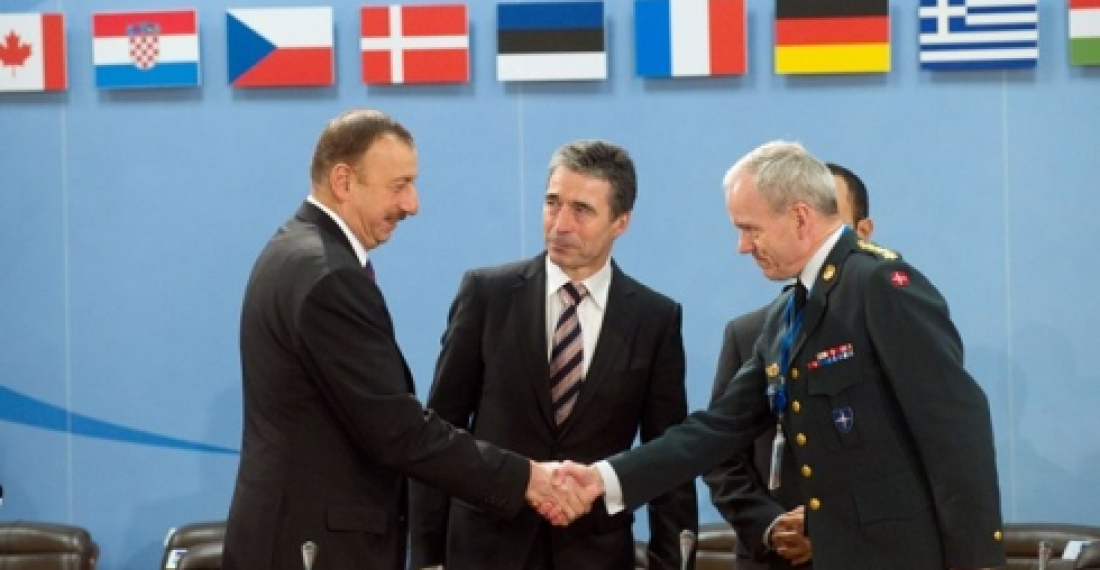
photo: President Ilham Aliyev of Azerbaijan shaking hands with General Knud Bartels, Chairman of the NATO Military Committee, during his visit to NATO Headquarters on 15 February 2012 (picture courtesy of the NATO Information Service).


Related articles

Editor's choice
News
Ramadan begins

Ramadan begins

The Muslim Holy month of Ramadan started on Wednesday, 18 February. For Muslims across the world, the holy month of Ramadan is a time for religious reflection, increased worship, charity and community. Observant Muslims abstain from all forms of food and drink between the hours of dawn and sunset whilst trying to reconnect with their faith. Islam adheres to the lunar calendar. This means that the month of Ramadan begins when the first crescent of a new moon is sighted  The lunar calendar is 10 to 11 days shorter than the modern 365-day Gregorian calendar, which is based on the Earth's rotation around the sun. This difference means Ramadan begins on a different day each year.  In Muslim-majority countries, dedicated state committees check for the crescent moon and officially announce the start of Ramadan. Saudi Arabia, Qatar and several other Gulf countries claimed to have sighted the crescent moon on 17 February and declared 18 February as the first day of Ramadan. However, Egypt, Turkey Jordan and some other countries said the crescent moon was not sighted and therefore announced that Ramadan would begin on Thursday 19 February. This means that the month of fasting will likely end on either Wednesday 18 March or Thursday 19 March, as there are either 29 or 30 days in a lunar month. As a result, Eid al-Fitr, the festival of breaking the fast, is likely to fall on either Thursday 19 March or Friday 20 March. Eid al-Fitr marks the end of Ramadan. Muslims tend to celebrate Eid with a small breakfast and give to charity before Eid prayers in congregation.

Popular

Editor's choice
Interview
Thursday Interview: Murad Muradov

Thursday Interview: Murad Muradov

Today, commonspace.eu starts a new regular weekly series. THURSDAY INTERVIEW, conducted by Lauri Nikulainen, will host  persons who are thinkers, opinion shapers, and implementors in their countries and spheres. We start the series with an interview with Murad Muradov, a leading person in Azerbaijan's think tank community. He is also the first co-chair of the Action Committee for a new Armenian-Azerbaijani Dialogue. Last September he made history by being the first Azerbaijani civil society activist to visit Armenia after the 44 day war, and the start of the peace process. Speaking about this visit Murad Muradov said: "My experience was largely positive. My negative expectations luckily didn’t play out. The discussions were respectful, the panel format bringing together experts from Armenia, Azerbaijan, and Turkey was particularly valuable during the NATO Rose-Roth Seminar in Yerevan, and media coverage, while varied in tone, remained largely constructive. Some media outlets though attempted to represent me as more of a government mouthpiece than an independent expert, which was totally misleading.  Overall, I see these initiatives as important steps in rebuilding trust and normalising professional engagement. The fact that soon a larger Azerbaijani civil society visits to Armenia followed, reinforces the sense that this process is moving in the right direction." (click the image to read the interview in full)

