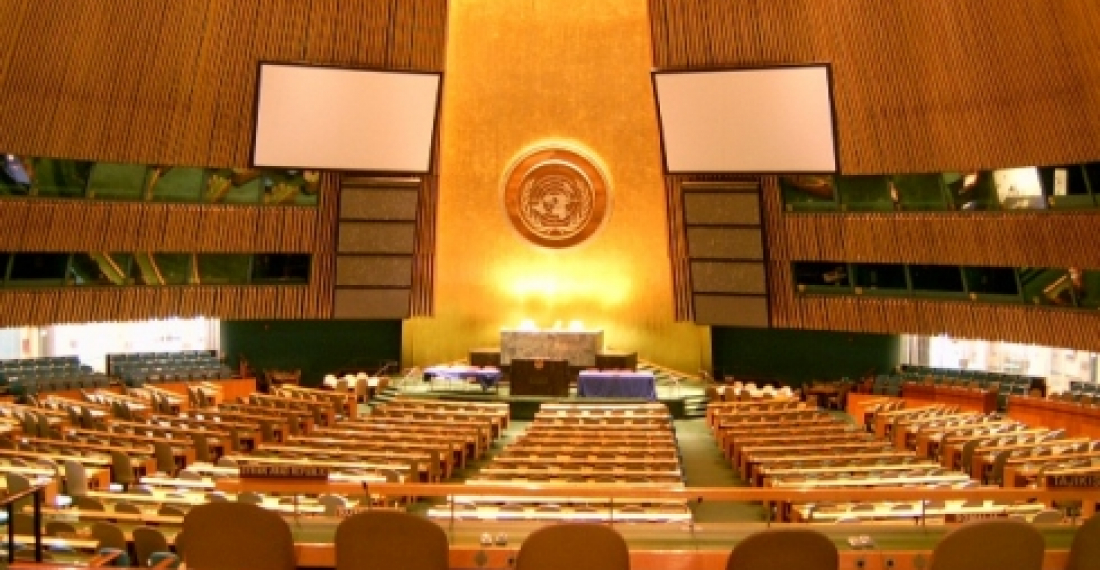
Armenia abstains on Syria vote at UN General Assembly. The resolution was adopted with 133 votes in favour, 12 against and 31 abstentions

The U.N. General Assembly overwhelmingly denounced Syria's crackdown on dissent on Friday in a symbolic effort meant to push the deadlocked Security Council and the world at large into action on stopping the country's civil war. Before the vote, Secretary-General Ban Ki-Moon reminded the Assembly of the fresh violence in the city of Aleppo and drew comparisons between the failure to act in Syria with the international community's failure to protect people from past genocide in Srebrenica, Bosnia, and Rwanda.

"The conflict in Syria is a test of everything this organization stands for," Ban said. "I do not want today's United Nations to fail that test."The vote came after the more powerful Security Council was stopped by a series of Russian and Chinese vetoes on resolutions that would have opened the door to sanctions on Syria. The General Assembly vote was 133 in support of the resolution and 12 against, with 31 abstaining. Syria's ambassador angrily called the vote "a piece of theater."

Russia led the group of countries voting against the resolution which also included Belarus, Bolivia, China, Cuba, Democratic People’s Republic of Korea, Iran, Myanmar, Nicaragua, Syria, Venezuela, Zimbabwe.

The other nine countries members of the CIS were split in their vote: Azerbaijan, Ukraine and Moldova voted for the resolution; Armenia, Kazakhstan and Kyrghistan abstained, and Turkmenistan, Tadjikistan and Uzbekistan were absent from the vote.

Commonspace.eu political editor said in a comment: "Armenia is in a difficult position because it not only needs to take into account Russia's viewpoint, but must also keep in mind the safety of the Armenian community in Syria. The government has already been criticised for not doing enough to protect this community although it is difficult to say what more it can do. Most Armenians in Syria are looking at moving to other Arab countries rather than to Armenia. Armenia's abstention would however have not been well regarded in western capitals, whose governments tried to use the General Assembly to move the UN Security Council into action."

source: commonspace.eu with Associated Press.
Related articles

Editor's choice
News
European leaders set out their plan for Ukraine

European leaders set out their plan for Ukraine

The leaders of Germany, Denmark, Finland, France, Italy, Netherlands, Norway, Poland, Sweden, and United Kingdom, together with the President of the European Council, and the President of the European Commission, o  Monday (15 December) issued a statement, outlining their plan for Ukraine. In their statement, Chancellor Merz, Prime Minister Frederiksen, President Stubb, President Macron, Prime Minister Meloni, Prime Minister Schoof, Prime Minister Støre, Prime Minister Tusk, Prime Minister Kristersson, Prime Minister Starmer, as well as President Costa and President von der Leyen spoke about "Peace for Ukraine". The Leaders welcomed significant progress on President Trump’s efforts to secure a just and lasting peace in Ukraine. They also welcomed the close work between President Zelenskyy’s and President Trump’s teams as well as European teams over the recent days and weeks. They agreed to work together with President Trump and President Zelenskyy to get to a lasting peace which preserves Ukrainian sovereignty and European security. Leaders appreciated the strong convergence between the United States, Ukraine and Europe. Leaders agreed that ensuring the security, sovereignty, and prosperity of Ukraine was integral for wider Euro-Atlantic security. They were clear that Ukraine and its people deserved a prosperous, independent, and sovereign future, free from fear of future Russian aggression. Both the US and European leaders committed to work together to provide robust security guarantees and economic recovery support measures for Ukraine in the context of an agreement on ending the war. This would include commitments to: Provide sustained and significant support to Ukraine to build its armed forces, which should remain at a peacetime level of 800,000 to be able to deter conflict and defend Ukraine’s territory. A European-led ‘multinational force Ukraine’ made up from contributions from willing nations within the framework of the Coalition of the Willing and supported by the US. It will assist in the regeneration of Ukraine’s forces, in securing Ukraine’s skies, and in supporting safer seas, including through operating inside Ukraine. (Click the image to read the statement in full).

Popular