


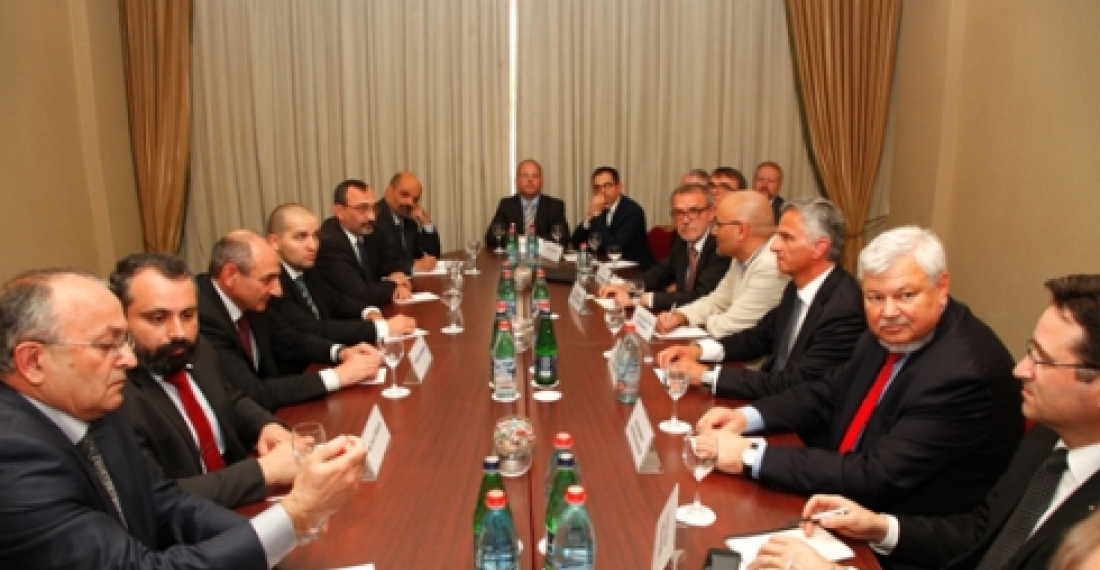
Burkhalter in Armenia (Updated). Swiss President had discussions with the Armenian President, and with the leadership of the self-declared NKR.

The President of the Swiss Confederation is in Armenia on the last leg of his visit to the South Caucasus. Didier Burkhalter, who is also the current Chairman-in-Office of the OSCE, met with the President of Armenia Serzh Sargsyan and other Armenian officials. Shortly after his arrival in Yerevan, Burkhalter visited the "Armenian Genocide Memorial" where he paid his respects to the victims of the atrocities committed in Anatolia at the begining of the 20th century.

Relations between Armenia and Turkey were expected to feature in Burkhalter's talks with the Armenian leadership. Switzerland has been involved for a number of years in intensive mediation efforts between the two countries. The other main issue under discussion was the Karabakh conflict and Swiss attempts to take the ongoing negotiations under the auspices of the OSCE Minsk Process to a more advanced level, leading to the signing of a peace agreement. Azerbaijan gave a cautious welcome to the Swiss initiative during the visit of Burkhalter to Baku on Monday.

Speaking after his meeting with Burkhalter, the Armenian President  Serzh Sargsyan described the Karabakh conflict as a "national liberation struggle" and said that the interests of the people of Nagorno-Karabakh need to be at the centre of any resolution of the conflict.

In Yerevan the President of the Swiss Confederation and current Chairman of the OSCE also met with a delegation from the self-declared Nagorno-Karabakh Republic (NKR) led by its President Bako Sahakyan. This was a rare meeting between a head of state and the leader of an unrecognised entity. President Burkhalter used his role as OSCE chairman to bypass protocol and have the meeting, re-enforcing the Swiss Government's position of the need for an inclusive peace process involving all the interested sides. However despite Sahakyan's call for NKR to join the formal peace process this is unlikely to happen soon, and will depend on considerable progress in the negotiations.

Commonspace.eu political editor said in a comment:

This has been one of the most successful visits by a current OSCE Chairman to the South Caucasus for many years. These annual visits are often seen as a chore by the politicians holding the the OSCE Chairmanship. The Swiss presidency has however clearly prioritised the South Caucasus in its leadership of the OSCE for this year and the visit has been well prepared in a number of ways. the visit has positively contributed to improving the prospects for re-energising the peace process. However both Armenia and Azerbaijan will need to engage constructively and quickly if the momentum is to be maintained.

source: commonspace.eu

photo: Swiss President Didier Burkhalter at a meeting with the leadership of the self-declared Nagorno Karabakh Republic in Yerevan on 4 June 2014.
Related articles

Editor's choice
News
Borrell tells the European Parliament that the situation in Afghanistan was critical, but the EU will remain engaged

Borrell tells the European Parliament that the situation in Afghanistan was critical, but the EU will remain engaged

Borrell underlined that the European Union will make every effort to support the peace process and to remain a committed partner to the Afghan people. "Of course, we will have to take into account the evolving situation, but disengagement is not an option.  We are clear on that: there is no alternative to a negotiated political settlement, through inclusive peace talks.
Editor's choice
News
Germany accuses Russia of cyberattacks and disinformation campaign

Germany accuses Russia of cyberattacks and disinformation campaign

The German government holds Russia responsible for a cyberattack on German air traffic control, and for targeted disinformation campaigns before the last federal election. According to the German Foreign Office in Berlin, the incidents could be clearly attributed to the Russian military intelligence service, the GRU. In response, the Russian ambassador to Berlin was summoned to the Foreign Ministry. "We have been observing a massive increase in threatening hybrid activities by Russia for some time now," a spokesperson for the Foreign Ministry stated. These range from disinformation campaigns and espionage to cyberattacks and sabotage attempts. The aim is to divide society, sow distrust, and undermine confidence in democratic institutions. The spokesperson added that with these actions, Russia is "very concretely threatening our security, not only through its war of aggression against Ukraine, but also here in Germany."  The Foreign Ministry spokesperson explained that the cyberattack on air traffic control in August 2024 was clearly attributed to the hacker collective "APT28," known as "Fancy Bear," and to the responsibility of the Russian military intelligence service, the GRU. Furthermore, it could now be "conclusively stated" that Russia had attempted "to influence and destabilize both the last Federal election and the ongoing internal affairs of the Federal Republic of Germany." There was "absolutely irrefutable evidence" for this". The so-called "Storm 1516" campaign, which has been running since 2024, is allegedly backed by "reliable information" that the Moscow-based think tank "Center for Geopolitical Expertise" is behind it. The Center is also said to be supported by Russian military intelligence. Its primary aim is to influence democratic elections in the West. (Click the image to read more).

Popular

Editor's choice
News
Germany accuses Russia of cyberattacks and disinformation campaign

Germany accuses Russia of cyberattacks and disinformation campaign

The German government holds Russia responsible for a cyberattack on German air traffic control, and for targeted disinformation campaigns before the last federal election. According to the German Foreign Office in Berlin, the incidents could be clearly attributed to the Russian military intelligence service, the GRU. In response, the Russian ambassador to Berlin was summoned to the Foreign Ministry. "We have been observing a massive increase in threatening hybrid activities by Russia for some time now," a spokesperson for the Foreign Ministry stated. These range from disinformation campaigns and espionage to cyberattacks and sabotage attempts. The aim is to divide society, sow distrust, and undermine confidence in democratic institutions. The spokesperson added that with these actions, Russia is "very concretely threatening our security, not only through its war of aggression against Ukraine, but also here in Germany."  The Foreign Ministry spokesperson explained that the cyberattack on air traffic control in August 2024 was clearly attributed to the hacker collective "APT28," known as "Fancy Bear," and to the responsibility of the Russian military intelligence service, the GRU. Furthermore, it could now be "conclusively stated" that Russia had attempted "to influence and destabilize both the last Federal election and the ongoing internal affairs of the Federal Republic of Germany." There was "absolutely irrefutable evidence" for this". The so-called "Storm 1516" campaign, which has been running since 2024, is allegedly backed by "reliable information" that the Moscow-based think tank "Center for Geopolitical Expertise" is behind it. The Center is also said to be supported by Russian military intelligence. Its primary aim is to influence democratic elections in the West. (Click the image to read more).

