


Azerbaijan says it has suffered 12 losses in front line operations since 1 January and that there were 1178 cease fire violations this year.

The Azerbaijani Ministry of Defence has given its own version of cease fire violations, on the line of contact separating Armenian and Azerbaijani forces, over the last ten months.

The spokesman of the Azerbaijani Defence Ministry, Colonel Eldar Sabiroglu, addressing a press conference on the frontline near the region of Terter, was quoted by the APA News Agency as saying that the Azerbaijani Army suffered 12 losses over the last 10 months. He added that according to information released by the Armenian side they suffered 32 losses as a result of shootings.

Sabiroglu said that the ceasefire was mostly violated in  areas around Fuzuli, Terter and Agdam. The spokesman said that the highest tension on the contact line was observed in June.

Commonspace.eu political editor said that if the figures provided are accurate, and the likelyhood is that they are, then this means that with 44 casualties so far this has been the worst year since the two sides agreed a ceace fire way back in 1994. Such high casualties continue to add concerns about the conflict, and the failure of the sides to move forward with its resolution.

source: commonspace.eu with APA

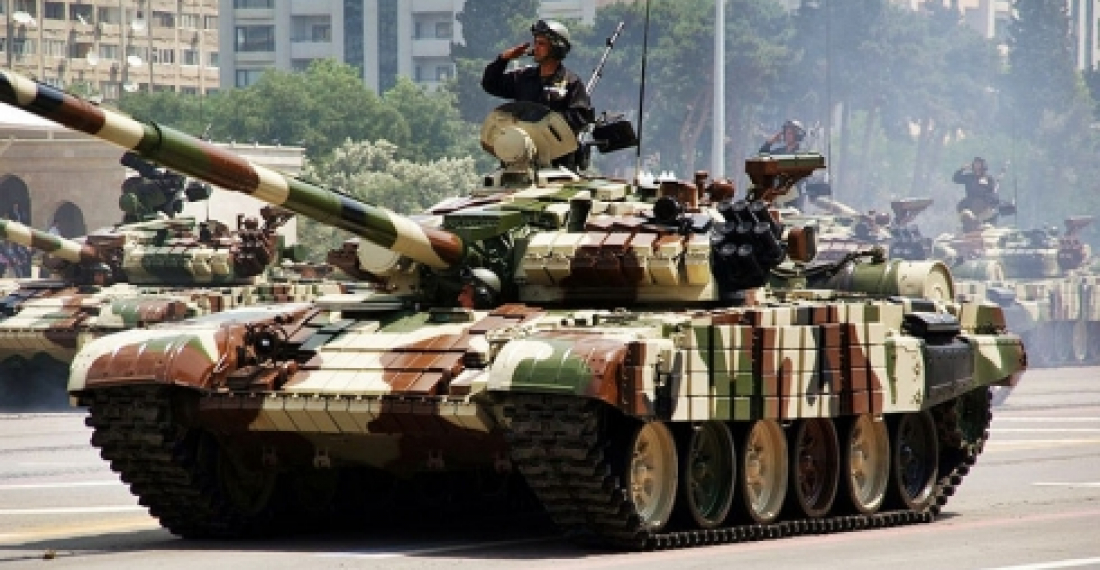
photo: An Azerbaijani tank on parade (archive picture)
Related articles

Editor's choice
News
The great American love-in in the South Caucasus has ended

The great American love-in in the South Caucasus has ended

US Vice President J.D, Vance has ended his whirlwind visit to the South Caucasus having been in Armenia on Monday (9th February), and Azerbaijan on Tuesday (10th February). It was a big success. Vance was on his best behavior, and went out of his way to be nice and complimentary to his hosts. In Yerevan, the Vice President and Armenia’s Prime Minister Nikol Pashinyan signed a joint statement on the completion of negotiations on a 123 Agreement, which establishes a legally binding framework for peaceful nuclear cooperation between the U.S. and partner countries. While in Azerbaijan, Vance and Azerbaijani President Ilham Aliyev signed a Strategic Partnership Charter between the U.S. and Azerbaijan that covers regional connectivity, economic investment, and security and defense issues.  The guests were happy, and the hosts were delighted. Now it is time to put what was agreed in practice. That will be more challenging.

Popular

Editor's choice
Interview
Thursday Interview: Murad Muradov

Thursday Interview: Murad Muradov

Today, commonspace.eu starts a new regular weekly series. THURSDAY INTERVIEW, conducted by Lauri Nikulainen, will host  persons who are thinkers, opinion shapers, and implementors in their countries and spheres. We start the series with an interview with Murad Muradov, a leading person in Azerbaijan's think tank community. He is also the first co-chair of the Action Committee for a new Armenian-Azerbaijani Dialogue. Last September he made history by being the first Azerbaijani civil society activist to visit Armenia after the 44 day war, and the start of the peace process. Speaking about this visit Murad Muradov said: "My experience was largely positive. My negative expectations luckily didn’t play out. The discussions were respectful, the panel format bringing together experts from Armenia, Azerbaijan, and Turkey was particularly valuable during the NATO Rose-Roth Seminar in Yerevan, and media coverage, while varied in tone, remained largely constructive. Some media outlets though attempted to represent me as more of a government mouthpiece than an independent expert, which was totally misleading.  Overall, I see these initiatives as important steps in rebuilding trust and normalising professional engagement. The fact that soon a larger Azerbaijani civil society visits to Armenia followed, reinforces the sense that this process is moving in the right direction." (click the image to read the interview in full)


