Armenia and Azerbaijan assess situation after dozens are killed in Karabakh.

The Presidents of Armenia and Azerbaijan convened their respective national security councils following clashes on Saturday in the Karabakh conflict zone which left dozens of their soldiers killed and many more wounded. Both sides also report civilian casualties.

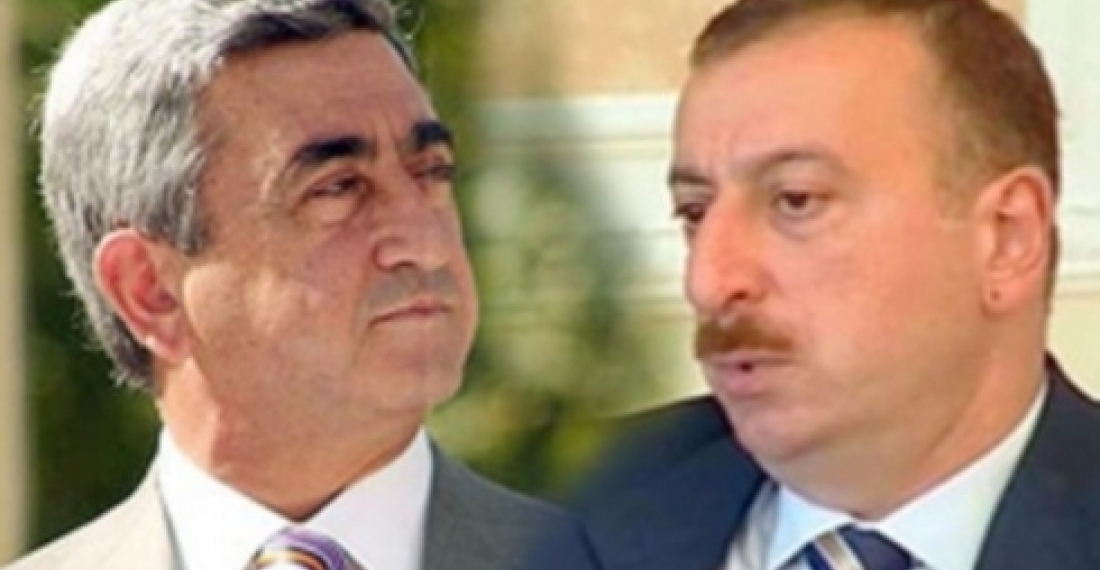
President Serzh Sargsyan of Armenia and President Ilham Aliyev of Azerbaijan had both just flown back home from Washington where they were attending an International nuclear security summit hosted by President Obama.

Addressing the Armenian National Security Council in Yerevan, President Sargsyan pledged to stand by the population of Nagorno Karabakh and proposed that Armenia and the self-declared Nagorno-Karabakh Republic should sign "an agreement on mutual assistance". "Armenia will properly fulfill its obligation in terms of ensuring the security of the Nagorno-Karabakh population, and we also have the legal right to this: we are a party to the ceasefire agreement signed in 1994," Sargsyan was quoted by the Armenian media as saying..

During the meeting the Armenian President confirmed that 18 Armenian soldiers were killed in the latest fighting and that, about 35 soldiers were wounded.

In Baku, President Ilham Aliev convened a meeting of the Azerbaijani National Security Council. No information was released from the meeting, but earlier an Azerbaijani Ministry of Defence source had confirmed that 12 Azerbaijani soldiers were killed in the conflict. There have also been intensive consultations between Azerbaijan and Turkey over the last twenty four hours. President Aliev spoke with Turkish Prime Minister Davitoglu on Saturday evening, and earlier the Defence Ministers of the two countries also held telephone conversations.

source: commonspace.eu with agencies.
 

Related articles

Editor's choice
News
Pakistan bombs University in nearby Afghanistan

Pakistan bombs University in nearby Afghanistan

Pakistan has bombed a university in Afghanistan, amid an outbreak of new violence between the two neighbours. Pakistan and Afghanistan have accused one another of launching cross-border attacks. Afghanistan’s Taliban authorities said on Monday that four people were killed in attacks in the eastern Kunar province. Pakistani officials reported at least three civilians were injured by gunfire in South Waziristan. The resumption of violence threatens fragile peace talks between the neighbours. The two countries agreed on a fragile ceasefire in March that halted weeks of violence. The Taliban’s Deputy ⁠Spokesperson Hamdullah Fitrat ⁠said that the Pakistani military had launched mortar ⁠and rocket attacks that wounded 45 people. He said that students, women, and children were among those injured as homes and the Sayed Jamaluddin Afghani ⁠University in Kunar province’s capital Asadabad came under fire.  A spokesman for Pakistan’s border forces described the incident in South Waziristan as the most serious clash since the ceasefire was declared. The strikes marked the first major attack since the pair had agreed to halt the violence at peace talks last month, mediated by China. (click image to read full report).

Popular

Editor's choice
Interview
Thursday Interview: Murad Muradov

Thursday Interview: Murad Muradov

Today, commonspace.eu starts a new regular weekly series. THURSDAY INTERVIEW, conducted by Lauri Nikulainen, will host  persons who are thinkers, opinion shapers, and implementors in their countries and spheres. We start the series with an interview with Murad Muradov, a leading person in Azerbaijan's think tank community. He is also the first co-chair of the Action Committee for a new Armenian-Azerbaijani Dialogue. Last September he made history by being the first Azerbaijani civil society activist to visit Armenia after the 44 day war, and the start of the peace process. Speaking about this visit Murad Muradov said: "My experience was largely positive. My negative expectations luckily didn’t play out. The discussions were respectful, the panel format bringing together experts from Armenia, Azerbaijan, and Turkey was particularly valuable during the NATO Rose-Roth Seminar in Yerevan, and media coverage, while varied in tone, remained largely constructive. Some media outlets though attempted to represent me as more of a government mouthpiece than an independent expert, which was totally misleading.  Overall, I see these initiatives as important steps in rebuilding trust and normalising professional engagement. The fact that soon a larger Azerbaijani civil society visits to Armenia followed, reinforces the sense that this process is moving in the right direction." (click the image to read the interview in full)