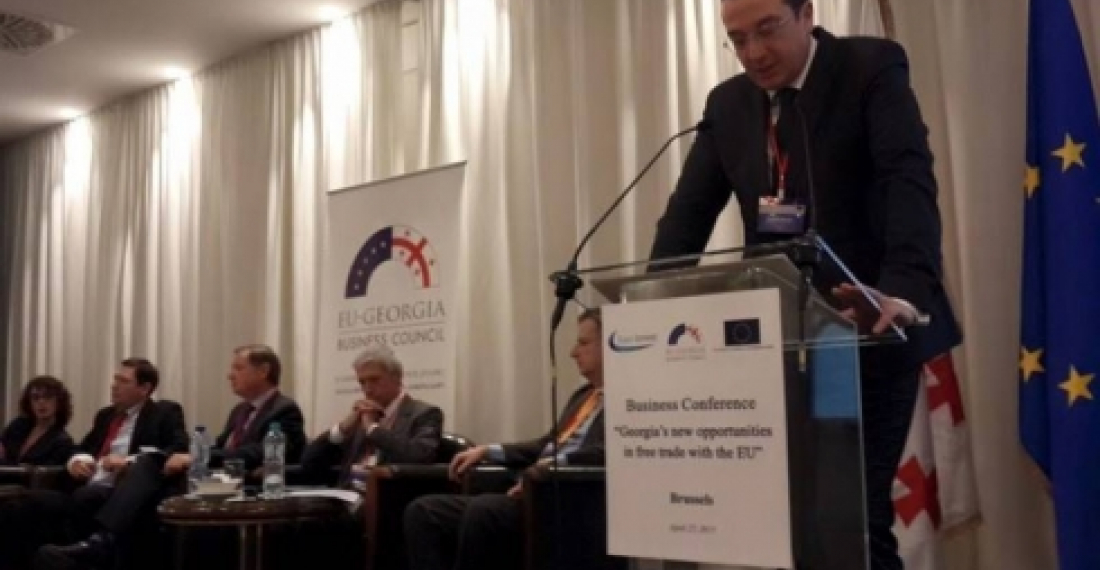
"The Georgian government is under no illusion that the path to implementation of the Association Agreement with the European Union is easy but we are determined to show that we can make possible what once seemed impossible". This was stated by Georgian State Minister for Euro-Atlantic Integration, David Bakradze, when addressing the Conference "Georgia's new opportunities in free trade with the EU" which was held in Brussels on Monday (27 April). The conference was organised by the EU-Georgia Business Council and was attended by representatives of European companies, as well as dozens of Georgian businessmen. The conference offered a good opportunity to assess how the Association Agreement (AA) and the Deep and Comprehensive Free Trade Agreement (DCFTA) that was signed last year is being implemented. BP's Emanul Hatton said that this was the first Georgian business conference of this size to be held in Europe.
In his opening speech at the Conference State Minister Bakradze spoke about measures that were implemented in 2014 as part of the process of harmonising legislation, as well as business practices to enable Georgia to benefit fully from the agreements. He also said that the government gave the highest priority to these tasks and that the Prime Minister, Irakli Gariobashvili has taken personal responsibility to head the monitoring process.
Speaking on behalf of the European Commission, the Director for Neighbourhood East at DG NEAR, Gerhard Schumann Hitzler, said that for Georgia the challenges ahead as it started implementing the AA and DCFTA with the EU were big, but the opportunities are even bigger. Hitzler said that whilst the main benefits from the new agreements will be felt in the medium to long term some benefits should start being felt in the short term also.
In the panel discussions that followed the opening session representatives of Georgian businesses shared their experience as the new arrangements with the EU start taking shape. There was a general feeling of optimism as business representatives outlined how free trade with the EU will help their work. The AA and DCFTA are helping to give Georgia a sound and stable legal framework which foreign investors seek, and the results are already starting to show. Addressing the issue of compliance with EU regulations, one businessman Konstantine Vekua, Director of an agrobusiness company, Nergeta, said that most of the new regulations were demanding that businesses do things that they should be doing anyway, and that whilst there was a slight increase in paperwork everybody should be able to benefit from better business practices.
Whilst speakers in the conference were upbeat about the future, there was also a tone of realism throughout the meeting, with speaker after speaker repeating the need for continued commitment on the part of both the Georgian government, as well as the European Union. This was perhaps best summed up by Dirk Scheubel, from the European External Action Service, who said that Georgia and the EU can congratulate themselves for what they have achieved so far, but it was important not to be complacent. Scheubel highlighted the importance that Georgian society also feels that it is part of the process and remains committed to its success.
The issue of visa free travel for Georgians was brought up in the presentations of both Minister Bakradze, as well as Ambassador Natalie Sabanadze, the Head of the Georgian Mission to the EU. Director Schumann-Hitzler in his intervention said that a report assessing progress towards introducing a visa-free regime would be available in two weeks, and this will enable the EU member states to make decisions going forward.
Commonspace.eu political editor said "the conference was timely, coming just a few weeks before the Riga Summit of the Eastern Partnership where the EU and Georgia will be able to review the progress done so far. The conference struck the right tone, with a sense of optimism, tempered by a heavy doze of realism. The business community was quite unanimous in saying that they liked what they were seeing happening as a result of the first few months of experience of the new relationship with the EU. They were confident looking forward, and assessed the present quite positively too. For those who have followed Georgian affairs for a long time this was a happy departure from the past when assessments of Georgia were either full of doom and gloom or full of unrealistic and exaggerated predictions. For both Georgia and for the European Union there is now too much at stake for mistakes to be made. The two sides must remain engaged and focused, and must also be able to communicate their actions to society in general. The fact that those attending the Brussels conference on Monday seem to have well understood this is already a positive development."
source: commonspace.eu
photo: Georgian State Minister David Bakradze addressing the conference "Georgia's new opportunities in free trade with the EU" at the Radisson Blu Ropyal Hotel in Brussels on Monday, 27 April 2015.