


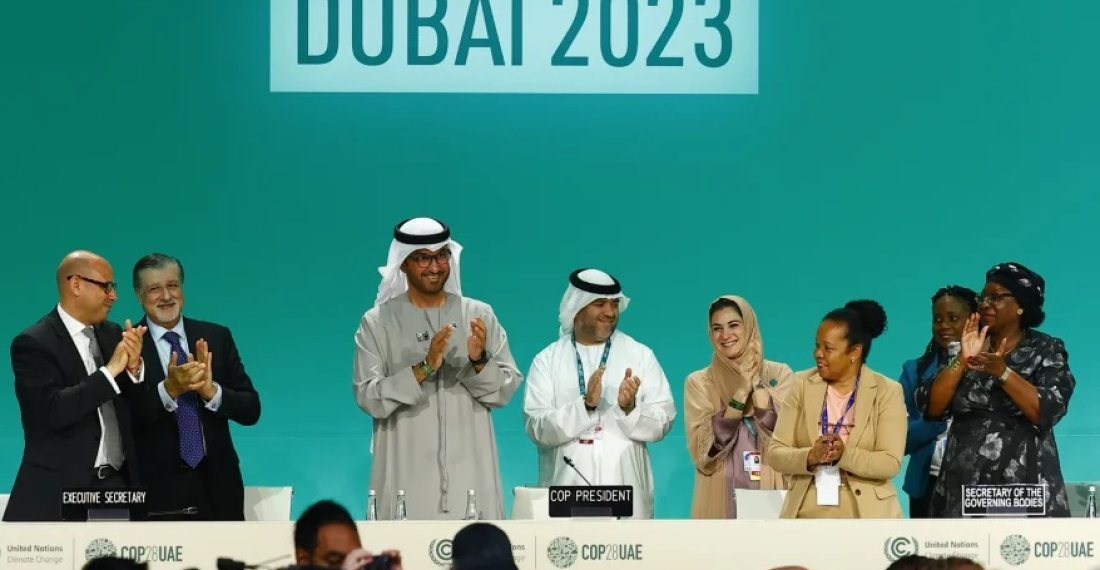
"COP28 Declaration on Climate, Relief, Recovery and Peace" lays a solid foundation for future work

At the COP28 summit held in Dubai last November, for the first time a day dedicated to peace was marked, during which the "COP28 Declaration on Climate, Relief, Recovery and Peace" was launched. The declaration, endorsed by more than a hundred countries and international organisations, highlights a commitment by the international community to act on the vital impact of climate change "in situations of fragility, conflict or severe humanitarian needs".

The declaration lays a solid basis for future work on the nexus between climate change, peace and security.

The urgency of the topic of climate change, and of the action needed to stop and reverse it, is increasingly starkly evident. There is now also no doubt that the problem is multidimensional and has implications right across the agenda of the international community. This is reflected in recent discussions in the UN Security Council, where the nexus Climate Change, Peace and Security, has been discussed frequently, including in June 2023 at a Ministerial Level Session convened by the UAE (9345th meeting), and in February 2024, in the discussions on food insecurity convened by Guyana (9547th meeting). 

There is an increasing need for the international community to develop a shared and enhanced understanding that climate change and environmental degradation lead to spiralling instability and conflicts, and vice versa, as well as to human suffering, resource scarcity including water and food insecurity, internal displacement and forced migration, as was stated in a recent statement by the Council of the European Union.

It is now necessary, on the basis of the "COP28 Declaration on Climate, Relief, Recovery and Peace" for the international community, working with non-governmental stakeholders, to develop a road-map for future action. Work in this direction must be done ahead of the COP29 meeting in November in Baku.

You can read the full text of the "COP28 Declaration on Climate, Relief, Recovery and Peace" on the COP28 website here
source: This editorial comment was prepared by the editorial team of commonspace.eu
photo:The closing session of COP28 in Dubai, UAE in December 2023 (photo courtesy of the press service of the Ministry of Foreign Affairs of the UAE).

Related articles

Editor's choice
News
Borrell tells the European Parliament that the situation in Afghanistan was critical, but the EU will remain engaged

Borrell tells the European Parliament that the situation in Afghanistan was critical, but the EU will remain engaged

Borrell underlined that the European Union will make every effort to support the peace process and to remain a committed partner to the Afghan people. "Of course, we will have to take into account the evolving situation, but disengagement is not an option.  We are clear on that: there is no alternative to a negotiated political settlement, through inclusive peace talks.
Editor's choice
News
G7 foreign ministers issue wide ranging statement after their meeting in Canada

G7 foreign ministers issue wide ranging statement after their meeting in Canada

The Foreign Ministers of Canada, France, Germany, Italy, Japan, the United Kingdom, and the United States of America, and the High Representative of the European Union, met under Canada’s G7 Presidency, in Niagara, on November 11-12, 2025. The Foreign Ministers of Brazil, India, the Kingdom of Saudi Arabia, Mexico, the Republic of Korea, South Africa, and Ukraine, also joined the meeting for discussions on maritime security and prosperity, critical minerals, economic resilience and energy security. At the end of their meeting the G7 foreign ministers said: We reaffirmed our unwavering support for Ukraine in defending its territorial integrity and right to exist, and its freedom, sovereignty, and independence. We reiterated that an immediate ceasefire is urgently needed. We agreed that the current line of contact should be the starting point of negotiations. We remain committed to the principle that international borders must not be changed by force. We are increasing the economic costs to Russia, and exploring measures against countries and entities that are helping finance Russia’s war efforts. We condemned the provision to Russia of military assistance by DPRK and Iran, and the provision of weapons and dual-use components by China, a decisive enabler of Russia’s war. We acknowledged the ongoing discussions on a wide range of financing options, including further leveraging immobilised Russian Sovereign Assets in our jurisdictions in a coordinated way to support Ukraine. We strongly condemned Russia’s recent direct attacks on energy infrastructure and reaffirmed our support for Ukraine’s energy security. We reiterated our strong support for President Trump’s Comprehensive Plan to End the Gaza Conflict. We welcomed the ceasefire and the release of hostages. We stressed the urgency of returning the remains of deceased hostages. We also welcomed the increased flows of aid, but expressed concern about restrictions that remain in place. We called on all parties to allow for humanitarian assistance without interference at scale, through the United Nations and its agencies, and the Red Crescent, in addition to other international institutions and INGOs, as stipulated in President Trump’s plan. It is vital that all parties continue to engage constructively on the next steps outlined in the Comprehensive Plan, in pursuit of a political horizon for peaceful and prosperous co-existence for the Israeli and Palestinian peoples that advances comprehensive Middle East peace and stability. We will also continue to maintain attention on the situation in the West Bank. (click headline to read more)

Popular

Editor's choice
News
G7 foreign ministers issue wide ranging statement after their meeting in Canada

G7 foreign ministers issue wide ranging statement after their meeting in Canada

The Foreign Ministers of Canada, France, Germany, Italy, Japan, the United Kingdom, and the United States of America, and the High Representative of the European Union, met under Canada’s G7 Presidency, in Niagara, on November 11-12, 2025. The Foreign Ministers of Brazil, India, the Kingdom of Saudi Arabia, Mexico, the Republic of Korea, South Africa, and Ukraine, also joined the meeting for discussions on maritime security and prosperity, critical minerals, economic resilience and energy security. At the end of their meeting the G7 foreign ministers said: We reaffirmed our unwavering support for Ukraine in defending its territorial integrity and right to exist, and its freedom, sovereignty, and independence. We reiterated that an immediate ceasefire is urgently needed. We agreed that the current line of contact should be the starting point of negotiations. We remain committed to the principle that international borders must not be changed by force. We are increasing the economic costs to Russia, and exploring measures against countries and entities that are helping finance Russia’s war efforts. We condemned the provision to Russia of military assistance by DPRK and Iran, and the provision of weapons and dual-use components by China, a decisive enabler of Russia’s war. We acknowledged the ongoing discussions on a wide range of financing options, including further leveraging immobilised Russian Sovereign Assets in our jurisdictions in a coordinated way to support Ukraine. We strongly condemned Russia’s recent direct attacks on energy infrastructure and reaffirmed our support for Ukraine’s energy security. We reiterated our strong support for President Trump’s Comprehensive Plan to End the Gaza Conflict. We welcomed the ceasefire and the release of hostages. We stressed the urgency of returning the remains of deceased hostages. We also welcomed the increased flows of aid, but expressed concern about restrictions that remain in place. We called on all parties to allow for humanitarian assistance without interference at scale, through the United Nations and its agencies, and the Red Crescent, in addition to other international institutions and INGOs, as stipulated in President Trump’s plan. It is vital that all parties continue to engage constructively on the next steps outlined in the Comprehensive Plan, in pursuit of a political horizon for peaceful and prosperous co-existence for the Israeli and Palestinian peoples that advances comprehensive Middle East peace and stability. We will also continue to maintain attention on the situation in the West Bank. (click headline to read more)

