


Swiss OSCE Chairmanship outlines strategy for South Caucasus and of "a security community for the benefit of everyone".

The Head of the Swiss Federal Department for Foreign Affairs and current Chairman in Office of the Organisation for Security and Co-operation in Europe, Didier Burkhalter, this morning addressed the Permanent Council of the organisation in Vienna, outlining a vision for "seizing opportunities to create a security community for the benefit of everyone". In the wide-ranging speech the Head of Swiss diplomacy said,

"The Swiss Chairmanship will focus on incremental progress rather than any new grand designs. Our ambition is to reinforce positive dynamics in the OSCE that allow participating States to gradually increase their level of security and their mutual understanding. The OSCE provides opportunities for all of us. As Chairperson- in-Office, I call upon you to seize these opportunities."

Speaking about the conflicts in the South Caucasus, Burkhalter said that the strategy of the Swiss Chairmanship will focus on dialogue and confidence-building. He said:

"As for the protracted conflicts, it is the view of the Swiss Chairmanship that we all have a collective responsibility to contribute to their fair and sustainable settlement. We are well aware that progress may not come overnight, and that no settlement will be feasible unless the parties are committed to it. However, we firmly believe that it is not an option to simply wait and see in these conflicts. We will work hard to move forward, proceeding step by step.

In the South Caucasus, there have been some encouraging signs concerning the Nagorno-Karabakh conflict in recent weeks. High-level contacts have intensified since the meeting of the presidents of Armenia and Azerbaijan on 19 November in Vienna. Incidents at the Line of Contact do, however, remain a matter of great concern. And we all are under no illusion that the road to peace remains long and winding.

The Swiss Chairmanship will support the efforts of the co-chairs of the Minsk Group through Ambassador Kasprzyk, my Personal Representative for this conflict. We will also encourage contacts between the civil societies of Armenia and Azerbaijan and between experts.

Regarding the conflict in Georgia, the Geneva International Discussions mark a unique platform which should be strengthened to lay the ground for a conflict settlement. Ambassador Gnädinger, my Special Representative for the South Caucasus, will co-chair the Geneva Discussions, together with the representatives of the EU and the UN.

We will encourage the participants of the Geneva Discussions to seek status-neutral solutions for a range of conflict-related problems. The Incident Prevention and Response Mechanism will remain a crucial element to stabilize the security situation on the ground.

The Swiss Chairmanship is also ready to re-launch a discussion on the OSCE presence in Georgia, provided that the stakeholders show flexibility and creativity regarding the institutional setup of the OSCE presence."

You may read the full text of the speech of the Swiss Chairman-In-Office of the OSCE to the Permanent Council in Vienna on 16 January 2014 here

source:commonspace.eu with the Swiss Chairmanship of the OSCE

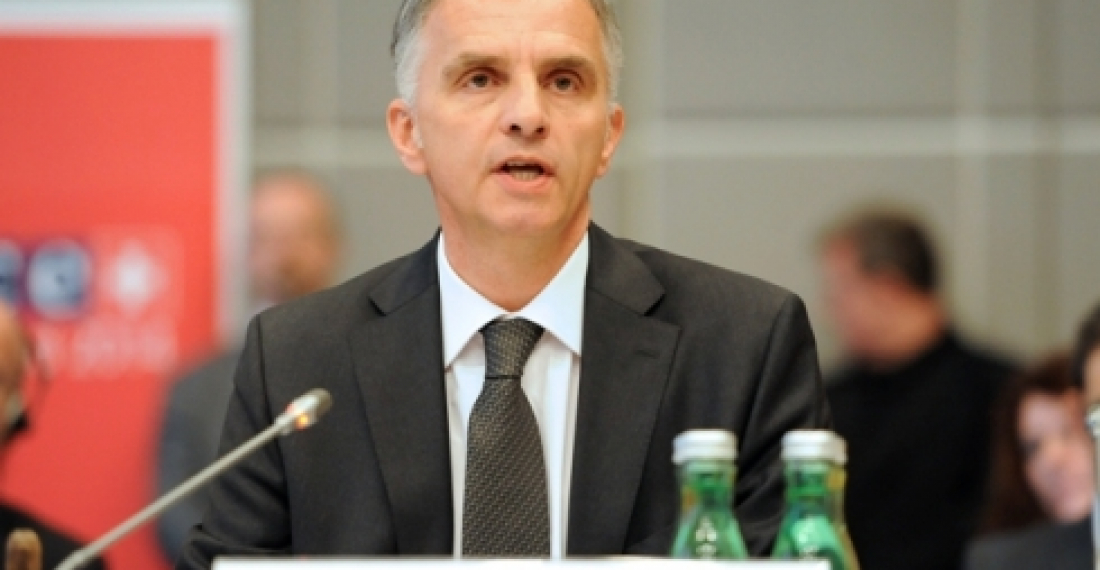
photo: Didier Burkhalter, the Chairman-in-Office of the OSCE for 2014. (picture courtesy of OSCE)
Related articles

Editor's choice
News
Borrell tells the European Parliament that the situation in Afghanistan was critical, but the EU will remain engaged

Borrell tells the European Parliament that the situation in Afghanistan was critical, but the EU will remain engaged

Borrell underlined that the European Union will make every effort to support the peace process and to remain a committed partner to the Afghan people. "Of course, we will have to take into account the evolving situation, but disengagement is not an option.  We are clear on that: there is no alternative to a negotiated political settlement, through inclusive peace talks.
Editor's choice
News
Pope's visit to Türkiye and Lebanon has a strong ecumenical character, and places interreligious dialogue at its centre

Pope's visit to Türkiye and Lebanon has a strong ecumenical character, and places interreligious dialogue at its centre

Pope Leo XIV has begun the first overseas trip of his pontificate, a six-day visit to Türkiye and Lebanon, which started yesterday (27 November) and ends on Tuesday (2 December). According to Vatican Radio, the visit "carries a strong ecumenical character and places interreligious dialogue at its centre. It will also be a moment of closeness to Christian communities and local populations across the region".   During nearly a week in the region, Pope Leo XIV will meet civil and religious authorities, visit mosques and ancient churches, pray at Beirut’s port in memory of the victims of the 2020 explosion, and hold private meetings with Presidents Recep Tayyip Erdoğan and Joseph Aoun.   A highlight of the visit will be a visit to Nicaea, where the Pope will mark the anniversary of the Council of Nicaea. Christians of many traditions recognise the Council of Nicaea as a foundation of shared faith. One of the most anticipated moments will be the Pope’s encounter with Lebanese youth in Bkerké, at the Maronite Patriarchate, a meeting expected to carry strong messages of hope in the Jubilee Year. A central event will be the ecumenical celebration in İznik, where the Pope and Ecumenical Patriarch Bartholomew will walk together toward the ruins of the Basilica of St Neophytos. The prayer, held before icons of Christ and the Council, will conclude with the lighting of a candle—a symbolic gesture of unity. The journey will also highlight interreligious engagement.   Memorable moments are expected throughout the trip: a wreath at Atatürk’s mausoleum, prayer inside the Blue Mosque, Mass at Istanbul’s Volkswagen Arena, the planting of a cedar at the presidential palace in Beirut, and prayer at the tomb of St Charbel in Lebanon. The Vatican said that "Pope Leo XIV’s pilgrimage to Türkiye and Lebanon aims to offer a voice of peace, unity, and hope at the heart of the Middle East."

Popular

Editor's choice
News
Pope's visit to Türkiye and Lebanon has a strong ecumenical character, and places interreligious dialogue at its centre

Pope's visit to Türkiye and Lebanon has a strong ecumenical character, and places interreligious dialogue at its centre

Pope Leo XIV has begun the first overseas trip of his pontificate, a six-day visit to Türkiye and Lebanon, which started yesterday (27 November) and ends on Tuesday (2 December). According to Vatican Radio, the visit "carries a strong ecumenical character and places interreligious dialogue at its centre. It will also be a moment of closeness to Christian communities and local populations across the region".   During nearly a week in the region, Pope Leo XIV will meet civil and religious authorities, visit mosques and ancient churches, pray at Beirut’s port in memory of the victims of the 2020 explosion, and hold private meetings with Presidents Recep Tayyip Erdoğan and Joseph Aoun.   A highlight of the visit will be a visit to Nicaea, where the Pope will mark the anniversary of the Council of Nicaea. Christians of many traditions recognise the Council of Nicaea as a foundation of shared faith. One of the most anticipated moments will be the Pope’s encounter with Lebanese youth in Bkerké, at the Maronite Patriarchate, a meeting expected to carry strong messages of hope in the Jubilee Year. A central event will be the ecumenical celebration in İznik, where the Pope and Ecumenical Patriarch Bartholomew will walk together toward the ruins of the Basilica of St Neophytos. The prayer, held before icons of Christ and the Council, will conclude with the lighting of a candle—a symbolic gesture of unity. The journey will also highlight interreligious engagement.   Memorable moments are expected throughout the trip: a wreath at Atatürk’s mausoleum, prayer inside the Blue Mosque, Mass at Istanbul’s Volkswagen Arena, the planting of a cedar at the presidential palace in Beirut, and prayer at the tomb of St Charbel in Lebanon. The Vatican said that "Pope Leo XIV’s pilgrimage to Türkiye and Lebanon aims to offer a voice of peace, unity, and hope at the heart of the Middle East."

