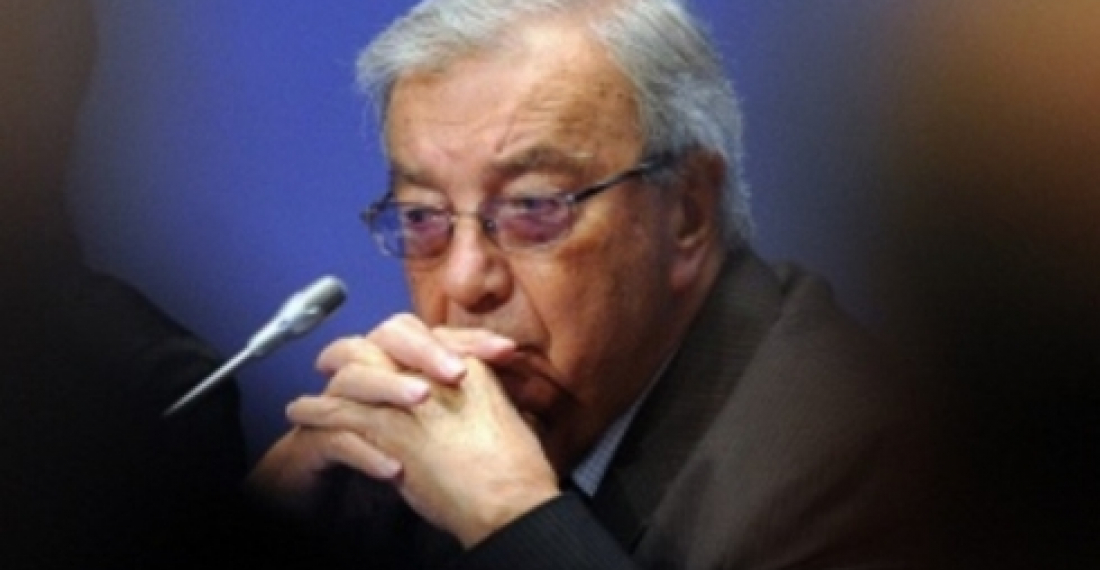
Russia mourns death of wise statesman Yevgeni Primakov.

Russian leaders and world statesmen have expressed sorrow following news on Friday of the death of former Russian Prime Minister, Yevgeni Primakov.

A spokeman for President Vladimir Putin said, "The president expressed his deep regrets to the family of Yevgeny Maximovich and all those who knew him, his close associates". The Russian president said on many occasions that "Yevgeny Maximovich was a statesman, a scientist and a politician and left a huge heritage after him," the Kremlin spokesman said. Putin had met Primakov for the last time about a month ago.

Yevgeny Primakov was a Russian statesman, public personality, scholar, and diplomat. Born to a mixed Russian-Jewish family in Kiev on October 19, 1929, he grew up in Tbilisi and graduated from Moscow State University's Institute of the Orient in 1953.

His extensive career spans years of journalistic activity for Arabic Service of Radio Moscow and for the Communist Party's main daily Pravda, research and administrative positions at the Institute of World Economy and International Relations reporting to the national Academy of Sciences, and directorship at the Academy's Institute of Oriental Studies.

In addition to this, he was a member of Mikhail Gorbachev's Presidential Council and a deputy chairman of the Soviet Peace Committee. In 1991, he took charge of the Soviet (and then Russian) Foreign Intelligence Service, and later served as Russian Foreign Minister.

In August 1998, President Boris Yeltsin appointed him Russia's Prime Minister - a job that he took up at a critical moment when the Russian government had just defaulted on its short-term sovereign liabilities and the nation had plunged into an economic crisis.

Commonspace.eu political editor said in a comment that "whilst Russians normally admire strong leaders who project the image of a strong Russia, Primakov was admired and respected because he was considered wise. While he was always loyal to the state - be it the USSR or its successor the Russian Federation, Primakov was often cautious. A case in point was what was probably his last significant public intervention shortly after the start of the Ukraine crisis last year when he warned his compatriots against indulging in cold war rhetoric. He was a realist who accepted that once the Soviet Union disintegrated it was impossible to put back together, and was therefore a proponent of a new basis for relations, with countries such as Georgia. He also continued to advocate close partnership with western countries as an important factor for the modernisation and development of Russia, particularly in the economic sphere. He was widely respected by all recent Russian leaders, including President Putin, who often asked him for advice. His words of wisdom will be missed, but his death may help focus on some of the important messages he conveyed in his lifetime, particularly those that impact current relations between Russia and the west."

source: commonspace.eu with Itar-Tass
 

Related articles

Editor's choice
News
Borrell tells the European Parliament that the situation in Afghanistan was critical, but the EU will remain engaged

Borrell tells the European Parliament that the situation in Afghanistan was critical, but the EU will remain engaged

Borrell underlined that the European Union will make every effort to support the peace process and to remain a committed partner to the Afghan people. "Of course, we will have to take into account the evolving situation, but disengagement is not an option.  We are clear on that: there is no alternative to a negotiated political settlement, through inclusive peace talks.
Editor's choice
News
NATO Chief says war is on Europe's doorstep, and warns against complacency

NATO Chief says war is on Europe's doorstep, and warns against complacency

Russia could attack a Nato country within the next five years, the Secretary General of NATO, Mark Rutte, said in a stark new warning. "Nato's own defences can hold for now," Rutte warned in Berlin, but conflict was "next door" to Europe and he feared "too many are quietly complacent, and too many don't feel the urgency, too many believe that time is on our side. "Russia is already escalating its covert campaign against our societies," Rutte said in a speech in Germany. "We must be prepared for the scale of war our grandparents or great-grandparents endured." Earlier this month, Russia's President Vladimir Putin said his country was not planning to go to war with Europe, but it was ready "right now" if Europe wanted to - or started a war. But similar reassurances were given by Moscow in 2022, just before 200,000 Russian troops crossed the border and invaded Ukraine. Putin has accused European countries of hindering US efforts to bring peace in Ukraine - a reference to the role Ukraine's European allies have recently played in trying to change a US peace plan to end the war, whose initial draft was seen as favouring Russia. But Putin was not sincere, Nato's secretary-general said in the German capital, Berlin. Supporting Ukraine, he added, was a guarantee for European security. "Just imagine if Putin got his way; Ukraine under the boot of Russian occupation, his forces pressing against a longer border with Nato, and the significantly increased risk of an armed attack against us." Russia's economy has been on a war footing for more than three years now - its factories churn out ever more supplies of drones, missiles and artillery shells. According to a recent report by the Kiel Institute for the World Economy, Russia has been producing each month around 150 tanks, 550 infantry fighting vehicles, 120 Lancet drones and more than 50 artillery pieces. The UK, and most of its Western allies, are simply not anywhere near this point. Analysts say it would take years for Western Europe's factories to come close to matching Russia's mass-production of weapons. "Allied defence spending and production must rise rapidly, our armed forces must have what they need to keep us safe," the Nato chief said.

Popular

Editor's choice
News
NATO Chief says war is on Europe's doorstep, and warns against complacency

NATO Chief says war is on Europe's doorstep, and warns against complacency

Russia could attack a Nato country within the next five years, the Secretary General of NATO, Mark Rutte, said in a stark new warning. "Nato's own defences can hold for now," Rutte warned in Berlin, but conflict was "next door" to Europe and he feared "too many are quietly complacent, and too many don't feel the urgency, too many believe that time is on our side. "Russia is already escalating its covert campaign against our societies," Rutte said in a speech in Germany. "We must be prepared for the scale of war our grandparents or great-grandparents endured." Earlier this month, Russia's President Vladimir Putin said his country was not planning to go to war with Europe, but it was ready "right now" if Europe wanted to - or started a war. But similar reassurances were given by Moscow in 2022, just before 200,000 Russian troops crossed the border and invaded Ukraine. Putin has accused European countries of hindering US efforts to bring peace in Ukraine - a reference to the role Ukraine's European allies have recently played in trying to change a US peace plan to end the war, whose initial draft was seen as favouring Russia. But Putin was not sincere, Nato's secretary-general said in the German capital, Berlin. Supporting Ukraine, he added, was a guarantee for European security. "Just imagine if Putin got his way; Ukraine under the boot of Russian occupation, his forces pressing against a longer border with Nato, and the significantly increased risk of an armed attack against us." Russia's economy has been on a war footing for more than three years now - its factories churn out ever more supplies of drones, missiles and artillery shells. According to a recent report by the Kiel Institute for the World Economy, Russia has been producing each month around 150 tanks, 550 infantry fighting vehicles, 120 Lancet drones and more than 50 artillery pieces. The UK, and most of its Western allies, are simply not anywhere near this point. Analysts say it would take years for Western Europe's factories to come close to matching Russia's mass-production of weapons. "Allied defence spending and production must rise rapidly, our armed forces must have what they need to keep us safe," the Nato chief said.