


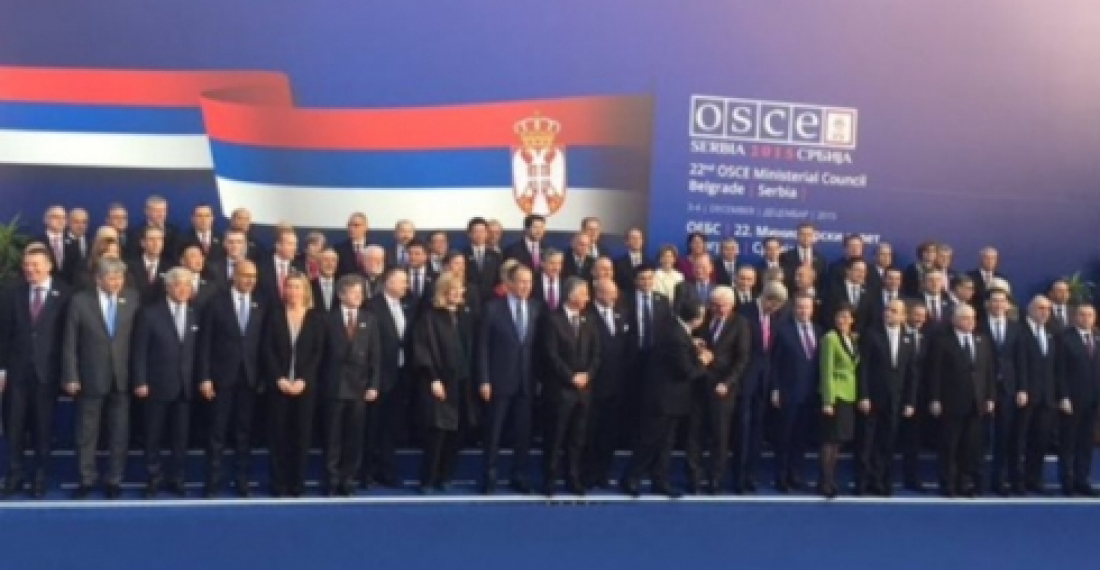
OSCE Foreign Ministers meeting opens in Belgrade.

The 22nd Ministerial Council of the Organisation for Security and Co-operation in Europe (OSCE) opened this morning in Belgrade, capital of Serbia. Some 40 Foreign Affairs Ministers and a number of high-level diplomats from across the OSCE region, gathered at the Kombank Arena, in Belgrade, at the invitation of the 2015 OSCE Chairperson-in-Office, Serbia's First Deputy Prime Minister and Foreign Minister Ivica Dačić.

In his opening remarks the Prime Minister of Serbia, Alexander Vucic, urged participants to work together to strengthen the principles of the Helsinki Final Act.

The Ministerial Council is the central decision-making and governing body of the OSCE. The meeting, held annually, provides foreign ministers and more than 70 delegations of OSCE participating States, partner countries and several international organizations an opportunity to review and assess the Organization's activities during the past year and offer national viewpoints on security matters.

The foreign ministers will discuss the crisis in and around Ukraine, migration, terrorism and other common challenges within and beyond the OSCE area, as well as ways to rebuild consensus on European security as a common project. The Council will set the course for the future work of the organization with Germany taking up the Chairmanship from 1 January 2016.

source: commonspace.eu with osce.org

photo: The Foreign Ministers of OSCE member states and partner countries before the opening ceremony of the 22 Ministerial Council of the organisation opened in Belgrade on Thursday, 3 December 2015. (picture courtesy of osce.org).
 

Related articles

Editor's choice
News
International Election Observation Mission finds that Armenians were offered a genuine choice against a backdrop of direct foreign pressure and uneven campaign opportunities

International Election Observation Mission finds that Armenians were offered a genuine choice against a backdrop of direct foreign pressure and uneven campaign opportunities

Farah Karimi, Special Co-ordinator and leader of the short-term OSCE observer mission, said that: “The concentration of arrests and criminal prosecutions against opposition figures contributed to perceptions of selective justice, while a polarized media landscape, inflammatory rhetoric, misinformation, and persistent foreign pressure and interference challenged Armenia’s democratic resilience and the integrity of public debate. This underscores the importance of continued efforts to strengthen democratic institutions, safeguard fundamental freedoms, and foster public trust in democratic processes. ” Damien Cottier, Head of the delegation of the Parliamentary Assembly of the Council of Europe, argued that “The Armenian elections took place in a particularly tense geopolitical context, with direct foreign interference. In particular, pressure and threats from Russian authorities reached an unprecedented and worrying level.” Janez Lenarčič, head of the election observation mission from the OSCE Office for Democratic Institutions and Human Rights, stated that “Armenia’s voters were given – and took – the opportunity to make a genuine choice in a professionally managed election process and a vibrant and pluralistic, if often highly polarized campaign. “Unfortunately, they had to make that choice against the backdrop of unprecedented foreign interference and pressure, in the form of punitive trade measures and day-by-day threats of further negative consequences contingent on which choice they made”. == click image to read full report

Popular

Editor's choice
Interview
Thursday Interview: Murad Muradov

Thursday Interview: Murad Muradov

Today, commonspace.eu starts a new regular weekly series. THURSDAY INTERVIEW, conducted by Lauri Nikulainen, will host  persons who are thinkers, opinion shapers, and implementors in their countries and spheres. We start the series with an interview with Murad Muradov, a leading person in Azerbaijan's think tank community. He is also the first co-chair of the Action Committee for a new Armenian-Azerbaijani Dialogue. Last September he made history by being the first Azerbaijani civil society activist to visit Armenia after the 44 day war, and the start of the peace process. Speaking about this visit Murad Muradov said: "My experience was largely positive. My negative expectations luckily didn’t play out. The discussions were respectful, the panel format bringing together experts from Armenia, Azerbaijan, and Turkey was particularly valuable during the NATO Rose-Roth Seminar in Yerevan, and media coverage, while varied in tone, remained largely constructive. Some media outlets though attempted to represent me as more of a government mouthpiece than an independent expert, which was totally misleading.  Overall, I see these initiatives as important steps in rebuilding trust and normalising professional engagement. The fact that soon a larger Azerbaijani civil society visits to Armenia followed, reinforces the sense that this process is moving in the right direction." (click the image to read the interview in full)

