Murder at the Kremlin Walls

Dennis Sammut comments on the assassination of Boris Nemtsov - "a political earthquake that potentially can shake the Russian political establishment from its foundations".

The image of president Putin firmly entrenched in the Kremlin, supported by very high popular ratings, and a large and intricate state and security apparatus that does his bidding, is one that we have got used to, and by and large accept as being the reality of today's modern Russia. Putin's soft totalitarianism does not primarily depend on arrests and torture, relying more on an ineffective judicial system, and a media that has not only been tamed, but has now become an important instrument of cohersion. Sophisticated corruption does not seem to erode the system, as is often the case in other countries, but helps to gel it together.

Yet this picture does not do justice to ongoing political undercurrents in the Russian political space. Putin's success since 1999 can be attributed to his ability to weave together a compact between the oligarchs, the tightly knit state and security establishment that is still embedded in old Soviet ways, and a relatively small but prospering Russian middle class. The mass of the Russian population have by and large been spectators in politics over the fifteen years -  indoctrinated into the Putin project, thanks to a compliant mass media, but also thanks to the fact that most ordinary Russians fear change, which they usually associate with hardship and worse. As long as the government could provide the basic minimum they prefer to acquiesce rather than challenge. This societal compact has up to now made Putin look invincible. The events of the last year have however put this arrangement under question.

Of course, if asked, most Russians will say that their country's annexation of Crimea is a good idea. Whether Russians want to pay the price for such an occupation is however a very different matter. Events in Ukraine have caused deep concern in Russian society. And it is not just simply the price of sanctions and counter sanctions. For most Russian's Ukrainians are brotherly people. There are no racial or religious grounds, as say was the case with Chechnya, around which support for a military adventure could be mustered. That is why Putin had to invent a narrative of Ukraine becoming a fascist state to justify Russian action. Many Russians do not buy into this, which is why many Russian opposition figures have been arguing for some time that Ukraine can become Putin's Achilles heel. Boris Nemtsov was one of them. He was one of a large number of opposition figures who believed that Ukraine can be Putin's undoing. It seems that he has now paid the ultimate price for doing so. On Friday night he was assassinated a few meters away from the walls of the Kremlin.

Nemtsov was a charismatic figure, popular both in Russia and abroad. A liberal reformer who rose to prominence under Boris Yeltsin he was less tainted with some of the pains that those reforms inflicted on the Russian people in the 1990s. After he left government when Yeltsin resigned Nemtsov became an outspoken critic of president Putin and became a thorn in the side of Putin and the establishment. In 2011 he took part in large scale opposition marches that followed controversial elections, and was arrested for some days after. He however, may be even more dangerous for Mr Putin now that he is dead, than alive.

A few days before his death Nemtsov had stated that it could be that Putin will try to kill him. Certainly Nemtsov, together with others who opposed the annexation of Crimea and the war in Ukraine, was freely being branded as a traitor and fifth columnist by the pro Kremlin media.  But did the Kremlin want Nemtsov dead?

President Vladimir Putin was "immediately informed of Nemtsov's murder in Moscow," according to Putin's spokesman. "Putin noted that the violent murder bears the marks of a contract killing and is purely provocative," Dmitry Peskov was quoted by the Russian News Agency, Itar-Tass, as saying.

Provocative to whom and a provocation by whom? That is the question that is being asked today by most Russians. The shock to Russian political society of Nemtsov's murder cannot be underestimated. One can well argue that the murder was too messy, and with too many consequences given Nemtov's high profile, to have been ordered by Putin himself. Yet the murder itself reflects the current tragic state of Russian politics over which President Putin presides. It is a situation that can no longer be ignored by those in the establishment who have up to now preferred to close their eyes, and say that it was all for the sake of Russia and its future.

It has also been clear for some time that within that same establishment there are forces that want to take Russia to the next stage of confrontation with the west, and repress any critics inside the country as a first step. Putin may have a strong hold on power in Russia, but he is not the only power broker. Nemtsov's murder is likely the result of a power struggle within the Kremlin establishment, a power struggle of which we are only thus far seeing the very tip of the iceberg. Nemtsov's murder may end up bringing that power struggle to the open. That can have grave consequences for Russia, but it is possible that that has now become inevitable.

Dennis Sammut is the Executive Director of LINKS (Dialogue, Analysis and Research). He may be contacted at dennis@links-dar.org.
source: Dennis Sammut contributed this op-ed to commonspace.eu
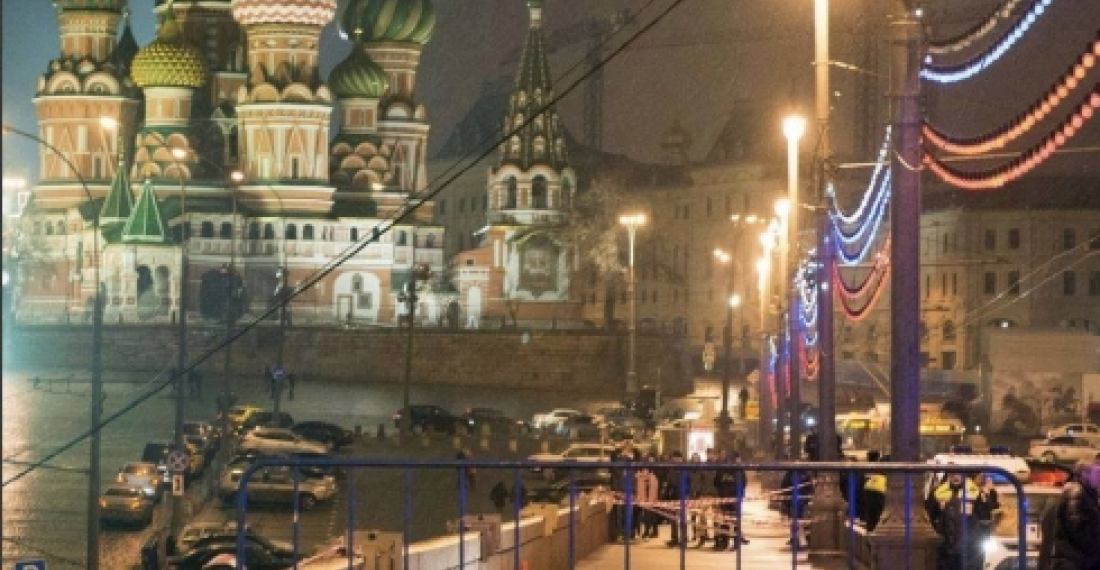
photo: The body of Boris Nemtsov lies on the ground a few hundred meters from the walls of the kremlin after the Russian politician was assassinated on 27 February 2015

Related articles

Editor's choice
News
Borrell tells the European Parliament that the situation in Afghanistan was critical, but the EU will remain engaged

Borrell tells the European Parliament that the situation in Afghanistan was critical, but the EU will remain engaged

Borrell underlined that the European Union will make every effort to support the peace process and to remain a committed partner to the Afghan people. "Of course, we will have to take into account the evolving situation, but disengagement is not an option.  We are clear on that: there is no alternative to a negotiated political settlement, through inclusive peace talks.
Editor's choice
News
NATO Chief says war is on Europe's doorstep, and warns against complacency

NATO Chief says war is on Europe's doorstep, and warns against complacency

Russia could attack a Nato country within the next five years, the Secretary General of NATO, Mark Rutte, said in a stark new warning. "Nato's own defences can hold for now," Rutte warned in Berlin, but conflict was "next door" to Europe and he feared "too many are quietly complacent, and too many don't feel the urgency, too many believe that time is on our side. "Russia is already escalating its covert campaign against our societies," Rutte said in a speech in Germany. "We must be prepared for the scale of war our grandparents or great-grandparents endured." Earlier this month, Russia's President Vladimir Putin said his country was not planning to go to war with Europe, but it was ready "right now" if Europe wanted to - or started a war. But similar reassurances were given by Moscow in 2022, just before 200,000 Russian troops crossed the border and invaded Ukraine. Putin has accused European countries of hindering US efforts to bring peace in Ukraine - a reference to the role Ukraine's European allies have recently played in trying to change a US peace plan to end the war, whose initial draft was seen as favouring Russia. But Putin was not sincere, Nato's secretary-general said in the German capital, Berlin. Supporting Ukraine, he added, was a guarantee for European security. "Just imagine if Putin got his way; Ukraine under the boot of Russian occupation, his forces pressing against a longer border with Nato, and the significantly increased risk of an armed attack against us." Russia's economy has been on a war footing for more than three years now - its factories churn out ever more supplies of drones, missiles and artillery shells. According to a recent report by the Kiel Institute for the World Economy, Russia has been producing each month around 150 tanks, 550 infantry fighting vehicles, 120 Lancet drones and more than 50 artillery pieces. The UK, and most of its Western allies, are simply not anywhere near this point. Analysts say it would take years for Western Europe's factories to come close to matching Russia's mass-production of weapons. "Allied defence spending and production must rise rapidly, our armed forces must have what they need to keep us safe," the Nato chief said.

Popular

Editor's choice
News
NATO Chief says war is on Europe's doorstep, and warns against complacency

NATO Chief says war is on Europe's doorstep, and warns against complacency

Russia could attack a Nato country within the next five years, the Secretary General of NATO, Mark Rutte, said in a stark new warning. "Nato's own defences can hold for now," Rutte warned in Berlin, but conflict was "next door" to Europe and he feared "too many are quietly complacent, and too many don't feel the urgency, too many believe that time is on our side. "Russia is already escalating its covert campaign against our societies," Rutte said in a speech in Germany. "We must be prepared for the scale of war our grandparents or great-grandparents endured." Earlier this month, Russia's President Vladimir Putin said his country was not planning to go to war with Europe, but it was ready "right now" if Europe wanted to - or started a war. But similar reassurances were given by Moscow in 2022, just before 200,000 Russian troops crossed the border and invaded Ukraine. Putin has accused European countries of hindering US efforts to bring peace in Ukraine - a reference to the role Ukraine's European allies have recently played in trying to change a US peace plan to end the war, whose initial draft was seen as favouring Russia. But Putin was not sincere, Nato's secretary-general said in the German capital, Berlin. Supporting Ukraine, he added, was a guarantee for European security. "Just imagine if Putin got his way; Ukraine under the boot of Russian occupation, his forces pressing against a longer border with Nato, and the significantly increased risk of an armed attack against us." Russia's economy has been on a war footing for more than three years now - its factories churn out ever more supplies of drones, missiles and artillery shells. According to a recent report by the Kiel Institute for the World Economy, Russia has been producing each month around 150 tanks, 550 infantry fighting vehicles, 120 Lancet drones and more than 50 artillery pieces. The UK, and most of its Western allies, are simply not anywhere near this point. Analysts say it would take years for Western Europe's factories to come close to matching Russia's mass-production of weapons. "Allied defence spending and production must rise rapidly, our armed forces must have what they need to keep us safe," the Nato chief said.