The festivities marking the centennial of the first republics in Armenia, Azerbaijan and Georgia were well deserved, and not without present-day significance for regardless of the managed narratives the powerful messages from a hundred years ago still resonate throughout the region, argues Dennis Sammut in this week's Monday Commentary
In the Caucasus they know how to throw a party, and the 100th anniversary of the declaration of independence and establishment of the three republics was as good an excuse as any for Armenia, Azerbaijan and Georgia to celebrate. They all did it in their own way, and the emphasis was more about the present, than on the past. Yet the political elites in all three feel that they should wrap themselves in the aura of the events of a hundred years ago, and for good reason.
In Georgia, celebrations were held on Saturday - 26 May 1918 is the day Georgian independence and establishment of the first republic was declared. The emphasis was on the continuity of Georgian statehood, but with a contemporary twist. Georgia's "Europeanness" was emphasised - the quest for EU and NATO membership being projected as the next chapter of the story.
Prime Minister Giorgi Kvirikashvili, addressing members of the Georgian diaspora, said ''the event celebrated on 26th May once again presented the importance of the European and democratic traditions and history of Georgia to the entire world. We need to talk more about it. We need to talk more than we did previously about the titanic work performed during 1918-1921.''
The presence at the celebrations of the president of the European Commission, Jean-Claude Junker, was a testimonial that Georgia's goal is not out of reach or irrational, even if for the moment, distant. The memories of 1918-21 also evoke in many Georgians images of their country's attempt to escape Russian power. The first republic was crushed by advancing Bolshevik forces. Not by co-incidence Junker in his speech emphasised that Georgia and Europe are now together and will always be there for each other.
In Azerbaijan and Armenia, the event was celebrated two days later, on 28 May.
Azerbaijan's independence was actually declared in Tbilisi - then the political capital of the region, because Baku was still under the control of unfriendly forces. The anniversary celebrations in Azerbaijan had a somewhat different message attached to them. The founding fathers projected as idealists. It however was up to the present authorities to turn those dreams into reality.
In a speech on the occasion, President Ilham Aliyev said: "Today, independent Azerbaijan is a source of pride for every Azerbaijani. We made the dreams of the founders of the Azerbaijan Democratic Republic come true. We built a state that every Azerbaijani is proud of. I'm sure that if the founders of Azerbaijan Democratic Republic were here today, they would be proud of our country".
In Armenia celebrations were a bit subdued. The new government is only days old. Like the founding fathers of 1918 the present leaders have quite a lot on their plate, with enemies without, as well as within. But Nikol Pashinyan in his speech on the occasion also linked the past with the present, emphasising that it was people's power that enabled Armenians to establish the first republic, and that this people's power had shown itself again in the events of recent weeks.
Pashinyan said that in 1918 "the Armenian people won because they did not pin hopes on others, but on themselves. They won for the first time in 400 years. The Armenian people won because they decided to win." He added that each and every citizen must feel himself as the master of his country, and that in 2018 "the Armenian people once again pinned their hope on themselves, rather than on others."
Historical assessments of the first republics in both official and alternative narratives, glossed over many of the issues of the time. Instead a more idyllic picture of progressive minded politicians thinking ahead of their time, and leading their countries to independence was the common thread. The truth is somewhat less romantic, even if no less heroic. The region was in chaos. Independence, as they soon found out, was far from an easy course of action. Many of those who ended up being the protagonists of it, initially hesitated, and would have preferred the security of being in a bigger entity. There was lawlessness, poverty, and outright war between the three countries, partly because even by the time their independence was recognised by the victorious powers in their marathon conference in Versailles, their borders were not fully and properly defined. Around them bigger conflicts were ongoing, which they knew they were not able to escape from. But despite all this what happened in 1918 was a tremendously huge event for the region, and the key defining moment for the three modern states of Armenia, Azerbaijan and Georgia.
1918 lit a beacon, that has not been extinguished since. It remains a reference point that all look back to. The Sovietisation of the region had also to take it into account. The three republics were absorbed in the Soviet system as free-standing entities. When the communists tried to erase the memory by creating one Transcaucasian republic it was a complete failure, and they quickly had to revert to three separate entities - all given the status of full union republics. So, when the Soviet Union collapsed no one questioned their right to statehood. In fact, the official narrative is that in 1991, the 1918-20 short-lived statehood was simply restored.
Yet the 1918 beacon is not only about constitutional niceties. For all their shortcomings the first republics were also models. They were multi-party democracies; women were given the right to vote, long before in many more advanced European countries. The emphasis was on change and modernity. They set a benchmark that no contemporary politician can ignore.
So, the festivities were well deserved, and not without present significance. And regardless of the managed narratives the powerful messages from a hundred years ago still resonate throughout the region.
source: Dennis Sammut is the Director of LINKS (Dialogue, Analysis and Research). His Monday commentary is published weekly on commonspace.eu. dennis@links-dar.org
The views expressed in opinion pieces and commentaries do not necessarily reflect the position of commonspace.eu or its partners
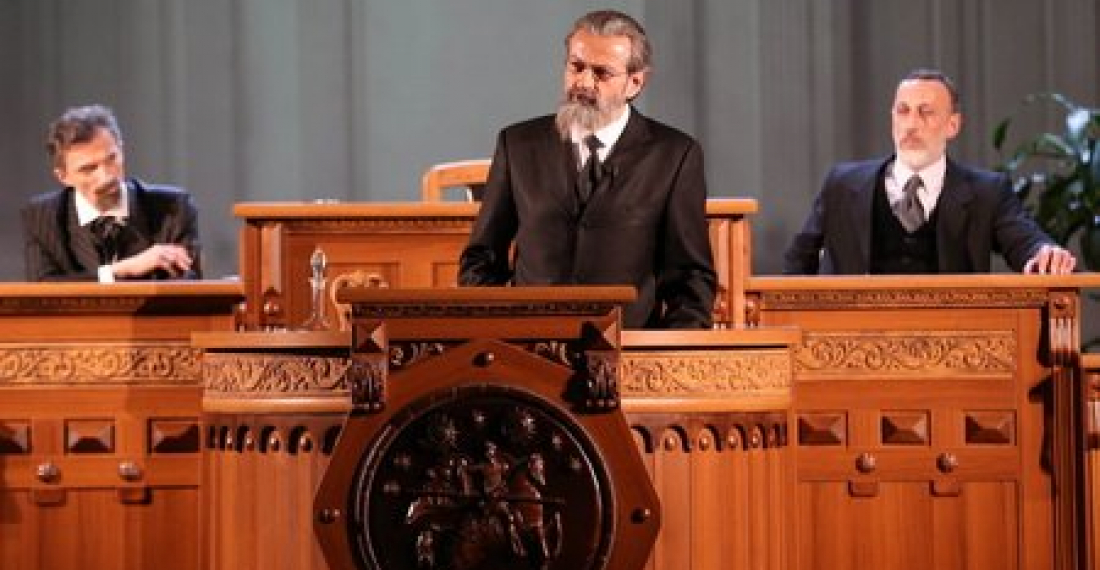
photo: A re-enactment of the declaration of georgian indpendence in 1918 was held in Tbilisi as part of the centeniial celebrations on 26 May 2018 (picture courtesy of agenda.ge)