


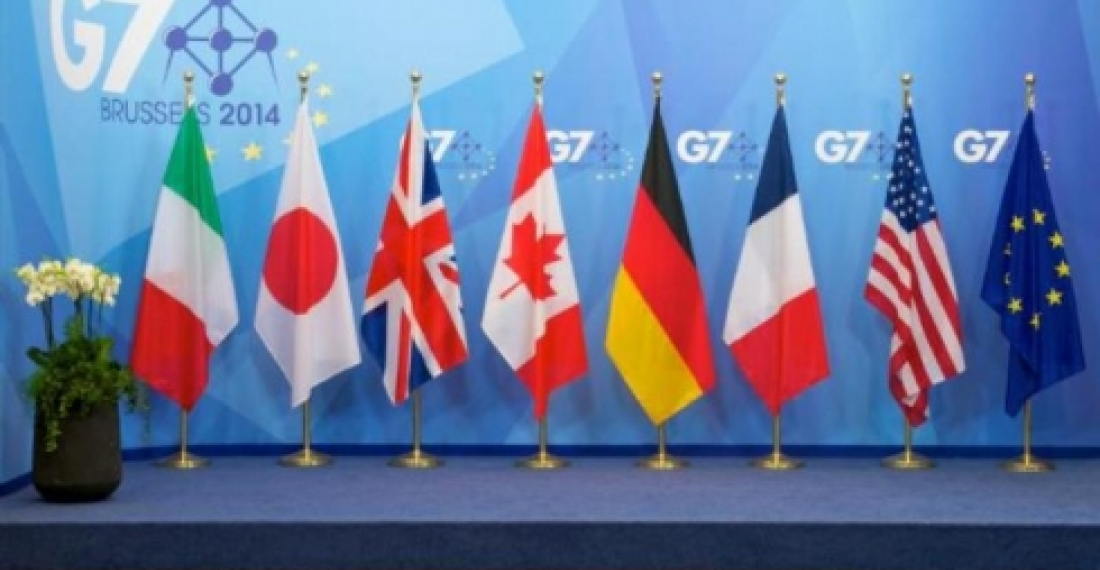
G7 meeting in Brussels says that "Russia's illegal annexation of Crimea, and actions to de-stabilise eastern Ukraine are unacceptable and must stop."

The leaders of the G7 nations (Britain, Canada, France, Germany, Italy, Japan, and the United States) together with the European Union have sent another clear and unambiguous message to Russia regarding events in Ukraine.

The G7 is meeting in Brussels at the invitation of the European Union. The meeting originally planned as a G8 summit together with Russia was scheduled to be held in Sochi, however Russia was suspended from the group following its annexation of Crimea.

In a communique issued yesterday the G7 leaders welcomed the successful conduct under difficult circumstances of the election in Ukraine on 25 May. "The strong voter turnout underlined the determination of Ukraine's citizens to determine the future of their country. We welcome Petro Poroshenko as the President-elect of Ukraine and commend him for reaching out to all the people of Ukraine," the statement said.

The G7 leaders said that "in the face of unacceptable interference in Ukraine's sovereign affairs by the Russian Federation, we stand by the Ukrainian government and people. We call upon the illegal armed groups to disarm. We encourage the Ukrainian authorities to maintain a measured approach in pursuing operations to restore law and order. We fully support the substantial contribution made by the Organisation for Security Cooperation in Europe (OSCE) to the de-escalation of the crisis through the Special Monitoring Mission and other OSCE instruments. We commend the willingness of the Ukrainian authorities to continue the national dialogue in an inclusive manner. We welcome the "Memorandum of Peace and Unity" adopted by the Verkhovna Rada on 20 May and express the wish that it can be implemented rapidly. We also encourage the Ukrainian parliament and the Government of Ukraine to continue to pursue constitutional reform in order to provide a framework for deepening and strengthening democracy and accommodating the rights and aspirations of all people in all regions of Ukraine.

The G7 leaders said that they are committed to continuing to work with Ukraine to support its economic development, sovereignty and territorial integrity and are united in condemning the Russian Federation's continuing violation of the sovereignty and territorial integrity of Ukraine.The statement said: 


"Russia's illegal annexation of Crimea, and actions to de-stabilise eastern Ukraine are unacceptable and must stop. These actions violate fundamental principles of international law and should be a concern for all nations. We urge the Russian Federation to recognise the results of the election, complete the withdrawal of its military forces on the border with Ukraine, stop the flow of weapons and militants across the border and to exercise its influence among armed separatists to lay down their weapons and renounce violence. We call on the Russian Federation to meet the commitments it made in the Geneva Joint Statement and cooperate with the government of Ukraine as it implements its plans for promoting peace, unity and reform."

source: commonspace.eu
Related articles

Editor's choice
News
Borrell tells the European Parliament that the situation in Afghanistan was critical, but the EU will remain engaged

Borrell tells the European Parliament that the situation in Afghanistan was critical, but the EU will remain engaged

Borrell underlined that the European Union will make every effort to support the peace process and to remain a committed partner to the Afghan people. "Of course, we will have to take into account the evolving situation, but disengagement is not an option.  We are clear on that: there is no alternative to a negotiated political settlement, through inclusive peace talks.
Editor's choice
News
Pope's visit to Türkiye and Lebanon has a strong ecumenical character, and places interreligious dialogue at its centre

Pope's visit to Türkiye and Lebanon has a strong ecumenical character, and places interreligious dialogue at its centre

Pope Leo XIV has begun the first overseas trip of his pontificate, a six-day visit to Türkiye and Lebanon, which started yesterday (27 November) and ends on Tuesday (2 December). According to Vatican Radio, the visit "carries a strong ecumenical character and places interreligious dialogue at its centre. It will also be a moment of closeness to Christian communities and local populations across the region".   During nearly a week in the region, Pope Leo XIV will meet civil and religious authorities, visit mosques and ancient churches, pray at Beirut’s port in memory of the victims of the 2020 explosion, and hold private meetings with Presidents Recep Tayyip Erdoğan and Joseph Aoun.   A highlight of the visit will be a visit to Nicaea, where the Pope will mark the anniversary of the Council of Nicaea. Christians of many traditions recognise the Council of Nicaea as a foundation of shared faith. One of the most anticipated moments will be the Pope’s encounter with Lebanese youth in Bkerké, at the Maronite Patriarchate, a meeting expected to carry strong messages of hope in the Jubilee Year. A central event will be the ecumenical celebration in İznik, where the Pope and Ecumenical Patriarch Bartholomew will walk together toward the ruins of the Basilica of St Neophytos. The prayer, held before icons of Christ and the Council, will conclude with the lighting of a candle—a symbolic gesture of unity. The journey will also highlight interreligious engagement.   Memorable moments are expected throughout the trip: a wreath at Atatürk’s mausoleum, prayer inside the Blue Mosque, Mass at Istanbul’s Volkswagen Arena, the planting of a cedar at the presidential palace in Beirut, and prayer at the tomb of St Charbel in Lebanon. The Vatican said that "Pope Leo XIV’s pilgrimage to Türkiye and Lebanon aims to offer a voice of peace, unity, and hope at the heart of the Middle East."

Popular

Editor's choice
News
Pope's visit to Türkiye and Lebanon has a strong ecumenical character, and places interreligious dialogue at its centre

Pope's visit to Türkiye and Lebanon has a strong ecumenical character, and places interreligious dialogue at its centre

Pope Leo XIV has begun the first overseas trip of his pontificate, a six-day visit to Türkiye and Lebanon, which started yesterday (27 November) and ends on Tuesday (2 December). According to Vatican Radio, the visit "carries a strong ecumenical character and places interreligious dialogue at its centre. It will also be a moment of closeness to Christian communities and local populations across the region".   During nearly a week in the region, Pope Leo XIV will meet civil and religious authorities, visit mosques and ancient churches, pray at Beirut’s port in memory of the victims of the 2020 explosion, and hold private meetings with Presidents Recep Tayyip Erdoğan and Joseph Aoun.   A highlight of the visit will be a visit to Nicaea, where the Pope will mark the anniversary of the Council of Nicaea. Christians of many traditions recognise the Council of Nicaea as a foundation of shared faith. One of the most anticipated moments will be the Pope’s encounter with Lebanese youth in Bkerké, at the Maronite Patriarchate, a meeting expected to carry strong messages of hope in the Jubilee Year. A central event will be the ecumenical celebration in İznik, where the Pope and Ecumenical Patriarch Bartholomew will walk together toward the ruins of the Basilica of St Neophytos. The prayer, held before icons of Christ and the Council, will conclude with the lighting of a candle—a symbolic gesture of unity. The journey will also highlight interreligious engagement.   Memorable moments are expected throughout the trip: a wreath at Atatürk’s mausoleum, prayer inside the Blue Mosque, Mass at Istanbul’s Volkswagen Arena, the planting of a cedar at the presidential palace in Beirut, and prayer at the tomb of St Charbel in Lebanon. The Vatican said that "Pope Leo XIV’s pilgrimage to Türkiye and Lebanon aims to offer a voice of peace, unity, and hope at the heart of the Middle East."


