


The complex relations between Armenia and Azerbaijan played themselves out yesterday in separate, seemingly unconnected events that highlighted many of the facets of this relationship.
Early in the morning reports started coming in of a major military clash in the Northern sector of the international border between the two countries. The Armenian Ministry of Defence then released information that three of its soldiers had been killed and six seriously injured when they tried to repel an Azerbaijani advance into Armenian territory near the villages of Berdavan and Chinari in the Tavush Region. Armenian sources said that they had stoped Azerbaijani forces trying to occupy their positions.
"The sabotage advance was halted and the enemy was repelled, suffering casualties," read an Armenian Defense Ministry statement. "The Armenian Armed Forces control the situation along the line of contact, carrying out actions commensurate with the situation," it said without providing details.
Within hours the Azerbaijani Defence Ministry had issued a counter statement in which they denied that their forces were involved in any clashes with Armenian forces at all, according to Radio Liberty, although some Azerbaijani media, including APA, were saying that Azerbaijan had prevented "a provocation attempt by the Armenian Army on the front line".
An Armenia based foreign diplomat who was travelling in the region wrote on facebook of a grim atmosphere as villagers prepared to bury the dead.
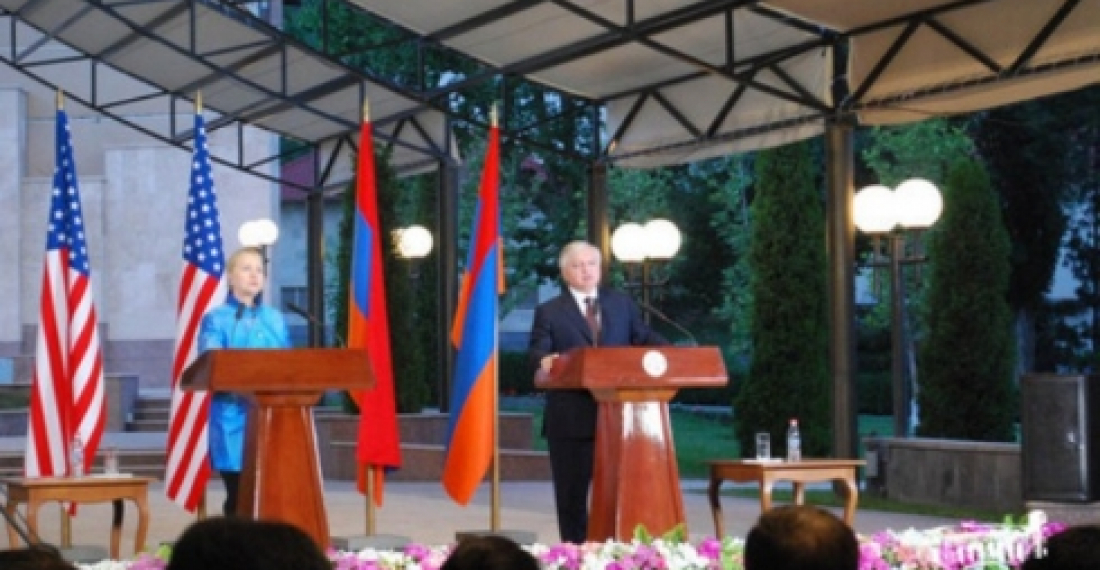
In the early afternoon the plane of US Secretary of State Hilary Clinton who is currently touring the region, landed in Yerevan. By this time Armenian political commentators writing on a number of blogs and news websites, were connecting the incidents in Tavush with her visit, saying that this was Azerbaijan's attempt to frustrate any peace efforts. The same message was repeated by Armenian Foreign Minister Nalbandian in his press conference with Clinton later that evening. "Azerbaijani actions threaten the Karabakh settlement talks as well as regional stability, and official Baku is responsible for consequences of its actions,” Nalbandian said.
Clinton herself mentioned the incident in the press Conference. Refering to her meeting with Armenia President Serzh Sargsyan Clinton said
"Of course, the president and I had a serious discussion of Nagorno-Karabakh, including the most recent incidents along the front lines. While I had only just learned of these incidents, I am very concerned about the danger of escalation of tensions and the senseless deaths of young soldiers and innocent civilians. The use of force will not resolve the Nagorno-Karabakh conflict, and therefore force must not be used. And we are calling on everyone to renounce force as well as refraining from violence. I assured the president that I would make these points in Baku when I am there the day after tomorrow.
Now, these incidents underscore the necessity to try to keep making progress on the peace process. As a co-chair of the Minsk Group, the United States is committed to working with all the parties to find a way forward. And I am very committed that there has to be a way forward. And it’s not only the actions of leaders; it must be the actions of citizens as well to try to find a way to enable people of the region to live together in peace and dignity."
In the meantime as all this was going on in Moscow another significant event got under way as a Russian sponsored public diplomacy event, involving the heads of Armenian and Azerbaijani media outlets started at the office of “Rossisyskaya Gazeta”. Various reports from the meeting suggest that it went well and in a good atmosphere.
According to Azerbaijani ambassador in Moscow, Polad Bulbuloglu at the meeting the sides expressed their positions and views. “The common view was that journalism should be patriotic but not with a tendency. State figures, peoples’ representatives should not be humiliated. Discussions should continue within frame of normal journalism. The sides agreed to form a permanent group for conducting meetings. It was noted that the meeting will work in favor of strengthening relations. It was also noted that we live in this region and nobody will leave this region.”
With deaths, diplomacy and dialogue happening simultaneously it is difficult to conclude if this was a good day or a bad day for Armenian-Azerbaijani relations. It was however one more reflection of the complexity of the conflict between them that continues to play itself out on different fronts and in different contexts.
source: commonspace.eu with reporting from APA, RFE/RL, and the US State Department.
photo: Hilary Clinton and Armenia Foreigfn Minister Nalbandian addressing a joint Press Conference in Yerevan on 4 June 2012. (picture courtesy of the Press Service of the Armenian Foreign Ministry).



