


In the second part of an article on Azerbaijan LINKS Analysis argues that failure to implement political reforms has left a lot of Azerbaijan’s governance system anchored in its Soviet past, and this now threatens the country’s real achievements in other fields.
Shortly after he was sworn in as president of Azerbaijan in October 2003, Ilham Aliev made a number of speeches both inside the country and outside, in which he stated clearly that his priority was economic and social development, and that political reforms will have to wait. These speeches were never given much attention by the international community.
The President has by and large been true to his word. The result is that in Azerbaijan today there are no checks and balances of power. Indeed a lot of Azerbaijan’s governance system remains anchored in its Soviet past. This situation now threatens the country’s real achievements in other spheres.
The election that brought Ilham Aliev to power in 2003 was the last one that was remotely competitive. The other presidential and parliamentary elections that followed have been found lacking in many respects by international observers, and hardly competitive. None of the parties that can be qualified as opposition are represented in the parliament.
The political space for what remained of the opposition has meanwhile been narrowing substantially. The government used both stick and carrot. Many opposition personalities of the previous decade were given an opportunity to cross over to the government side and rewarded with appointments and incentives, and even allowed to retain separate political identities different from that of the ruling party. Their space for political activity was however very limited.
The government also holds complete monopoly on radio and TV broadcasts; the printed media is continuously harassed through different forms of pressures.
This monopoly on power created conditions for corruption to thrive, and as oil wealth increased so did accusations that the ruling circles were enriching themselves at the expense of the people.
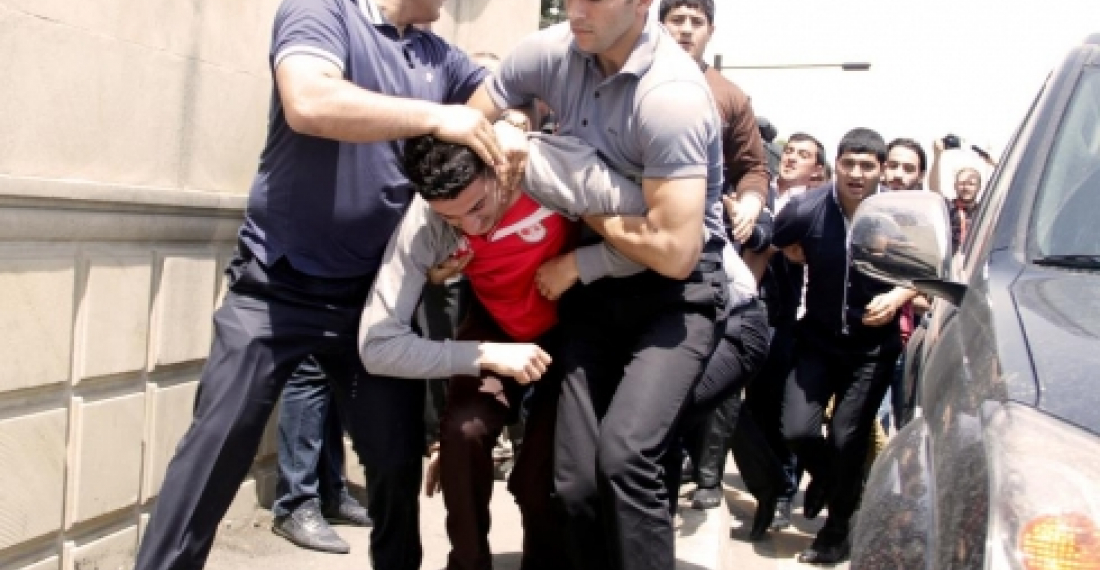
For some time, very few outside Azerbaijan cared. But things have changed. The government’s first big mistake was to try to clamp down on a small but vocal group of western educated activist who were using the relative freedom of the internet to challenge the authorities monopoly on information. The tactics used against them were no different than had been previously employed against more traditional opposition activists. The difference was that the new targets were already well networked internationally, and all of a sudden the human rights situation in Azerbaijan became an issue of concern to a wide circle of western journalists and intellectuals. This also coincided with Azerbaijan’s victory in Eurovision in 2011, and the subsequent decision to hold Eurovision 2012 in Baku. The media attention that goes with the hosting of one of the world’s largest cultural events was on the one hand one of the things that made it attractive to the Azerbaijani government. But its attempts to manage the message failed miserably, as many media outlets took up the cause of the embattled Azerbaijani activists.
Azerbaijani officials have hinted that this was a smear campaign organised by the Armenian lobby in Europe and the US. However there is very little evidence that this is true.
The spread and fury of the criticism has taken the Azerbaijani government somewhat by surprise. It is used to dealing with external criticism one by one, but did not seem to have a strategy against a massive onslaught.
It is hoping that once the lights of Eurovision are switched off world attention will fade with it.
Two things have however changed and their impact will be felt long after the singers of Eurovision have left Baku. The first is that a small but determined group of articulate critics of the government have decided that fear is not an option, and that they will engage the government head on. The second is that these, and others critical of the government, have decided to challenge one of its important narratives - that somehow freedom and liberty needed to wait until Azerbaijan liberates Karabakh and the other territory it lost to Armenia. Indeed open criticism of the failure of the Azerbaijani government to liberate the lost territories is now emerging as one of the lines of attack of government critics.
There is also a possibility that the international response to the situation in Azerbaijan may also escalate. A toughly worded resolution criticising Azerbaijan’s human rights record, sailed through the European Parliament yesterday (24 May 2012). Apart from the usual condemnations, it talks for the first time of targeted sanctions against those in the Azerbaijan Government who commit human rights abuses.
Tomorrow: Part 3: The future. In the third and final part of this article LINKS Analysis looks at the options available to the Azerbaijani government, once the Eurovision festival is over. The first part: "Azerbaijan's parallel worlds. Part 1: The successes" is available here.
Source: LINKS Analysis
Photo: Police breaking up a youth protest in Baku on 24 May 2012 during the Eurovision Song Contest (picture courtesy of Mehman Huseynov).



