


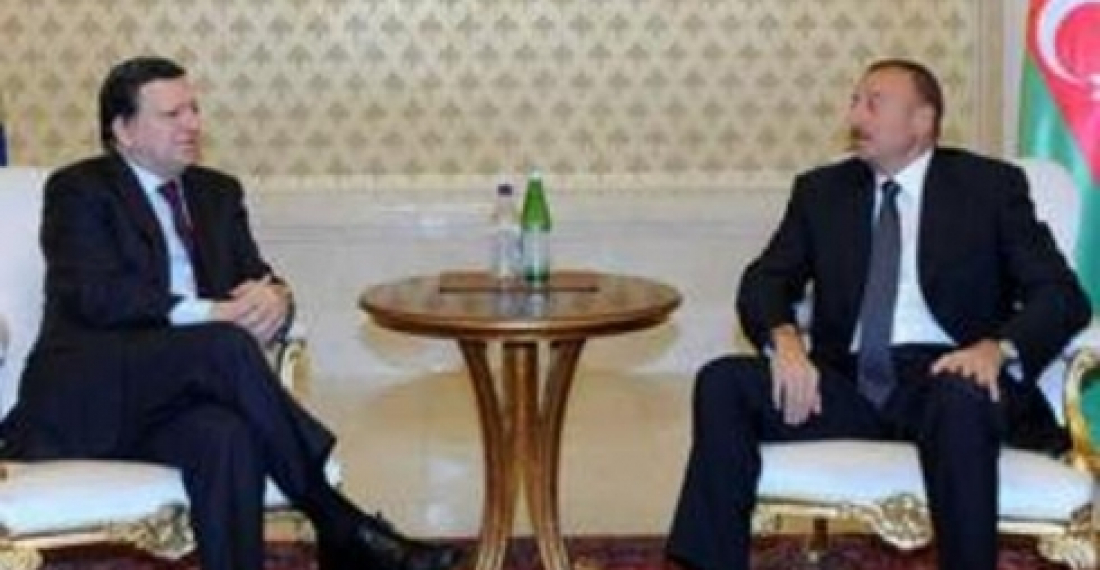
Barroso in Azerbaijan. (updated) The President of the European Commission, paid a short but highly significant official visit to Baku on Saturday.

The President of the European Commission, Jose Manuel Barroso emphasised the importance of relations between the European Union and Azerbaijan during a short but highly significant official visit to Baku during which he met with President Ilham Aliev and other Azerbaijani officials. 

President Barroso programme in Azerbaijan started with  a one-to-one discussion with President Ilham Aliev which focussed on bilateral relations. The meeting continued after in the presence of officials.

Speaking at a Press Conference later, President Barroso said:

"Azerbaijan is a very important partner for the European Union. We have achieved a reliable strategic partnership in the energy field. And we want to build on this, moving to a long-term association grounded on democracy and shared values, in particular fundamental freedoms.

I have explained very openly to President Alyiev that we believe that multi-party democracy, open societies and open economies are the best way to achieve stability and prosperity. A thriving civil society is essential for a thriving democracy.

Another important reason for being here in Baku today is to mark the strong energy partnership which we have established. Azerbaijan is today one of the EU's major and most reliable energy partners, and this contributes to our mutual economy and energy security."

President Barroso said that the EU and Azerbaijan were on course to deepen their relationship, adding

"The EU wants to broaden and deepen its relationship with Azerbaijan. A fixed approach is important within the frameworks of the Eastern Partnership. We have given new inputs to the Strategic Modernization Partnership and aim to conclude it in next months. I would like to invite President Aliyev to come to Brussels now for the 6th time to sign these agreements."

Barroso also spoke about the importance of contacts at the level of civil society and of the European Union continued committment to support a peaceful resolution of the Karabakh conflict.

On his part President Aliev also emphasised the importance of EU-Azerbaijan relations and said that these were a priority for Azerbaijan.

President Barroso later gave a keynote speech at the Azerbaijan Diplomatic Academy durıng which he dwelt on the European Union's policy towards its eastern neighbours. Addressing the EU's relations with Russia, President Barroso said,

"We remain interested in having good relations with Russia. We are also neighbours. No one is interested in going back to a past of confrontation. At least, no-one in the European Union. But for that to happen Russia, as well as all our partners, needs to abide by international norms and values and it needs to respect the sovereign decisions of our common neighbours. "

 (The full text of the speech is available here)

source: commonspace.eu

photo: The President of the European Commission with the President of Azerbaijan at their tete-a-tete meeting in Baku on 14 June 2014. (picture courtesy of the Press Service of the President of Azerbaijan.)
Related articles

Editor's choice
News
Borrell tells the European Parliament that the situation in Afghanistan was critical, but the EU will remain engaged

Borrell tells the European Parliament that the situation in Afghanistan was critical, but the EU will remain engaged

Borrell underlined that the European Union will make every effort to support the peace process and to remain a committed partner to the Afghan people. "Of course, we will have to take into account the evolving situation, but disengagement is not an option.  We are clear on that: there is no alternative to a negotiated political settlement, through inclusive peace talks.
Editor's choice
News
Pope's visit to Türkiye and Lebanon has a strong ecumenical character, and places interreligious dialogue at its centre

Pope's visit to Türkiye and Lebanon has a strong ecumenical character, and places interreligious dialogue at its centre

Pope Leo XIV has begun the first overseas trip of his pontificate, a six-day visit to Türkiye and Lebanon, which started yesterday (27 November) and ends on Tuesday (2 December). According to Vatican Radio, the visit "carries a strong ecumenical character and places interreligious dialogue at its centre. It will also be a moment of closeness to Christian communities and local populations across the region".   During nearly a week in the region, Pope Leo XIV will meet civil and religious authorities, visit mosques and ancient churches, pray at Beirut’s port in memory of the victims of the 2020 explosion, and hold private meetings with Presidents Recep Tayyip Erdoğan and Joseph Aoun.   A highlight of the visit will be a visit to Nicaea, where the Pope will mark the anniversary of the Council of Nicaea. Christians of many traditions recognise the Council of Nicaea as a foundation of shared faith. One of the most anticipated moments will be the Pope’s encounter with Lebanese youth in Bkerké, at the Maronite Patriarchate, a meeting expected to carry strong messages of hope in the Jubilee Year. A central event will be the ecumenical celebration in İznik, where the Pope and Ecumenical Patriarch Bartholomew will walk together toward the ruins of the Basilica of St Neophytos. The prayer, held before icons of Christ and the Council, will conclude with the lighting of a candle—a symbolic gesture of unity. The journey will also highlight interreligious engagement.   Memorable moments are expected throughout the trip: a wreath at Atatürk’s mausoleum, prayer inside the Blue Mosque, Mass at Istanbul’s Volkswagen Arena, the planting of a cedar at the presidential palace in Beirut, and prayer at the tomb of St Charbel in Lebanon. The Vatican said that "Pope Leo XIV’s pilgrimage to Türkiye and Lebanon aims to offer a voice of peace, unity, and hope at the heart of the Middle East."

Popular

Editor's choice
News
Pope's visit to Türkiye and Lebanon has a strong ecumenical character, and places interreligious dialogue at its centre

Pope's visit to Türkiye and Lebanon has a strong ecumenical character, and places interreligious dialogue at its centre

Pope Leo XIV has begun the first overseas trip of his pontificate, a six-day visit to Türkiye and Lebanon, which started yesterday (27 November) and ends on Tuesday (2 December). According to Vatican Radio, the visit "carries a strong ecumenical character and places interreligious dialogue at its centre. It will also be a moment of closeness to Christian communities and local populations across the region".   During nearly a week in the region, Pope Leo XIV will meet civil and religious authorities, visit mosques and ancient churches, pray at Beirut’s port in memory of the victims of the 2020 explosion, and hold private meetings with Presidents Recep Tayyip Erdoğan and Joseph Aoun.   A highlight of the visit will be a visit to Nicaea, where the Pope will mark the anniversary of the Council of Nicaea. Christians of many traditions recognise the Council of Nicaea as a foundation of shared faith. One of the most anticipated moments will be the Pope’s encounter with Lebanese youth in Bkerké, at the Maronite Patriarchate, a meeting expected to carry strong messages of hope in the Jubilee Year. A central event will be the ecumenical celebration in İznik, where the Pope and Ecumenical Patriarch Bartholomew will walk together toward the ruins of the Basilica of St Neophytos. The prayer, held before icons of Christ and the Council, will conclude with the lighting of a candle—a symbolic gesture of unity. The journey will also highlight interreligious engagement.   Memorable moments are expected throughout the trip: a wreath at Atatürk’s mausoleum, prayer inside the Blue Mosque, Mass at Istanbul’s Volkswagen Arena, the planting of a cedar at the presidential palace in Beirut, and prayer at the tomb of St Charbel in Lebanon. The Vatican said that "Pope Leo XIV’s pilgrimage to Türkiye and Lebanon aims to offer a voice of peace, unity, and hope at the heart of the Middle East."

