


Armenia and Azerbaijan exchange bodies over the weekend

The bodies of Armenian and Azerbaijani soldiers, killed in renewed fighting in the Nagorno-Karbakakh conflict a week ago, have been retrieved and transferred in an operation facilitated by the International Committee of the Red Cross (ICRC).

Dozens have been killed in the worst outbreak of violence since a 1994 ceasefire, with both sides blaming the other for starting hostilities on April 2. The warring parties agreed a ceasefire last Tuesday, which both are claiming the other has breached.

\"Our priority is to help the families of those missing in action who still do not know the fate of their loved ones,\" said Patrick Vial, the ICRC\\\'s regional director for Europe and Central Asia. \"It was also important for the sides to have the bodies returned and so provide answers for the families.\"

A \"period of silence\" took place on Friday afternoon, for both sides to identify their dead. Bodies were retrieved over the weekend, with the actual handover taking place on Sunday.

The operation took place following an agreement between the two sides, the personal representative of the OSCE chairman-in-office, and the co-chairs of the OSCE Minsk Group, which is trying to mediate a solution to the conflict.

In December, the ICRC handed to Armenia and Azerbaijan a list of 4,496 names of people who went missing during the full-blown conflict over Nagorno-Karabakh, which formally ended two decades ago.

SOURCE: commonspace.eu, ICRC and agencies

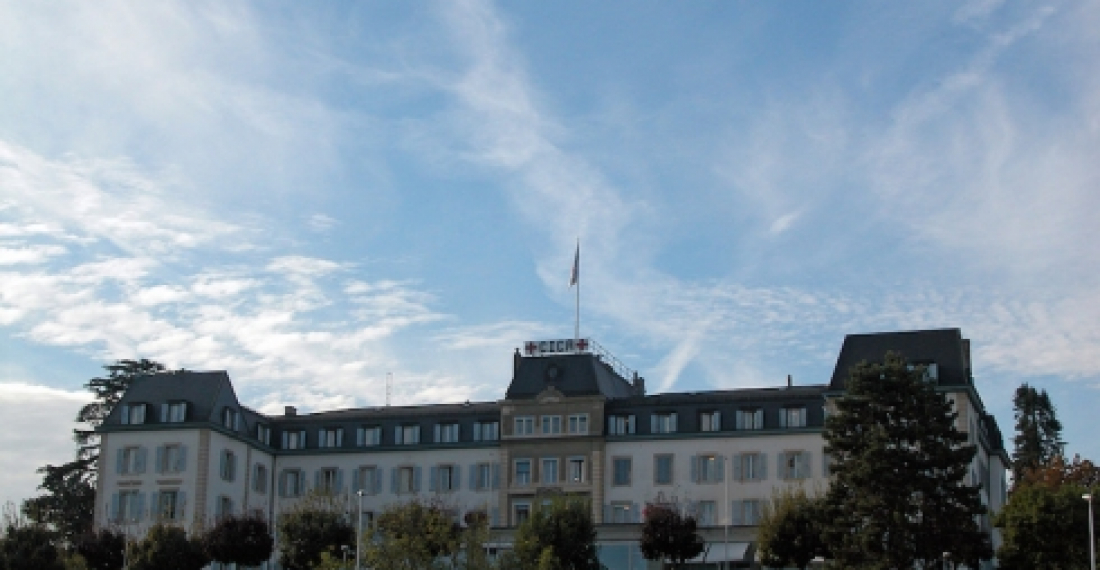
PHOTO: ICRC headquarters in Geneva, Switzerland

Related articles

Editor's choice
News
Israel destroys 17 UNIFIL Cameras

Israel destroys 17 UNIFIL Cameras

Israeli forces destroyed 17 surveillance cameras linked to the United Nations peacekeepers’ main headquarters in southern Lebanon in 24 hours, a UN security official told AFP on Saturday. Since the start of the Israel-Hezbollah war on March 2, the UN Interim Force in Lebanon (UNIFIL) has been caught in the crossfire in the country’s south, with Hezbollah launching attacks on Israel and its troops, and Israeli forces pushing into border towns. The official, who requested anonymity, said “17 of the headquarters’ cameras have been destroyed by the Israeli army” in the coastal town of Naqura. UNIFIL spokeswoman Kandice Ardiel told AFP on Saturday that “the cameras appear to have been destroyed by some kind of laser.” She added that “(Israeli) soldiers are present in Naqura and have been undertaking massive demolitions of buildings in the village this week.” Earlier this week, Ardiel told AFP that “not only have these demolitions destroyed civilian homes and businesses, but the strength of the blasts have caused damage to UNIFIL’s headquarters.” Three Indonesian peacekeepers from the UN force have been killed in two separate incidents over the past week. UNIFIL also reported Friday an “explosion” in one of its bases near Odaisseh in south Lebanon that wounded three personnel, adding that they “do not yet know the origin of the explosion.” The Israeli army accused Hezbollah of firing “a rocket that landed in a UNIFIL outpost.” The UN office in Jakarta said on Saturday the wounded were Indonesian. Indonesia condemned the incident as “unacceptable,” saying “these events underscore the urgent need to strengthen protection for UN peacekeeping forces amid an increasingly dangerous conflict situation.” According to the UN, 97 force members have been killed in violence since its establishment in 1978 to monitor the withdrawal of Israeli forces after they invaded Lebanon.
Editor's choice
News
Armenian leader meets Putin in the Kremlin

Armenian leader meets Putin in the Kremlin

Armenian prime minister, Nikol Pashinyan, met at the Kremlin in Moscow, on Wednesday 1, April, with Russian president Vladimir Putin. The current state and prospects of Russian-Armenian strategic partnership and alliance, integration cooperation in the Eurasian region, and current issues on the regional agenda, in particular the development of economic and transport-logistics ties in the South Caucasus, were discussed, according to the Kremlin website. In his remarks before the meeting, Prime Minister Pashinyan said our relations with the Russian Federation are very deep, they are very important to us, and, in my opinion, they are developing dynamically in the context of the new realities in our region, when peace has finally been established between Armenia and Azerbaijan. And I think this has a positive impact on our relations with the Russian Federation, because for the first time since our independence, we have a railway connection with the Russian Federation. We import goods from Russia via Azerbaijan by rail. I hope we will also export in the near future. This, of course, strengthens our traditional economic ties, and it strengthens our ties within the Eurasian Economic Union. Regarding the European Union, of course, we know that, in principle, membership in the two associations is incompatible. But what we're doing and the agenda we have, at least for now, are compatible. That's a fact. And as long as there's an opportunity to combine these agendas, we will. And when processes develop to the point where a decision must be made, I'm confident that we, the citizens of the Republic of Armenia, will make that decision. Of course, in this context, our relations with the Russian Federation have never been and never will be in question, because, as I have already said, these ties and relations are very deep and not subject to discussion. (read the report in full by clicking the image at the top).

Popular

Editor's choice
Interview
Thursday Interview: Murad Muradov

Thursday Interview: Murad Muradov

Today, commonspace.eu starts a new regular weekly series. THURSDAY INTERVIEW, conducted by Lauri Nikulainen, will host  persons who are thinkers, opinion shapers, and implementors in their countries and spheres. We start the series with an interview with Murad Muradov, a leading person in Azerbaijan's think tank community. He is also the first co-chair of the Action Committee for a new Armenian-Azerbaijani Dialogue. Last September he made history by being the first Azerbaijani civil society activist to visit Armenia after the 44 day war, and the start of the peace process. Speaking about this visit Murad Muradov said: "My experience was largely positive. My negative expectations luckily didn’t play out. The discussions were respectful, the panel format bringing together experts from Armenia, Azerbaijan, and Turkey was particularly valuable during the NATO Rose-Roth Seminar in Yerevan, and media coverage, while varied in tone, remained largely constructive. Some media outlets though attempted to represent me as more of a government mouthpiece than an independent expert, which was totally misleading.  Overall, I see these initiatives as important steps in rebuilding trust and normalising professional engagement. The fact that soon a larger Azerbaijani civil society visits to Armenia followed, reinforces the sense that this process is moving in the right direction." (click the image to read the interview in full)

