


Armenia and Azerbaijan closely watch each other. But are they seeing everything, or seeing what Russia wants them to see?

Armenia and Azerbaijan are engaged in massive efforts to monitor each other's military capacities and movements. The two countries have been locked in an unresovled conflict for the last two decades. Whilst major military hostilities ended with a cease fire in 1994 no peace treaty was ever signed, and the two states remain in a state of war. Every now and then the world gets a glimpse into the extent the two countires monitor each other's military activity.

Yesterday, the President of Armenia Serzh Sargsyan, visited the National Security Threat Analysis Centre which is part of the National Security Council of Armenia where Centre officials briefed the Armenian leader of the work done and further programs. Of interest is that on this visit Sargsyan was accompanied by the Secretary General of the Collective Security Treaty of Organization (CSTO), Nikolay Bordyuzhha, who has become a frequent visitor to Yerevan and by the President of Rostelecom Company Sergey Kalugin, adding to speculation that the president was reviewing new equipment that had been received, or plans to do so.

On the same day, perhaps by coincidence, perhaps not, the commander of Azerbaijan's Air Defense Forces, Major General Altay Mehdiyev, in a rare briefing to the Press, said that Azerbaijan now had sophisticated equipment that "could detect a plane taking off from Armenia's Zvartnots airport after rising 10 meters". The General said that Azerbaijan has the strongest air defense system, which very few countries in the post-Soviet area have. Azerbaijan's system fully covers the air defense of the country", according to the Azerbaijani News Agency APA.

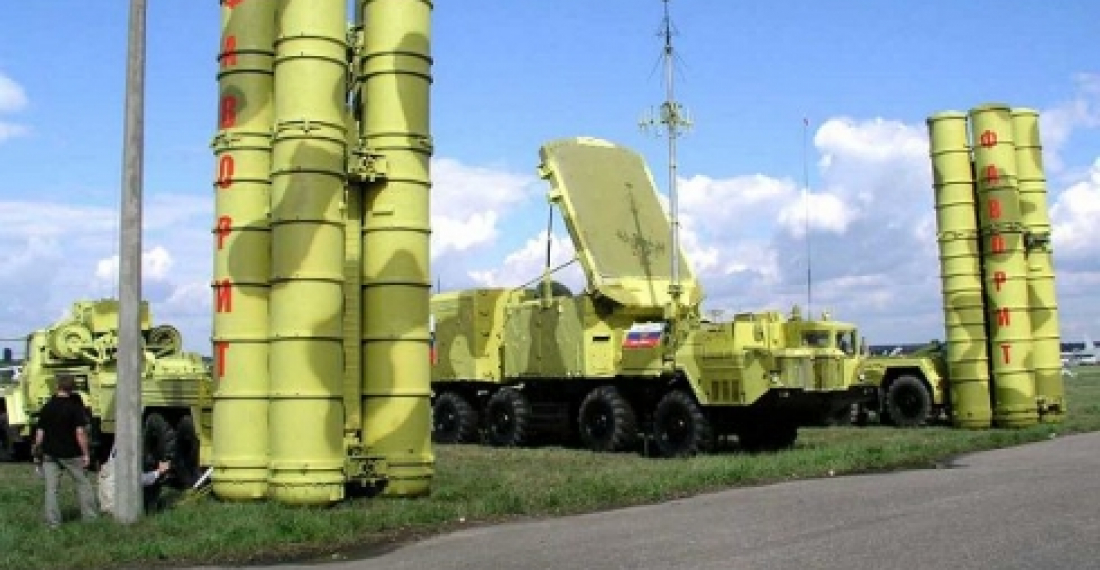
The agency noted that in recent years, Baku has acquired sophisticated anti-aircraft complexes and radiolocation equipment. S300 PMU-2 Favorit anti-craft complexes purchased from Russia in 2011 are most powerful among them, and that all civil and military airplanes of Azerbaijan have already been equipped with IFF (Identification Friend or Foe). It allows the Air Defense Forces to get information about all aircrafts entering the country's air space, according to the source.

In the meantime, another Azerbaijani media outlet, the 1news.az web portal, yesterday also carried a story about the transfer of Russian equipment from the Military base in Gyumri to the Armenian military. Quoting diplomatic sources in Vienna, the portal says that at a recent inspection in the framework of the Conventional Forces in Europe (CFE) Treaty two unreported military bases and 283 military items including 76 tanks and 60 armoured vehicles were discovered.These items correspond to a similar list of items that earlier had been reported by Russia as having become obsolete from its base in Gyumri, whilst in fact they were transferred to the Armenian army in violation of the Treaty. For good measure the agency tried to hit two birds with one stone by saying that European countries have only just started taking an interest in Russian and Armenian violations of the CFE Treaty, and that this was due to Armenia's recent decision to abandon plans to sign an Association Agreement with the EU and to join the Russian backed Customs Union instead.

Commonspace.eu political editor said in a comment, that "it is well known that the military and security organisations of Armenia and Azerbaijan closely monitor each other's movements. In a situation where confidence between the two countries is non existant such monitoring is necessary and in many ways helpful since it reduces chances of misperception. On the other hand misperception remains the single most dangerous problem. A move by one side can be interpreted wrongly by the other. Seeing is one thing, understanding what you are seeing is very often more difficult. Around all of this are concerns about the role of Russia, which seems to provide the equipment to both sides, leading to the question, are Armenia and Azerbaijan seeing everything, or are they seeing what Russia wants them to see?" 

source: commonspace.eu with APA, 1news.az, and Armenian media sources.

photo: An S300 PMU-2 Favorit anti-craft complexes similar to the ones Azerbaijan purchased from Russia in 2011


 

Related articles

Editor's choice
News
Borrell tells the European Parliament that the situation in Afghanistan was critical, but the EU will remain engaged

Borrell tells the European Parliament that the situation in Afghanistan was critical, but the EU will remain engaged

Borrell underlined that the European Union will make every effort to support the peace process and to remain a committed partner to the Afghan people. "Of course, we will have to take into account the evolving situation, but disengagement is not an option.  We are clear on that: there is no alternative to a negotiated political settlement, through inclusive peace talks.
Editor's choice
News
NATO Chief says war is on Europe's doorstep, and warns against complacency

NATO Chief says war is on Europe's doorstep, and warns against complacency

Russia could attack a Nato country within the next five years, the Secretary General of NATO, Mark Rutte, said in a stark new warning. "Nato's own defences can hold for now," Rutte warned in Berlin, but conflict was "next door" to Europe and he feared "too many are quietly complacent, and too many don't feel the urgency, too many believe that time is on our side. "Russia is already escalating its covert campaign against our societies," Rutte said in a speech in Germany. "We must be prepared for the scale of war our grandparents or great-grandparents endured." Earlier this month, Russia's President Vladimir Putin said his country was not planning to go to war with Europe, but it was ready "right now" if Europe wanted to - or started a war. But similar reassurances were given by Moscow in 2022, just before 200,000 Russian troops crossed the border and invaded Ukraine. Putin has accused European countries of hindering US efforts to bring peace in Ukraine - a reference to the role Ukraine's European allies have recently played in trying to change a US peace plan to end the war, whose initial draft was seen as favouring Russia. But Putin was not sincere, Nato's secretary-general said in the German capital, Berlin. Supporting Ukraine, he added, was a guarantee for European security. "Just imagine if Putin got his way; Ukraine under the boot of Russian occupation, his forces pressing against a longer border with Nato, and the significantly increased risk of an armed attack against us." Russia's economy has been on a war footing for more than three years now - its factories churn out ever more supplies of drones, missiles and artillery shells. According to a recent report by the Kiel Institute for the World Economy, Russia has been producing each month around 150 tanks, 550 infantry fighting vehicles, 120 Lancet drones and more than 50 artillery pieces. The UK, and most of its Western allies, are simply not anywhere near this point. Analysts say it would take years for Western Europe's factories to come close to matching Russia's mass-production of weapons. "Allied defence spending and production must rise rapidly, our armed forces must have what they need to keep us safe," the Nato chief said.

Popular

Editor's choice
News
NATO Chief says war is on Europe's doorstep, and warns against complacency

NATO Chief says war is on Europe's doorstep, and warns against complacency

Russia could attack a Nato country within the next five years, the Secretary General of NATO, Mark Rutte, said in a stark new warning. "Nato's own defences can hold for now," Rutte warned in Berlin, but conflict was "next door" to Europe and he feared "too many are quietly complacent, and too many don't feel the urgency, too many believe that time is on our side. "Russia is already escalating its covert campaign against our societies," Rutte said in a speech in Germany. "We must be prepared for the scale of war our grandparents or great-grandparents endured." Earlier this month, Russia's President Vladimir Putin said his country was not planning to go to war with Europe, but it was ready "right now" if Europe wanted to - or started a war. But similar reassurances were given by Moscow in 2022, just before 200,000 Russian troops crossed the border and invaded Ukraine. Putin has accused European countries of hindering US efforts to bring peace in Ukraine - a reference to the role Ukraine's European allies have recently played in trying to change a US peace plan to end the war, whose initial draft was seen as favouring Russia. But Putin was not sincere, Nato's secretary-general said in the German capital, Berlin. Supporting Ukraine, he added, was a guarantee for European security. "Just imagine if Putin got his way; Ukraine under the boot of Russian occupation, his forces pressing against a longer border with Nato, and the significantly increased risk of an armed attack against us." Russia's economy has been on a war footing for more than three years now - its factories churn out ever more supplies of drones, missiles and artillery shells. According to a recent report by the Kiel Institute for the World Economy, Russia has been producing each month around 150 tanks, 550 infantry fighting vehicles, 120 Lancet drones and more than 50 artillery pieces. The UK, and most of its Western allies, are simply not anywhere near this point. Analysts say it would take years for Western Europe's factories to come close to matching Russia's mass-production of weapons. "Allied defence spending and production must rise rapidly, our armed forces must have what they need to keep us safe," the Nato chief said.

